
Alexander Reid Ross
The Left-Overs & Responses
How Fascists Court the Post-Left
Chapter 1: The Early Composition of Fascist Individualism
Chapter 2: The Creation of the Post-Left
“Donny, You’re Out of Your Element.”
Y’all Got Any More of Those Mass Generalizations?
Egomania! A Response to My Critics on the Post-Left
Stirnerists and the Foundations of Fascism
Individualism and Nihilism in Post-War Fascism
Hear No Evil, See No Evil, Speak No Evil
The Fascists Know What We Prefer To Forget
A few months ago, the radical publication, Fifth Estate, solicited an article from me discussing the rise of fascism in recent years. Following their decision to withdraw the piece, I accepted the invitation of Anti-Fascist News to publish an expanded version here, with some changes, at the urging of friends and fellow writers.
In Solidarity, ARR
Chapter 1: The Early Composition of Fascist Individualism
A friendly editor recently told me via email, “if anti-capitalism and pro individual liberty [sic] are clearly stated in the books or articles, they won’t be used by those on the right.” If this were true, fascism simply would vanish from the earth. Fascism comes from a mixture of left and right-wing positions, and some on the left pursue aspects of collectivism, syndicalism, ecology, and authoritarianism that intersect with fascist enterprises. Partially in response to the tendencies of left authoritarianism, a distinct antifascist movement emerged in the 1970s to create what has became known as “post-left” thought. Yet in imagining that anti-capitalism and “individual liberty” maintain ideological purity, radicals such as my own dear editor tend to ignore critical convergences with and vulnerabilities to fascist ideology.
The post-left developed largely out of a tendency to favor individual freedom autonomous from political ideology of left and right while retaining some elements of leftism. Although it is a rich milieu with many contrasting positions, post-leftists often trace their roots to individualist Max Stirner, whose belief in the supremacy of the European individual over and against nation, class, and creed was heavily influenced by philosopher G.W.F. Hegel. After Stirner’s death in 1856, the popularity of collectivism and neo-Kantianism obscured his individualist philosophy until Friedrich Nietzsche raised its profile again during the later part of the century. Influenced by Stirner, Nietzsche argued for the overcoming of socialism and the “modern world” by the iconoclastic, aristocratic philosopher known as the “Superman” or “übermensch.”
During the late-19th Century, Stirnerists conflated the “Superman” with the assumed responsibility of women to bear a superior European race—a “New Man” to produce, and be produced by, a “New Age.” Similarly, right-wing aristocrats who loathed the notions of liberty and equality turned to Nietzsche and Stirner to support their sense of elitism and hatred of left-wing populism and mass-based civilization. Some anarchists and individualists influenced by Stirner and Nietzsche looked to right-wing figures like Russian author Fyodor Dostoevsky, who developed the idea of a “conservative revolution” that would upend the spiritual crises of the modern world and the age of the masses. In the words of anarchist, Victor Serge, “Dostoevsky: the best and the worst, inseparable. He really looks for the truth and fears to find it; he often finds it all the same and then he is terrified… a poor great man…”
History’s “great man” or “New Man” was neither left nor right; he strove to destroy the modern world and replace it with his own ever-improving image—but what form would that image take? In Italy, reactionaries associated with the Futurist movement and various romantic nationalist strains expressed affinity with the individualist current identified with Nietzsche and Stirner. Anticipating tremendous catastrophes that would bring the modern world to its knees and install the New Age of the New Man, the Futurists sought to fuse the “destructive gesture of the anarchists” with the bombast of empire.
A hugely popular figure among these tendencies of individualism and “conservative revolution,” the Italian aesthete Gabrielle D’Annunzio summoned 2,600 soldiers in a daring 1919 attack on the port city of Fiume to reclaim it for Italy after World War I. During their exploit, the occupying force hoisted the black flag emblazoned by skull and crossbones and sang songs of national unity. Italy disavowed the imperial occupation, leaving the City-State in the hands of its romantic nationalist leadership. A constitution, drawn up by national syndicalist, Alceste De Ambris, provided the basis for national solidarity around a corporative economy mediated through collaborating syndicates. D’Annunzio was prophetic and eschatological, presenting poetry during convocations from the balcony. He was masculine. He was Imperial and majestic, yet radical and rooted in fraternal affection. He called forth sacrifice and love of the nation.
When he returned to Italy after the military uprooted his enclave in Fiume, ultranationalists, Futurists, artists, and intellectuals greeted D’Annunzio as a leader of the growing Fascist movement. The aesthetic ceremonies and radical violence contributed to a sacralization of politics invoked by the spirit of Fascism. Though Mussolini likely saw himself as a competitor to D’Annunzio for the role of supreme leader, he could not deny the style and mood, the high aesthetic appeal that reached so many through the Fiume misadventure. Fascism, Mussolini insisted, was an anti-party, a movement. The Fascist Blackshirts, or squadristi, adopted D’Annunzio’s flare, the black uniforms, the skull and crossbones, the dagger at the hip, the “devil may care” attitude expressed by the anthem, “Me ne frego” or “I don’t give a damn.” Some of those who participated in the Fiume exploit abandoned D’Annunzio as he joined the Fascist movement, drifting to the Arditi del Popolo to fight the Fascist menace. Others would join the ranks of the Blackshirts.
⁂
Originally a man of the left, Mussolini had no difficulty joining the symbolism of revolution with ultranationalist rebirth. “Down with the state in all its species and incarnations,” he declared in a 1920 speech. “The state of yesterday, of today, of tomorrow. The bourgeois state and the socialist. For those of us, the doomed (morituri) of individualism, through the darkness of the present and the gloom of tomorrow, all that remains is the by-now-absurd, but ever consoling, religion of anarchy!” In another statement, he asked, “why should Stirner not have a comeback?”
Mussolini’s concept of anarchism was critical, because he saw anarchism as prefiguring fascism. “If anarchist authors have discovered the importance of the mythical from an opposition to authority and unity,” declared Nazi jurist, Carl Schmitt, drawing on Mussolini’s concept of myth, “then they have also cooperated in establishing the foundation of another authority, however unwillingly, an authority based on the new feeling for order, discipline, and hierarchy.” The dialectics of fascism here are two-fold: only the anarchist destruction of the modern world in every milieu would open the potential for Fascism, but the mythic stateless society of anarchism, for Mussolini, could only emerge, paradoxically, from a self-disciplining state of total order.
Antifascist anarchist individualists and nihilists like Renzo Novatore represented for Mussolini a kind of “passive nihilism,” which Nietzsche understood as the decadence and weakness of modernity. The veterans that would fight for Mussolini rejected the suppression of individualism under the Bolsheviks and favored “an anti-party of fighters,” according to historian Emilio Gentile. Fascism would exploit the rampant misogyny of men like Novatore while turning the “passive nihilism” of their vision of total collapse toward “active nihilism” through a rebirth of the New Age at the hands of the New Man.
The “drift” toward fascism that took place throughout Europe during the 1920s and 1930s was not restricted to the collectivist left of former Communists, Syndicalists, and Socialists; it also included the more ambiguous politics of the European avant-garde and intellectual elites. In France, literary figures like Georges Bataille and Antonin Artaud began experimenting with fascist aesthetics of cruelty, irrationalism, and elitism. In 1934, Bataille declared his hope to usher in “room for great fascist societies,” which he believed inhabited the world of “higher forms” and “makes an appeal to sentiments traditionally defined as exalted and noble.” Bataille’s admiration for Stirner did not prevent him from developing what he described decades later as a “paradoxical fascist tendency.” Other libertarian celebrities like Louis-Ferdinand Céline and Maurice Blanchot also embraced fascist themes—particularly virulent anti-Semitism.
Like Blanchot, the Nazi-supporting Expressionist poet Gottfried Benn called on an anti-humanist language of suffering and nihilism that looked inward, finding only animal impulses and irrational drives. Existentialist philosopher and Nazi Party member, Martin Heidegger, played on Nietzschean themes of nihilism and aesthetics in his phenomenology, placing angst at the core of modern life and seeking existential release through a destructive process that he saw as implicit in the production of an authentic work of art. Literary figure Ernst Jünger, who cheered on Hitler’s rise, summoned the force of “active nihilism,” seeking the collapse of the civilization through a “magic zero” that would bring about a New Age of ultra-individualist actors that he later called “Anarchs.” The influence of Stirner was as present in Jünger as it was in Mussolini’s early fascist years, and carried over to other members of the fascist movement like Carl Schmitt and Julius Evola.
Evola was perhaps the most important of those seeking the collapse of civilization and the New Age’s spiritual awakening of the “universal individual,” sacrificial dedication, and male supremacy. A dedicated fascist and individualist, Evola devoted himself to the purity of sacred violence, racism, anti-Semitism, and the occult. Asserting a doctrine of the “political soldier,” Evola regarded violence as necessary in establishing a kind of natural hierarchy that promoted the supreme individual over the multitudes. Occult practice distilled into an overall aristocracy of the spirit, Evola believed, which could only find expression through sacrifice and a Samurai-like code of honor. Evola shared these ideals of conquest, elitism, sacrificial pleasure with the SS, who invited the Italian esotericist to Vienna to indulge his thirst for knowledge. Following World War II, Evola’s spiritual fascism found parallels in the writings of Savitri Devi, a French esotericist of Greek descent who developed an anti-humanist practice of Nazi nature worship not unlike today’s Deep Ecology. In her rejection of human rights, Devi insisted that the world manifests a totality of interlocking life forces, none of which enjoys a particular moral prerogative over the other.
Chapter 2: The Creation of the Post-Left
It has been shown by now that fascism, in its inter-war period, attracted numerous anti-capitalists and individualists, largely through elitism, the aestheticization of politics, and the nihilist’s desire for the destruction of the modern world. After the fall of the Reich, fascists attempted to rekindle the embers of their movement by intriguing within both the state and social movements. It became popular among fascists to reject Hitler to some degree and call for a return to the original “national syndicalist” ideas mixed with the elitism of the “New Man” and the destruction of civilization. Fascists demanded “national liberation” for European ethnicities against NATO and multicultural liberalism, while the occultism of Evola and Devi began to fuse with Satanism to form new fascist hybrids. With ecology and anti-authoritarianism, such sacralization of political opposition through the occult would prove among the most intriguing conduits for fascist insinuation into subcultures after the war.
In the ’60s, left-communist groups like Socialisme ou Barbarie, Pouvoir ouvrier, and the Situationists gathered at places like bookstore-cum-publishing house, La Vielle Taupe (The Old Mole), critiquing everyday life in industrial civilization through art and transformative practices. According to Gilles Dauvé, one of the participants in this movement, “the small milieu round the bookshop La Vieille Taupe” developed the idea of “communisation,” or the revolutionary transformation of all social relations. This new movement of “ultra-leftists” helped inspire the aesthetics of a young, intellectual rebellion that culminated in a large uprising of students and workers in Paris during May 1968.
The strong anti-authoritarian current of the ultra-left and the broader uprising of May ’68 contributed to similar movements elsewhere in Europe, like the Italian Autonomia movement, which spread from a wildcat strike against the car manufacturer, Fiat, to generalized upheaval involving rent strikes, building occupations, and mass street demonstrations. While most of Autonomia remained left-wing, its participants were intensely critical of the established left, and autonomists often objected to the ham-fisted strategy of urban guerrillas. In 1977, individualist anarchist, Alfredo Bonanno, penned the text, “Armed Joy,” exhorting Italian leftists to drop patriarchal pretensions to guerrilla warfare and join popular insurrectionary struggle. The conversion of Marxist theorist, Jacques Camatte, to the pessimistic rejection of leftism and embrace of simpler life tied to nature furthered contradictions within the Italian left.
With anti-authoritarianism, ecologically-oriented critiques of civilization emerged out of the 1960s and 1970s as significant strains of a new identity that rejected both left and right. Adapting to these currents of popular social movements and exploiting blurred ideological lines between left and right, fascist ideologues developed the framework of “ethno-pluralism.” Couching their rhetoric in “the right to difference” (ethnic separatism), fascists masked themselves with labels like the “European New Right,” “national revolutionaries,” and “revolutionary traditionalists.” The “European New Right” took the rejection of the modern world advocated by the ultra-left as a proclamation of the indigeneity of Europeans and their pagan roots in the land. Fascists further produced spiritual ideas derived from a sense of rootedness in one’s native land, evoking the old “blood and soil” ecology of the German völkische movement and Nazi Party.
In Italy, this movement produced the “Hobbit Camp,” an eco-festival organized by European New Right figure Marco Tarchi and marketed to disillusioned youth via Situationist-style posters and flyers. When Italian “national revolutionary,” Roberto Fiore, fled charges of participating in a massive bombing of a train station in Bologna, he found shelter in the London apartment of Tarchi’s European New Right colleague, Michael Walker. This new location would prove transformative, as Fiore, Walker, and a group of fascist militants created a political faction called the Official National Front in 1980. This group would help promote and would benefit from a more avant-garde fascist aesthetic, bringing forward neo-folk, noise, and other experimental music genres.
⁂
While fascists entered the green movement and exploited openings in left anti-authoritarian thought, Situationism began to transform. In the early 1970s, post-Situationism emerged through US collectives that combined Stirnerist egoism with collectivist thought. In 1974, the For Ourselves group published The Right to Be Greedy, inveighing against altruism while linking egoist greed to the synthesis of social identity and welfare—in short, to surplus. The text was reprinted in 1983 by libertarian group, Loompanics Unlimited, with a preface from a little-known writer named Bob Black.
While post-Situationism turned toward individualism, a number of European ultra-leftists moved toward the right. In Paris, La Vieille Taupe went from controversial views rejecting the necessity of specialized antifascism to presenting the Holocaust as a lie necessary to maintain the capitalist order. In 1980, La Vielle Taupe published the notorious Mémoire en Défense centre ceux qui m’accusent de falsifier l’histoire by Holocaust denier, Robert Faurisson. Though La Vielle Taupe and founder, Pierre Guillaume, received international condemnation, they gained a controversial defense from left-wing professor, Noam Chomsky. Even if they have for the most part denounced Guillaume and his entourage, the ultra-leftist rejection of specialized antifascism has remained somewhat popular—particularly as expounded by Dauvé, who insisted in the early 1980s that “fascism as a specific movement has disappeared.”
The idea that fascism had become a historical artifact only helped the creep of fascism to persist undetected, while Faurisson and Guillaume became celebrities on the far-right. As the twist toward Holocaust denial would suggest, ultra-left theory was not immune from translation into ethnic terms—a reality that formed the basis of the work of Official National Front officer, Troy Southgate. Though influenced by the Situationists, along with a scramble of other left and right-wing figures, Southgate focused particularly on the ecological strain of radical politics associated with the punk-oriented journal, Green Anarchist, which called for a return to “primitive” livelihoods and the destruction of modern civilization. In 1991, the editors of Green Anarchist pushed out their co-editor, Richard Hunt, for his patriotic militarism, and Hunt’s new publication, Green Alternative, soon became associated with Southgate. Two years later, Southgate would join allied fascists like Jean-François Thiriart and Christian Bouchet to create the Liaison Committee for Revolutionary Nationalism.
In the US, the “anarcho-primitivist” or “Green Anarchist” tendency had been taken up by former ultra-leftist, John Zerzan. Identifying civilization as an enemy of the earth, Zerzan called for a return to sustainable livelihoods that rejected modernity. Zerzan rejected racism but relied in no small part on the thought of Martin Heidegger, seeking a return authentic relations between humans and the world unmediated by symbolic thought. This desired return, some have pointed out, would require a collapse of civilization so profound that millions, if not billions, would likely perish. Zerzan, himself, seems somewhat ambiguous with regards to the potential death toll, regardless of his support for the unibomber, Ted Kaczynsky.
Joining with Zerzan to confront authoritarianism and return to a more tribal, hunter-gatherer social organization, an occultist named Hakim Bey developed the idea of the “Temporary Autonomous Zone” (TAZ). For Bey, a TAZ would actualize a liberated and erotic space of orgiastic, revolutionary poesis. Yet within his 1991 text, Temporary Autonomous Zone, Bey included extensive praise for D’Annunzio’s proto-fascist occupation of Fiume, revealing the disturbing historical trends of attempts to transcend right and left.
Along with Zerzan and Bey, Bob Black would prove instrumental to the foundation of what is today called the “post-left.” In his 1997 text, Anarchy After Leftism, Black responded to left-wing anarchist Murray Bookchin, who accused individualists of “lifestyle anarchism.” Drawing from Zerzan’s critique of civilization as well as from Stirner and Nietzsche, Black presented his rejection of work as a nostrum for authoritarian left tendencies that he identified with Bookchin (apparently Jew-baiting Bookchin in the process).[1]
Thus, the post-left began to assemble through the writings of ultra-leftists, green anarchists, spiritualists, and egoists published in zines, books, and journals like Anarchy: Journal of Desire Armed and Fifth Estate. Although these thinkers and publications differ in many ways, key tenets of the post-left included an eschatological anticipation of the collapse of civilization accompanied by a synthesis of individualism and collectivism that rejected left, right, and center in favor of a deep connection with the earth and more organic, tribal communities as opposed to humanism, the Enlightenment tradition, and democracy. That post-left texts included copious references to Stirner, Nietzsche, Jünger, Heidegger, Artaud, and Bataille suggests that they form a syncretic intellectual tendency that unites left and right, individualism and “conservative revolution.” As we will see, this situation has provided ample space for the fascist creep.
Chapter 3: The Fascist Creep
During the 1990s, the “national revolutionary” network of Southgate, Thiriart, and Bouchet, later renamed the European Liberation Front, linked up with the American Front, a San Francisco skinhead group exploring connections between counterculture and the avant-garde. Like prior efforts to develop a Satanic Nazism, American Front leader Bob Heick supported a mix of Satanism, occultism, and paganism, making friends with fascist musician Boyd Rice. A noise musician and avant-gardist, Rice developed a “fascist think tank” called the Abraxas Foundation, which echoed the fusion of the cult ideas of Charles Manson, fascism, and Satanism brought together by 1970s fascist militant James Mason. Rice’s protégé and fellow Abraxas member, Michael Moynihan, joined the radical publishing company, Feral House, which publishes texts along the lines of Abraxas, covering a range of themes from Charles Manson Scandinavian black metal, and militant Islam to books by Evola, James Mason, Bob Black, and John Zerzan.
In similar efforts, Southgate’s French ally, Christian Bouchet, generated distribution networks and magazines dedicated to supporting a miniature industry growing around neo-folk and the new, ”anarchic” Scandinavian black metal scene. Further, national anarchists attempted to set up and/or infiltrate e-groups devoted to green anarchism. As Southgate and Bouchet’s network spread to Russia, notorious Russian fascist, Alexander Dugin, emerged as another leading ideologue who admired Zerzan’s work.
Post-leftists were somewhat knowledgable about these developments. In a 1999 post-script to one of Bob Black’s works, co-editor of Anarchy: A Journal of Desire Armed, Lawrence Jarach, cautioned against the rise of “national anarchism.” In 2005, Zerzan’s journal, Green Anarchy, published a longer critique of Southgate’s “national anarchism.” These warnings were significant, considering that they came in the context of active direct action movements and groups like the Earth Liberation Front (ELF), a green anarchist group dedicated to large-scale acts of sabotage and property destruction with the intention of bringing about the ultimate collapse of industrial civilization.
As their ELF group executed arsons during the late-1990s and early-2000s, a former ELF member told me that two comrades, Nathan “Exile” Block and Joyanna “Sadie” Zacher, shared an unusual love of Scandinavian black metal, made disturbing references to Charles Manson, and promoted an elitist, anti-left mentality. While their obscure references evoked Abraxas, Feral House, and Bouchet’s distribution networks, their politics could not be recognized within the milieu of fascism at the time. However, their general ideas became clearer, the former ELF member told me, when antifascist researchers later discovered that a Tumblr account run by Block contained numerous occult fascist references, including national anarchist symbology, swastikas, and quotes from Evola and Jünger. These were only two members of a larger group, but their presence serves as food for thought regarding important radical cross-over points and how to approach them.
To wit, the decisions of John Zerzan and Bob Black to publish books with Feral House, seem peculiar—especially in light of the fact that two of the four books Zerzan has published there came out in 2005, the same year as Green Anarchy’s noteworthy warning against national anarchism. It would appear that, although in some cases prescient about the subcultural cross-overs between fascism and the post-left, post-leftists have, on a number of occasions, engaged in collaborative relationships.
⁂
As Green Anarchy cautioned against entryism and Zerzan simultaneously published with Feral House, controversy descended on an online forum known as the Anti-Politics Board. An outgrowth of the insurrectionist publication Killing King Abacus, the Anti-Politics Board was used by over 1,000 registered members and had dozens of regular contributors. The online platform presented a flourishing site of debate for post-leftists, yet discussions over insurrectionism, communisation, green anarchy, and egoism often produced a strangely competitive iconoclastism. Attempts to produce the edgiest take often led to the popularization of topics like “‘anti-sexism’ as collectivist moralism” and “critique of autonomous anti-fascism.” Attacks on morality and moralism tended to encourage radicals to abandon the “identity politics” and “white guilt” often associated with left-wing anti-racism.
Amid these discussions, a young radical named Andrew Yeoman began to post national anarchist positions. When asked repeatedly to remove Yeoman from the forum, a site administrator refused, insisting that removing the white nationalist would have meant behaving like leftists. They needed to try something else. Whatever they tried, however, it didn’t work, and Yeoman later became notorious for forming a group called the Bay Area National Anarchists, showing up to anarchist events like book fairs, and promoting anarchist collaboration with the Minutemen and American Front.
An important aspect of the Anti-Politics Board was the articulation of nihilist and insurrectionary theories, both of which gained popularity after the 2008 financial crisis. In an article titled, “The New Nihilism,” Peter Lamborn Wilson (aka Hakim Bey) pointed out that the rising wave of nihilism that emerged during the late 2000s and into the second decade could not immediately be distinguished from the far right, due to myriad cross-over points. Indeed, Stormfront is riddled with users like “TAZriot” and “whitepunx” who promote the basic, individualist tenets of post-leftism from the original, racist position of Stirnerism. Rejecting “political correctness” and “white guilt,” these post-left racists desire separate, radical spaces and autonomous zones for whites.
Through dogged research, Rose City Antifa in Portland, Oregon, discovered whitepunx’s identity: “Trigger” Tom Christensen, a known member of the local punk scene. “I was never an anti [antifascist] but I’ve hung out with a few of them,” Christensen wrote on Stormfront. “I used to be a big punk rocker in the music scene and there were some antis that ran around in the same scene. I was friends with a few. They weren’t trying to recruit me, or anybody really. They did not, however, know I was a WN [white nationalist]. I kept my beliefs to myself and would shut down any opinions the[y] expressed that seemed to have holes in them. It’s been fairly useful to know some of these people. I now know who all the major players are in the anti and SHARP [Skinheads Against Racial Prejudice] scene.”
For a time, Christensen says he hung out with post-leftists and debated them like Yeoman had done. Less than a year later, however, Christensen followed up in a chilling post titled, “Do You Think It Would Be Acceptable To Be A ‘Rat’ If It Was Against Our Enemies.” He wrote, “I had an interesting thought the other day and wanted peoples opinions. If you were asked by the Police to provide or find evidence that would incriminate people who are enemy’s [sic] of the movement, i.e. Leftists, reds, anarchists. Would you do it? Would you ‘rat’ or ‘narc’ on the Left side?” Twenty one responses came beckoning from the recesses of the white nationalist world. While some encouraged Christensen to snitch, others insisted that he keep gang loyalty. It is uncertain as to whether or not he went to the police, but the May 2013 discovery of his Stormfront activity took place shortly before a grand jury subpoenaed four anarchists who were subsequently arrested and held for contempt of court.
In another unsettling example of crossover between post-leftists and fascists, radicals associated with a nihilist group named Ultra harshly rebuked Rose City Antifa of Portland, Oregon, for releasing an exposé about Jack Donovan. An open member of the violent white nationalist group, Wolves of Vinland, Donovan also runs a gym called the Kabuki Strength Lab, which produces “manosphere” videos. As of November 2016, when the exposé was published, one member of Ultra was a member of the Kabuki Strength Lab. Although Donovan runs a tattoo shop out of the gym and gave Libertarian Party fascist Augustus Sol Invictus a tattoo of the fasces there, a fellow gym member wrote, “Obviously Jack has very controversial beliefs and practices that most disagree with; but I don’t believe it affects his behavior in the gym.” Donovan, who has publicly parroted “race realist” statistics at white nationalist gatherings like the National Policy Institute and the Pressure Project podcast, also embraces bioregionalism and the anticipation of a collapse of civilization that will lead to a reversion of identity-bound tribal structures at war with one another and reliant on natural hierarchies—an ideology that resonates with Ultra and some members of the broader post-left milieu.
It stands to reason that defending fascists and collaborating with them are not the same, and they are both separate from having incidental ideological cross-over points. However the cross-over points, when unchecked, frequently indicate a tendency to ignore, defend, or collaborate. Defense and collaboration can, and do, also converge. For instance, also in Portland, Oregon, the founder of a UK ultra-leftist splinter group called Wildcat began to participate in a reading group involving prominent post-leftists before sliding toward anti-Semitism. Soon he was participating in the former-leftist-turned-fascist Pacifica Forum in Eugene, Oregon, and defending anti-Semitic co-op leader, Tim Calvert. He was last seen by antifas creeping into an event for Holocaust denier, David Irving.
Perhaps the most troubling instance of collaboration, or rather synthesis, of post-left nihilism and the far right is taking place currently in the alt-right. Donovan is considered a member of the alt-right, while Christensen’s latest visible Facebook post hails from the misogynistic Proud Boys group. These groups and individuals connected to the alt-right are described as having been “red-pilled,” a term taken from the movie, The Matrix, in which the protagonist is awakened to a dystopian reality after choosing to take a red pill. For the alt-right, being “red-pilled” means waking up to the “reality” offered by anti-Semitic conspiracy theories, misogyny, and white nationalism—usually through online forums where the competitive iconoclasm of “edge-lords” mutates into ironic anti-Semitism and hatred. Among the most extreme forms of this phenomenon occurring in recent years is the so-called “black pill”—red-pillers who have turning toward the celebration of indiscriminate violence via the same trends of individualism and nihilism outlined above.
“Black-pillers” claim to have shed their attachments to all theories entirely. This tendency evokes the attitude of militant anti-civilization group, Individuals Tending to the Wild, which is popular among some post-leftist groups and advocates indiscriminate violence against any targets manifesting the modern world. Another influence for “black-pillers” is Adam Lanza, the infamous mass shooter who phoned John Zerzan a year before murdering his mother, 20 children, and six staff members at Sandy Hook Elementary School in Newtown, Connecticut. Zerzan has condemned Individuals Tending Toward the Wild, and months after Lanza’s horrifying actions, he penned a piece imploring post-left nihilists to find hope: “Egoism and nihilism are evidently in vogue among anarchists and I’m hoping that those who so identify are not without hope. Illusions no, hope yes.” Unfortunately, Zerzan developed his short communiqué into a book published by Feral House on November 10, 2015—the day after Feral House published The White Nationalist Skinhead Movement co-authored by Eddie Stampton, a Nazi skinhead.
Conclusion
In light of these cross-overs, many individualist anarchists, post-leftists, and nihilists tend not to deny that they share nodal networks with fascists. In many cases, they seek to struggle against them and reclaim their movement. Yet, there tends to be another permissive sense that anarchists bear no responsibility for distinguishing themselves from fascists. If there are numerous points in which radical milieus become a blur of fascists, anarchists, and romantics, some claim that throwing shade on such associations only propagates fallacious thinking, or “guilt by association.”
However, recalling the information in this essay, we might note that complex cross-overs seem to include, in particular, aspects of egoism and radical green theory. Derived from Stirnerism and Nietzschean philosophy, egoism can reify the social alienation felt by an individual, leading to an elitist sense of self-empowerment and delusions of grandeur. When mixed with insurrectionism and radical green thought, egoism can translate into “hunter versus prey” or “wolves versus sheep” elitism, in which compassion for others is rejected as moralistic. This kind of alienated elitism can also develop estranged aesthetic and affective positions tied to cruelty, vengeance, and hatred.
Emerging out of a rejection of humanism and urban modernism, the particular form of radical green theory often embraced by the post-left can relativize human losses by looking at the larger waves of mass extinctions. By doing this, radical greens anticipate a collapse that would “cull the herd” or cause a mass human die off of millions, if not billions, of people throughout the world. This aspect of radical green theory comes very close to, and sometimes intertwines with, ideas about over-population compiled and produced by white nationalists and anti-immigration activists tied to the infamous Tanton Network. Some radical green egoists (or nihilists) insist that their role should be to provoke such a collapse, through anti-moralist strikes against civilization.
As examples like Hakim Bey’s TAZ and the lionization of the Fiume misadventure, Zerzan and Black’s publishing with Feral House, and Ultra’s defense of Donovan indicate, the post-left’s relation to white nationalism is sometimes ambiguous and occasionally even collaborative. Other examples, like those of Yeoman and Christensen, indicate that the tolerance for fascist ideas on the post-left can result in unwittingly accepting them, providing a platform for white nationalism, and increasing vulnerability to entryism. Specific ideas that are sometimes tolerated under the rubric of the “critique of the left” include the approval of “natural hierarchies,” ultranationalism understood as ethno-biological and spiritual ties to homeland and ancestry, rejection of feminism and antifascism, and the fetishization of violence and cruelty.
It is more important today than ever before to recognize how radical movements develop intersections with fascists if we are to discover how to expose creeping fascism and develop stronger, more direct networks. Anarchists must abandon the equivocations that invite the fascist creep and reclaim anarchy as the integral struggle for freedom and equality. Sectarian polemics are the result of extensive learning processes, but are less important than engaging in solidarity to struggle against fascism in all its forms and various disguises.
Alexander Reid Ross is a former co-editor of the Earth First! Journal and the author of Against the Fascist Creep. He teaches in the Geography Department at Portland State University and can be reached at aross@pdx.edu.
Post-Left vs “Woke” Left
How Alexander R. Ross Got Max Stirner Wrong
By Dr. Bones
The recent essay by Alexander Reid Ross, titled “Left Overs,” is so shockingly bad in its journalism and ideas that I almost lost faith in Anarchism all together.
What do you say when a paper describing itself to be a “history” hasn’t read the majority of the subjects it claims to write about? How do you reconcile a university teacher from the whitest city in the United States telling Insurrectionists across the globe that it is THEIR ideas that are susceptible to the “entryism” of fascism when, by the author’s own admission, the AltRight is looting terms and ideas so common to the Woke Left of the American university crowd?
How do you respond to that with anything less than the most derisive of laughter?
What follows is my sincere attempt to gather an educated and through response to Alexander’s hatchet job, one already problematic because the same crowd that loved his essay will most certainly not like this one. As I will show Alexander and his kin are not interested in a discussion, and most certainly not a debate, with the vast and myraid philosophies they lump together as the “Post-Left.” We mad fools and criminals, lost in the American wastelands between the West Coast and New York must be brought to heel, must be shown that our ideas are far too dangerous to be left alone to our own devices. They are merely informing we misguided heretics of the Holy Church of Anarchism of our grave and mortal sins, though kind enough to allow us room to repent.
I am but one voice among many, though neither college educated or even wealthy enough to attempt such an endeavor, and so perhaps this response will be written off as another “misguided” and “confused” internet “manarchist” who just couldn’t understand what his enlightened superiors had to say.
The responses to this article will be telling of the state of Anarchism, a philosophy that outside of the putrid halls of American Intellectualism is still dangerous. I invite anybody reading this to share it as well as their interpretation of my words.
It’s the least the Popes of Privilege could do.
“Donny, You’re Out of Your Element.”
I was coming home from work when I first heard about Alexander’s essay. Our schedule, already light, had been damaged by a call out and a request from management to get out early because the floors needed to be waxed. I watched, painfully, as a crew who had already been stripped bare on hours to keep the company “competitive” noddingly made sacrifices to make the lives and schedules of their bosses easier. By the time I got home I was drenched in the kind of woeful feeling so common to the American Precariot, a quiet acknowledgement that the same workers Lenin once called “revolutionary” preferred to talk television shows on Netflix, discuss corporate sponsored sports, and get out early to make sure the “team” obeyed it’s commands.
My inbox was full with wild-eyed and almost incoherent rage about the article in question, some alleging Post-Leftists had been equated to Nazis while still others were confused as to what Post-Left Alexander was even talking about. I myself was an Egoist, albeit a Communist one at that, and was confused as to why the works of Stirner and Novatore were being placed among Zerzan and his computer-hating ilk. I had done actual journalism on the Anarchists influenced by Max Stirner and barring a few rogue wings of ELF and ALF was confused to see so many thoughts lumped together.
“Surely this is a mistake,” I can remember telling my wife. “He can’t actually mean any of this?” She lightly shrugged her shoulders, a ray of nihilism protruding from her eyes.
“He teaches at a university. In PORTLAND. What else would you expect?”
Alexander’s thesis in The Left Overs is that troublesome philosopher Max Stirner and his “belief in the supremacy of the European individual over and against nation, class, and creed” are some kind of mutant disease lurking within the Post-Left that is slowly leading people to Fascism. Nietzsche gets a few mentions in the essay, as many names as can be remembered are dropped, and all in all the Anarchist scenes in Portland and Seattle are put on notice that scary individualists are particularly weak to “entryism” and the fascist creep.
This is patently ridiculous. I feel like I wrote the world’s most terrible children’s book just typing that paragraph. This is evidence enough that Alexander Reid Ross has not read anything in regards to what he is talking about.
The big signal that everything is wrong about this essay is right in the beginning, and is very important because it is from here Alexander will base his entire polemic:
“belief in the supremacy of the European individual over and against nation, class, and creed”
Stirner never advocated any European anything. Ever. This is an outright LIE, the kind of elephant shit story you’d expect out of the National Enquirer. I’ve checked all of Stirner’s works and nothing of the sort Alex is claiming exists; Stirner went so far as to reject all things German and European, the whole point of his entire book is to point out how these things were all mental fictions people were fighting for.
Here’s what Stirner has to say about “race” and nationality:
“Now the Nationals are exerting themselves to set up the abstract, lifeless unity of beehood; but the self-owned are going to fight for the unity willed by their own will, for union. This is the token of all reactionary wishes, that they want to set up something general, abstract, an empty, lifeless concept, in distinction from which the self-owned aspire to relieve the robust, lively particular from the trashy burden of generalities. The reactionaries would be glad to smite a people, a nation, forth from the earth; the self-owned have before their eyes only themselves. In essentials the two efforts that are just now the order of the day — to wit, the restoration of provincial rights and of the old tribal divisions (Franks, Bavarians, Lusatia, etc.), and the restoration of the entire nationality — coincide in one. But the Germans will come into unison, i.e. unite themselves, only when they knock over their beehood as well as all the beehives; in other words, when they are more than — Germans: only then can they form a “German Union.” They must not want to turn back into their nationality, into the womb, in order to be born again, but let every one turn in to himself. How ridiculously sentimental when one German grasps another’s hand and presses it with sacred awe because “he too is a German!””
Stirner goes even deeper, making it clear that any descriptor of the individual that exists outside of the actual real person(the Real, or whatever the fuck Zizek might jabber on about) is itself a limiting fiction. This extends to all things: race, nation, god, even manhood. Stirner was lightyears ahead of his time and far beyond even Marx in his understanding of the oppression inherent in social mores and constructs, going so far as to make one of the first critiques of gender:
“If Stirner had said: You are more than a living essence or animal, this would mean, you are still an animal, but animality does not exhaust what you are. In the same way, he says: ‘You are more than a human being, therefore you are also a human being; you are more than a male, but you are also a male; but humanity and masculinity do not express you exhaustively, and you can therefore be indifferent to everything that is held up to you as ‘true humanity’ or ‘true masculinity.’”
This is literally fundamental to Stirner’s entire thought process, the placement of the individual above any racial, regional, or gender sterotypes and Alexander fucks it up in the second god-damn paragraph.
Why?
This question weighed mightily on me, and after 3 bottles of Sailor Jerry’s and several re-readings it becomes clear Alexander’s initial insistence on Stirner advocating for “European” individuality above any others can only mean a few things:
-
He has never actually read any Stirner beyond the Wikipedia article he linked to, and is just going on what other people have said, thus writing about nothing in particular but educated guesses on something he knows nothing about.
-
He is intentionally misleading the audience in the usual Tumblr-style of loaded language to achieve ideological ends, a typical move of the “Woke Left” and it’s love of Identity Politics.
Both of these are quite possible, perhaps in unison. Alexander has written for “Waging Non-Violence” a wonderfully liberal website where you can learn the “Art of Protest” and how you can use vietnam-era tactics to keep the Black Bloc out of your no-doubt revolutionary marches. In a piece co-authored by Alexander about fascists using “safe space” terminology, something he fails to call “entryism,” it’s remarked:
“For decades, both the institutional and radical left in the United States has relied on campus activism as a key part of its organizing base. From the antiwar movement of the 1960s to the development of feminist and queer politics to the growing youth labor and Black Lives Matter movement, colleges have been a center for political encounters and mobilizations. The radicalization of students has often leaned to the left because the left’s challenges to systems of power seem like a perfect fit for people expanding their understanding of the world.”
This should raise red flags as to the bias and historical blindness the Anarchists of Privilege usually have. Universities may have been hotbeds of radical politics but so were inner cities. Black Lives Matter has much more to do with poor people in Ferguson and Baltimore than anything currently seen on campus grounds. No word either on the fact that the only thing that got college kids pissed in the 60’s was the idea that they might have to die along poor, black, and latino kids because of the draft.
The Woke Left, a term growing in popularity to describe the “leftism” of city-based children of bourgeoisie backgrounds, is itself a puzzling beast, and born in the same “scene” Alexander immerses himself in. It is a Left with almost no class consciousness, no economic underpinning, and one that prefers battles over language and protest marches to actual combat. These are the same people that claimed the Black Bloc was a “patriarchal” and “racist” form of protest because it was favored by Europeans used to actually fighting the ruling class instead of writing letters to the local newspaper editor.
In one move Alexander, rather than analyze ideas, hopes to sway the reader that since Max Stirner was a “European male” his ideas could not possibly be good, and outs himself as a member of the college based “Woke Left.” Instantly it is clear that ideology will blind him from looking at anything objectively.
That or he had a seizure mid-essay and just began typing whatever words filtered into his head. Consider the following:
During the late-19th Century, Stirnerists conflated the “Superman” with the assumed responsibility of women to bear a superior European race—a “New Man” to produce, and be produced by, a “New Age.”
Sounds terrible, no? Some fascist, nazi shit dressed up as Anarchism? Too bad it never actually happened.
Alexander is literally just saying things with no evidence and no documentation for the theoretical underpinnings of the “danger” inherent in Post-Leftism. No sources, no names of individuals or papers where these thoughts were supposedly shared. Much of the Alexander’s article is just that: drivel without any hard evidence.
Let’s do some actual journalism and take a look at an early 1900’s publication called “The Eagle and the Serpent,” one that called itself Egoist and that actually featured the first English translations of Stirner’s The Ego and His Own. Surely it’s stated “creed and aim,” printed upon every issue, might allow us to have a feel for what Egoists might believe?
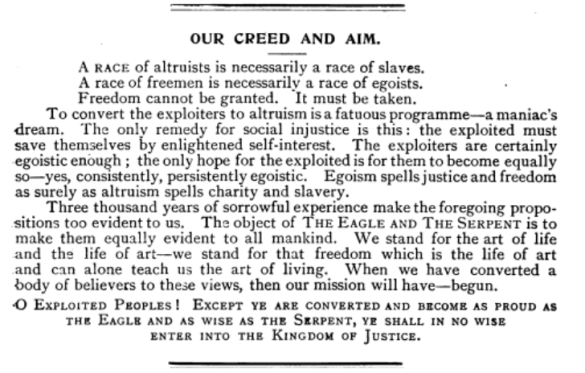
Well, what have we here? A call for the exploited (the “working class” the Woke Left seems to forget) to rise up and stop slaving away for the betterment of their masters in pursuit of their own desires? Is this the “New Man” the Stirnerites were seeking to create?
Pray tell, what was wrong with that?
Stirner’s genius was to tell the Working Class it needed to stop worrying about the morality and “needs” of the wealthy parasites above them and start caring about themselves, rather than hoping for an entire species to come around to a single idea(something that has never been seen before in human history and is still unseen today). This was further elucidated by the Illegalists in early 20th century France:
“By refusing us the right to free labor society gives us the right to steal. In taking possession of the wealth of the world the bourgeois give us the right to take back, however we can, what we need to satisfy our needs. Anti-authoritarian, we have the burning determination to live free without oppressing anyone, without being oppressed by anyone.”
The craziest thing about this is much of what Tankies and Woke Lefties have to talk about the “Post-Left” would agree with. We want the end of capitalist exploitation and an end to the enslavement of an entire species.
Where the difference lies is where we each sees the “end” of oppression.
Just as the Marxist-Leninist believes the hierarchy of the State can be put into worker control, so too does the “Woke” Anarchist believe that the manufactured society based on nothing more than old State institutions can be “liberated” and made into a tool for human development. For the Egoist nothing but the total emancipation of the individual will do.
And that’s why the Woke Left is scared: it knows it’s scared cows are on the chopping block.
WASN’T STIRNER RACIST THOUGH?
I expected alot of the Woke Left to champion Alexander’s essay. After all, it made the guilt-ridden collectives the “right” Anarchism and assured them that all those dirty little individualists were just a breath away from fascism. Of course anybody familiar with Stirner was pissed, which was to be expected when someone wrote about a topic they know nothing about just kind of makes it up as they go along.
But whenever I did see a weak acknowledgement of Alexander’s perceived lack of inquiry into anything about the Post-Left one quote did seem to get alot of play. In no less than four comment threads by different users I saw the same response almost word-for-word.
“Okay but the post-left hasn’t sufficiently addressed passages from Stirner like this:
“The history of the world, whose shaping properly belongs altogether to the Caucasian race, seems until now to have run through two Caucasian ages, in the first of which we had to work out and work off our innate Negroidity; this was followed in the second by Mongoloidity (Chineseness), which must likewise be terribly made an end of. Negroidity represents antiquity, the time of dependence on things (on cocks’ eating, birds’ flight, on sneezing, on thunder and lightning, on the rustling of sacred trees, and so forth); Mongoloidity the time of dependence on thoughts, the Christian time. Reserved for the future are the words, ‘I am owner of the world of things, and I am owner of the world of mind’”
This again betrays Alexander’s audience: because Stirner used bad words he is bad, a classic of the “Woke Left” whose battles primarily involve language rather than physical existence. These are the same “Anarchists” claiming that Huckleberry Finn needs to be banned from libraries and calling Mark Twain a racist.
Interestingly enough most of these people have never read Mark Twain because they would know he was violently anti-imperialist and very much opposed to the racial caste system of the American South. Noticing a pattern here?
Let’s humor our less-read “comrades” and actually dissect this.
Stirner is not talking about races. At all. He is talking about time periods in human thought using language that we know to be terrible but was actually normal for the time period. If you’d actually bothered to read a bit more you’d see he says this:
“Custom having once given the name of “the ancients” to our pre-Christian ancestors, we will not throw it up against them that, in comparison with us experienced people, they ought properly to be called children, but will rather continue to honor them as our good old fathers. But how have they come to be antiquated, and who could displace them through his pretended newness?…
…the ancients mounted to spirit, and strove to become spiritual. But a man who wishes to be active as spirit is drawn to quite other tasks than he was able to set himself formerly: to tasks which really give something to do to the spirit and not to mere sense or acuteness, which exerts itself only to become master of things. The spirit busies itself solely about the spiritual, and seeks out the “traces of mind” in everything; to the believing spirit “everything comes from God,” and interests him only to the extent that it reveals this origin; to the philosophic spirit everything appears with the stamp of reason, and interests him only so far as he is able to discover in it reason, i. e., spiritual content.”
So when Stirner says “Negroidity represents antiquity, the time of dependence on things (on cocks’ eating, birds’ flight, on sneezing, on thunder and lightning, on the rustling of sacred trees, and so forth)” he is referring to the time period THAT WAS BELIEVED AT THE TIME to be a tribal existence WHICH WAS BELIEVED AT THE TIME to be exemplified by the people of Africa.
Let me be the first Egoist to apologize that Max Stirner lived during the 1840’s. I’m sorry he wasn’t as “woke” as Anarchists are in this century. You’d know this of course if you actually read his book, BUT HEY, this is the internet. Fuck all that noise, we got memes.
The idea that the Post-Left hasn’t “sufficiently addressed” the critiques of others implies the Post-Left owes them anything or needs to explain itself to same grand, organizing body of Anarchism. Alexander and the Woke Left of the West Coast has determined that no matter what Stirner readers might say it is always, always wrong, and that they need to come back into the “right” kind of Anarchism.
Which is actually kind of racist.
Y’all Got Any More of Those Mass Generalizations?
The rest of Alexander’s essay dribbles on about famous Anarchist authors who I’ve never read, some eco-terrorists who I couldn’t give a shit about, and finally the idiot Jack Donovan who has the audacity to call himself an “anarcho-fascist.” If Alexander has the audacity to link any of those people to the ideas of Max Stirner or Egoism one might easily call Karl Marx and Lenin one of the founding pillars of National-Bolshevism.
The sad part is the essay might actually be half-way decent if it wasn’t a shallow attempt to link together as many ideas and authors on the “Post-Left” to a bunch fascists. Zerzan has NOTHING to do with Egoism. Primitivism has NOTHING to do with Max Stirner. What Alexander sees is a bloc of ideology where frankly there is NONE.
Novatore wanted “to create spiritual beauty, teach the poor the shame of their poverty, and the rich the shame of their wealth,” not live in a hut and piss in a pepsi bottle, but to the Woke Anarchists they are literally the same thing. Probably because Zerzan and Novatore both happen to pee standing up.
Alexander is literally chasing a ghost, a spook, a figment of his imagination. Egoists see no need to join with anybody. Alexander has decided we’re kin to primitivists simply because we don’t want to work in a goddamn factory or uphold the wretched consumer society he clearly sees worth saving.
The crown jewel on the essay is Alexander’s description of the philosophy of Egoism, a half-way glance at this very lack of unconditional solidarity:
“Derived from Stirnerism and Nietzschean philosophy, egoism can reify the social alienation felt by an individual, leading to an elitist sense of self-empowerment and delusions of grandeur. When mixed with insurrectionism and radical green thought, egoism can translate into “hunter versus prey” or “wolves versus sheep” elitism, in which compassion for others is rejected as moralistic.”
Only that’s not what Stirner, the guy who literally coined the term Egoism, said at all:
“But “the egoist is someone who thinks only of himself!” — This would be someone who doesn’t know and relish all the joys that come from participation with others, i.e., from thinking of others as well, someone who lack countless pleasures — thus a poor sort. But why should this desolate loner be an egoist in comparison to richer sorts? Certainly, for a long time, we were able to get used to considering poverty a disgrace, as a crime, and the sacred socialists have clearly proven that the poor are treated like a criminals. But sacred socialists treat those who are in their eyes contemptibly poor in this way, just as much as the bourgeoisie do it to their poor.
…And now if someone — we leave it open whether such a one can be shown to exist — doesn’t find any “human” interest in human beings,if he doesn’t know how to appreciate them as human beings, wouldn’t he be a poorer egoist with regard to this interest rather than being, as the enemies of egoism claim, a model of egoism? One who loves a human being is richer, thanks to this love, than another who doesn’t love anyone.” – Stirner’s Critics (penned by Stirner himself)
And further:
“Egoism, as Stirner uses it, is not opposed to love nor to thought; it is no enemy of the sweet life of love, nor of devotion and sacrifice; it is no enemy of intimate warmth, but it is also no enemy of critique, nor of socialism, nor, in short, of any actual interest. It doesn’t exclude any interest. It is directed against only disinterestedness and the uninteresting; not against love, but against sacred love, not against thought, but against sacred thought, not against socialists, but against sacred socialists, etc.” – Stirner’s Critics
Why is something so basic, the literal ideas of a philosopher, so fundamentally off base? What are we to make of an essay that isn’t only wrong but gleefully so?
That it serves a purpose.
Alexander is not a journalist, he is an ideologue whose one-time outing of a fascist has him seeing them everywhere. Alex and his ilk are threatened by the rise of Post-Left thought because it’s a beast uncomfortably foreign to them: it requires no apologizing, it puts no groups above any others, and it dispenses with any savior-complex about “The People.” Egoism simply says that you and you alone determine what is good, that you owe the world nothing, and if you want something you better well take it. This was reiterated by Emma Goldman, whose love for Nietzsche and Stirner clearly mark her as a fascist sympathizer:
“The individual is the true reality in life. A cosmos in himself, he does not exist for the State, nor for that abstraction called “society,” or the “nation,” which is only a collection of individuals. Man, the individual, has always been and, necessarily is the sole source and motive power of evolution and progress. Civilization has been a continuous struggle of the individual or of groups of individuals against the State and even against “society,” that is, against the majority subdued and hypnotized by the State and State worship..
The interests of the State and those of the individual differ fundamentally and are antagonistic. The State and the political and economic institutions it supports can exist only by fashioning the individual to their particular purpose; training him to respect “law and order;” teaching him obedience, submission and unquestioning faith in the wisdom and justice of government; above all, loyal service and complete self-sacrifice when the State commands it, as in war. The State puts itself and its interests even above the claims of religion and of God. It punishes religious or conscientious scruples against individuality because there is no individuality without liberty, and liberty is the greatest menace to authority.”
This is in direct opposition to the key tenet of Woke Anarchism: Identity Politics.
Anarchism, as it exists among the privileged and “Woke” Americans in Portland and other liberal enclaves depends upon certain “sacred” things. It is an “Anarchism” where certain things must never be questioned, certain lines must always be upheld, and above all the opinion of the community at large must be put first. It is an Anarchism of laws, rules, and little miniature cliques that get to describe who’s in and who’s out. And above all YOU are not an individual but a member of an “identity” and that literally determines everything about you.
Consider the editors of Anti-Fascist News were quick to call those that had legitimate issues with the article “a parade of angry white dudes mansplaining about ‘edgy’ books that almost no one has read and were written over a hundred years ago” and it becomes clear why a Post-Left even exists.
Stirner, in The Ego and His Own, wrote:
“Every community has the propensity, stronger or weaker according to the fullness of its power, to become an authority to its members and to set limits for them: it asks, and must ask, for a “subject’s limited understanding”; it asks that those who belong to it be subjected to it, be its “subjects”; it exists only by subjection. In this a certain tolerance need by no means be excluded; on the contrary, the society will welcome improvements, corrections, and blame, so far as such are calculated for its gain: but the blame must be “well-meaning,” it may not be “insolent and disrespectful” — in other words, one must leave uninjured, and hold sacred, the substance of the society.”
Stirner’s ideas are opposed to all the “Anarchists” in favor of writing laws, building prisons, and otherwise developing their own religious dogma pretending to be a political philosophy. It is opposed to spending your time at universities in Portland apologizing for having dreads or any group whatsoever dictating who can speak and when. It is about seizing what you require and attacking.
You know, ACTUALLY revolutionary stuff.
The Woke Left knows it can’t compete with letter-bombs and arson, so it does what it does best: complain and whine to some external force to GIVE it respect.
When Alexander says “Anarchists must abandon the equivocations that invite the fascist creep” he’s really saying the Post-Left must return to the ideological guidance of it’s enlightened white vanguard. He didn’t say “please stop talking to fascists,” didn’t say “please cull them from your ranks,” but basically called for the abandonment of any ideas they might steal to be thrown away. When Alexander says we must “reclaim anarchy as the integral struggle for freedom and equality” he means HIS anarchy, the kind favored by white intellectuals on liberal campuses, the only kind that “works.”
Never mind comrades the world over in the FAI, the leading Insurrectionary-Anarchist organization, have found Stirner and his thoughts on individualism and action a guiding light. The Woke Left of the West Coast has quickly denied them agency, the privileged white liberals who enjoy police protection of Vegan Days down at the park claiming yet again the audacity to dictate to Insurrectionists in South America, Greece, and Indonesia that their politics must be wary of “entryism” while white men are thrown out of Anarchist discussions in the US and into the arms of the Alt-Right.
What is THAT but liberal colonialism at it’s finest?
Do fascists try to use Leftist thought to further their own agenda? Absolutely. They’ve been doing it since Hitler decided to call his particular brand of goosestep “National Socialism.” Anybody that would believe Hitler’s policies proved a problematic “entryism” in Marx’s ideas should probably have their head examined.
It’s first world politics at its worst and Alexander doesn’t acknowledge it at all. His Woke Left privilege has left him blind to the glaring error in his own Identity-centered politics, something the Queer Insurrectionists in Bash Back! and indeed much of the larger world has been eager to point out:
“Identity Politics are rooted in the ideology of victimization, and thus celebrate and comes to enforce norms surrounding what activity people are allowed or able to participate in. This plays out by reinforcing certain mythologies about struggle (i.e. “only cis-white-men participate in black blocs or “oppressed people are incapable of certain strategies of revolt”)….A queer in prison has more in common with their straight cellmate than with some scumbag gay senator, and yet the mythology of the “queer community” serves to suffocate enemies of society and subjugate them to their self-appointed representatives.
Identity Politics are fundamentally reformist and seek to find a more favorable relationship between different subject positions rather than to abolish the structures that produce those positions from the beginning.”
Alexander’s essay is piss-poor journalism with almost zero understanding of the philosophers he’s clearly afraid of, and no manner of books he’s sold in Portland or elsewhere are going to change that. His attempt to rope Egoism and Stirner with every half-baked theory he could think of and asshole he could find is nothing short of a smear campaign in the hopes more people will return to the pointlessness Anarchism is normally afflicted with. In my line of business we call those people “terrible writers,” “not journalists,” or to use the industry term “fucking assholes,” and it immediately makes everything else suspect.
Alexander and the Woke Left haven’t read Stirner nor will they, they are unfamiliar with Nietzsche and they will continue to be, they’ve never heard of Dora Marsden and don’t care to, because they are convinced we are wrong and they are right. Individualism is responsible for “fascist-creep” while the wholesale alienation of wide swathes of the Earth’s population is totally okay and not at all responsible for the widespread laughing-stock Leftism has become.
And you know what? That’s okay.
It’s okay because Alexander and his ilk are the reason Trump has been elected and the reason Insurrectionism is on the rise, it’s the reason Anarchists the world over are dumping the protest marches and IWW branch meetings his folks enjoy and starting to buy guns. Woke Anarchists want to keep what little power they’ve won in a small and marginal community because they are afraid of what the Post-Left offers to the oppressed people of the world: that only the individual, not assemblies, parties, or organizations, can make themselves free; that Alexander and other “leaders” will do nothing but maintain their own leadership at the cost of real-world results.
Ultimately Alexander penned the essay because he knows Anarchists in the US will make a choice:
The Tumblr feuds, safe spaces, and groupthink of the Woke Left or the real world militancy, self-interest, and individualism proposed by Max Stirner; marches led by former CIA-agents and lauded by Huffington Post or the concrete struggles of oppressed comrades not afraid to break the law and find revolution today?
Can you guess which one American Anarchists have been doing for 20+ years with almost no results?
Rather than focus on why a Post-Left even exists they are content to whine and complain as they’ve continually done while people of color continue to be killed by police and automation effectively makes the term “worker” obsolete.
South America, Mexico, and Europe have made their choice and it’s to leave the classroom-bound theories of Seattle and Portland in the garbage heap of history.
I say it’s time American Anarchists learn some real solidarity and join them.
Egomania! A Response to My Critics on the Post-Left
My piece, “The Left-Overs: How Fascists Court the Post-Left,” has been shared on Facebook more than 2,000 times now and numerous interpretations have made the rounds. I feel like I must apologize for the inappropriate uses of “Left-Overs,” which unfortunately came across to some as against the post-left specifically. I would like to use this space to humbly correct what has been written about me and the subject of my article.
Those who are familiar with my work recognize that I outted Michael Schmidt, a fascist in the platformist tendency. During the heated first months of that episode, a number of post-leftists managed to condemn me for perpetuating “call out culture” while using my work to launch sectarian attacks against platformism. Meanwhile platformists attacked me for being a post-left primitivist. Since then, Schmidt has admitted, “my mind was toying with [national-anarchism’s] disastrous, racist arguments” (a taste of the truth, but not the buffet to be sure).[2]
Now, post-leftists who reveled in the controversy of “Schmidtgate” find in my present work “the very definition of a sectarian attack.” Although some of the critical engagement with my work bears the marks of sincere inquiry, much of it comes from rage. The recent 5,500 word piece, “Post-Left vs. ‘Woke’ Left,” by Dr. Bones, takes the reader on an extended tour of the latter. I have done my best to counter his efforts by taking on the former.
Forget that Bones antagonized me personally, admitting in a public apology, “I took something I’m sure has no truth to it whatsoever and threw it in his face not because I believed it but because I wanted to hurt him… This was not a fair or even a civil tactic, this was just stupid, cruel, and mean.” When one is dealing with a milieu with a reputation for troll tactics, reddit politics, and chan behavior, it helps to have a thick skin. Apology accepted.
What truly matters is that, in his vitriolic critique, Bones gets most facts plainly wrong and his essay is chock full of spurious accusations. I am, in fact, not “calling for the abandonment of any ideas [fascists] might steal to be thrown away,” whatever that means (it sounds like it would rid the world of ideas altogether and make us all a bit more like Bones).
Let’s look at my most daring claims and see whether or not they deserve the kind of animosity I have faced over the past week:
-
“[I]n imagining that anti-capitalism and ‘individual liberty’ maintain ideological purity, radicals such as my own dear editor tend to ignore critical convergences with and vulnerabilities to fascist ideology.” This claim stands up based on evidence I provided, including the correspondence that I had with my editor, as well as the defensive reaction to the piece. I am also clearly positing “radicals” not “post-leftists” specifically.
-
“[T]his situation [of ideological cross-over] has provided ample space for the fascist creep.” I am not marking the post-left as “particularly” vulnerable to entryism, nor am I saying that the post-left is, itself, fascist.
-
“[The] presence [of fascists among former Earth Liberation Front members] serves as food for thought regarding important radical cross-over points and how to approach them.” All I am implying here is that cross-over points in ideology and practical work should be recognized as important in the struggle against entryism and the clarification of anarchist ideas.
-
“[A]lthough in some cases prescient about the subcultural cross-overs between fascism and the post-left, post-leftists have, on a number of occasions, engaged in collaborative relationships.” I list a number of examples, and there are many more to boot. In recent twitter correspondence, one of my critics insisted, aside from the invective they aimed at me, that they agree with my thesis, but did not like the fact that I provided supporting evidence. As the Latin aphorism goes, “Precepts guide, but examples drags along” (Præcepta ducunt, at exempla trahunt).
To clarify, reviewing my central points, I never called the post-left fascist, called any of its leading figures fascist, or even made a claim that it is “particularly” vulnerable to fascist entryism.
What is the Point?
Perhaps the crux of my article is here: “It stands to reason that defending fascists and collaborating with them are not the same, and they are both separate from having incidental ideological cross-over points. However the cross-over points, when unchecked, frequently indicate a tendency to ignore, defend, or collaborate. Defense and collaboration can, and do, also converge.” I am saying it would be wise to check those cross-over points to ensure they are not putting a group or person in a vulnerable position in relation to the fascist creep. For example, I know plenty of pagans; many fascists are also pagans; it is wise for my pagan friends to avoid pagan groups tending toward fascism, like the Asatru Folk Assembly. With this in mind, it is incumbent on antifascists to expose fascist groups or persons and the cross-over points that they exploit—this should be seen as a service and a duty, not an attack.
Yet Bones takes me to task for putting anarchists on notice that “scary individualists are particularly weak to ‘entryism’ and the fascist creep.” If this were true, I would agree with my critic, “This is patently ridiculous.” I have worked and played with post-leftists for the last ten years, including direct action groups, reading groups, and black blocs, and I have published most of my work on Trump in It’s Going Down and Strangers in a Tangled Wilderness, both of which have generously published my articles in zines. My experience shows that I am no sectarian. Before ten years ago (roughly between the years of 1999–2004), my political alignment was basically post-left anarchist and even up to 2009, I was participating in things like a post-left reading group with green anarchist, Dan Todd, at the Dry River Radical Resource Center in Tucson, Arizona, that hosted post-left anarchy luminary, Lawrence Jarach, following his interesting piece, “Why I’m Not an Anti-Primitivist.”[3]
I am ecumenical in observing the cross-overs with the far right among collectivists as well as individualists, or as post-leftist, William Gillis, puts it in his review of my book, Against the Fascist Creep, I am “equal opportunity in [my] work.”[4] I clarify in the third sentence of my offending piece, “Fascism comes from a mixture of left and right-wing positions, and some on the left pursue aspects of collectivism, syndicalism, ecology, and authoritarianism that intersect with fascist enterprises.” The next sentence reads, “Partially in response to the tendencies of left authoritarianism, a distinct antifascist movement emerged in the 1970s to create what has become known as ‘post-left’ thought.”
So when I write about the post-left, I am clearly describing an antifascist tendency that emerged from a rejection of left-wing authoritarianism that shared common traits with fascism. The subtitle of my work is, “How Fascists Court the Post-Left,” not “How the post-left turned into a writhing cesspool of fascist ugliness.” Those who accuse me of authoring an anti-post-left “hit piece” ignore that I call it a “rich milieu” in “Left-Overs.” Oversights happen, but let me note that I have faced criticisms from antifascist post-leftists telling me I should not have pulled as many punches as I did. Suffice it to say that the defensive reactions have been instructive, in no small part, for the facts they get wrong.
Does the Post-Left Exist?
The principle critique of my work is that I have misunderstood or misconstrued the post-left milieu and the thought of its important intellectual rock stars—particularly Max Stirner. This is quite tricky, because post-leftists often insist that the term, “post-left,” amounts to nothing more than a sticky signifier—a place-holder that brings together a variety of tendencies based on temporary affinities.
Due to this loose system, which developed amid affinities between nihilists, green anarchists, individualists, egoist communists, and insurrectionaries, Bones claims that I am “literally chasing a ghost, a spook, a figment of his imagination. Egoists see no need to join with anybody. Alexander has decided we’re kin to primitivists simply because we don’t want to work in a goddamn factory or uphold the wretched consumer society he clearly sees worth saving.”
This denial of post-leftism as a milieu is not entirely accurate. According to Bob Black’s “Notes on ‘Post-Left Anarchism,’” “Among the people I was thinking of as post-left anarchists were Fredy Perlman, John Zerzan, Dan Todd, Hakim Bey, Max Cafard, Michael William, John Moore, the Fifth Estate writers of the 70’s and 80’s (such as George Bradford/David Watson and Peter Werbe), Wolfi Landstreicher (he had other names back then), the Green Anarchism writers (especially John Connor), and several regular contributors to Anarchy: A Journal of Desire including its editor Jason McQuinn (then known as Lev Chernyi), Lawrence Jarach, and Aragorn.”[5] With the caveat that the post-left exists on its own terms, our readers will hopefully recognize, against dissemblances, that I am not higlty-piglty scrabbling together a discursive field out of little else but hot air and black ink. Bones even insists (repeatedly) on the importance of understanding “why a Post-Left even exists.”[6]
A Bit About Stirner
Bones accuses me of never having read Stirner or Nietzsche, although I have read virtually all of Stirner and Nietzsche. The sensitivity is incredible, given that I devote only one sentence to Max Stirner in “The Left-Overs,” writing that he held a “belief in the supremacy of the European individual over and against nation, class, and creed.” For this, I have been subjected to some of the most intense invective I have ever experienced in my life. Bones calls me a “fucking asshole” in his piece and a leftist “class struggle” meme page attacks me as a liberal antifa cuck, deploying the racist vocabulary of the alt-right to denounce antifascism as if they were not proving my point.
Bones does not deny the Eurocentrism of Stirner’s insistence on a “really Caucasian” age following the purging of “innate Negroidity” and “Mongloidity.”[7] Yet he refuses to acknowledge the tacit racism, despite the fact that Stirner’s editor and translator, David Leopold, wrote in his introduction to Cambridge University Press’s 1995 edition of The Ego and Its Own, “Individual and historical development are the two primary forms of the Stirnerian dialectic, but in order to clarify its form he inserts ‘episodically’ a racial (and racist) analogue of the historical account.”[8] Those calling my interpretation of Stirner “dishonest,” “disingenuous,” and “dirty” must hurl the same invective at Dr. Leopold, an Oxford University fellow and professor entrusted with the leading edition of Stirner’s main text (available through Libcom).
Can we chalk this up to blind ignorance, friends? Stirner’s historical account runs parallel to the then-popular Aryan myth, wherein the passage of humans from Africa to Asia to Europe signifies a cultural-linguistic process of evolution. Bones posits Stirner’s rejection of nationalism as a defense against the charge that he was racist. Yet recall now that I mentioned that Stirner held a “belief in the supremacy of the European individual over and against nation, class, and creed.” Race and nation are different subjects, and looking at the complex history of ideological cross-overs, we can see fascinating outcroppings of the work of Stirner and Nietzsche that reject modern nationalism while reinforcing racist imperialism. The inability to detect this exposes a crucial vulnerability to racist anti-statism, which we will come to shortly.
Stirnerists and the Foundations of Fascism
In the 1860s, Stirner would become a topic for historians and philosophers of the mind, from Friedrich Lange’s History of Materialism to Hartmann’s Philosophy of the Unconscious. There is little doubt that perhaps the most influential thinker of nihilism, Friedrich Nietzsche, was familiar with Stirner, familiar as he was with those two influential texts. He lent his student, Adolf Baumgartner, a copy of Ego and Its Own in 1874.[9] Less than ten years later, shortly before publication of his most essential work, Thus Spoke Zarathustra, Nietzsche confessed to his friend Ida Overbeck the deep influence of Stirner on his thinking before worrying, “they will be talking of plagiarism.”[10]
Like Stirner, Nietzsche asserted the philosophical importance of iconoclasm—of destroying dominant paradigms that contain the individual. Nietzsche looked at the spirit of his day—the decadence of urban expansion, mundane philosophy, the herds of nationalism and flocks of the Church—as a form of passive nihilism. To overcome it, he predicted a new Superman would come about to annihilate the falsity of everyday life through an “active nihilism” perhaps evocative of an “eternal return” of human freedom.[11]
Anarchist writer George Woodcock notes, “Nietzsche himself regarded Stirner as one of the unrecognized seminal minds of the nineteenth century.”[12] By the end of the 20th Century, Nietzsche and Stirner formed fundamental pillars of radical thought. Writer and editor, Benjamin Tucker, discussed the significance of Stirner to anarchism, while Emma Goldman popularized Nietzsche.[13]
Aside from these influences, Stirner and Nietzsche also had a tremendous effect on Dora Marsden, a feminist leader who held the Aryan female genius responsible for breeding humanity into the New Order.[14] Aside from being a Stirnerist, Marsden was also influenced by the anti-Semitic and misogynistic individualist, Otto Weininger, who counted Stirner, with Ibsen and Nietzsche, as the only scholars to ever understand true ethics and individualism.[15] Though she was an egoist and an important member of the women’s movement, her agreement with Weininger led her to essentialize the sex binary in her writings. Weininger would also influence the Nazi regime and Evola openly admired him.[16]
As Stirner’s work gained traction, it also garnered increasing attention from the right. In his 1908 text, Gospels of Anarchy, and Other Contemporary Studies, Vernon Lee observed a similarity between Stirner’s “psychology” and that of anti-Semitic reactionary, Maurice Barrès.[17] This similarity was not an anomaly—Barrès was aware of the Young Hegelians and Stirner through the works of Saint-René Tallandier, and Stirner’s influence could be found in the first two volumes of Barrès’s Cult of Myself as well as Enemy of the Law.[18] By the 1920s, James Huneker’s book, Egoists: A Book of Supermen, could place Stirner and Nietzsche alongside Barrès within the same individualist milieu without controversy.[19]
Significantly, Barrès and his reactionary ally, Charles Maurras, would forward the earliest prefigurations of fascism. In his journal, La Cocarde, Barrès sought to reach out to “the proletariat of bacheliers, to those youths whom society has given a diploma and nothing else.”[20] To achieve such a goal, Barrès included the left-wing voices of Eugéne Fournière and Fernand Pelloutier, along with nationalist compatriots. In the spirit of La Cocarde, Maurras joined with the former anarcho-syndicalist, Georges Valois, to launch the Cercle Proudhon with Eduard Berth, a close associate of the famous syndicalist, Georges Sorel. Despite Maurras’s importance, Valois would later claim Barrès as the progenitor of original fascism.[21]
Here in its germ, at the merger of individualism and collectivism, nationalism and socialism, fascism could be found. Following the developments of the day, Benito Mussolini called Sorel the “notre Maître (Master)” and encouraged his followers to return to Stirner.[22] In Germany, conservative revolutionary, Ernst Jünger, conjured up the figure of the “magic zero,” exhorting readers to annihilate the modern world and produce the New Age of the “Anarch”—who “embodies the viewpoint of Stirner… that is, the anarch is unique.”[23]
It was the desire for the New Man and the New Age that created the conditions for fascist palingenesis (the ideology of rebirth). This movement was facilitated by avant-gardists like Filippo Marinetti, who praised the “destructive gesture of the anarchist,” and Gabriel D’Annunzio, who theorized an aesthetic, poetic and spiritual unity of the nation.[24] Hence, there is no doubting the influence of Stirner in the seedbed of fascism—from Barrès, Mussolini, and Jünger to Marinetti, D’Annunzio, and Weininger. But wait! There’s more!
The Problem with Bataille
Another critical mistake my critics have made is denying that avant-gardist, Georges Bataille, was influenced by Stirner. This fact is supported by among the most basic works on Bataille.[25] Not only was Bataille influenced by Stirner, but his reading of Stirner came during the crucial window between his denunciation by the Surrealists in 1930 and his publishing of “The Psychological Structure of Fascism” three years later, in which he calls fascism, “the constitution of a total heterogenous power whose manifest origin is to be found in the prevailing effervescence… the emanation of a principle which is none other than that of the glorious existence of a nation raised to the value of a divine force (which, superseding every other conceivable consideration, demands not only passion but ecstasy from its participants).”[26] Since “fascism is an imperative response to the growing threat of the working class movement,” for Bataille, those who believe in the “liberating subversion of society” must recreate the process through which human lives would be emancipated.[27]
The problem with Bataille is that this recreation looked a lot like fascism. In 1934, a year after writing “The Psychological Structure of Fascism,” Bataille attended the “Exhibition of the Fascist Revolution” in Rome. In response to what he saw as the inevitable rise of fascism, in a letter to his friend Pierre Kaan, he declared, “I have no doubt about the level on which we will have to place ourselves: it can only be that of fascism itself, which is to say the mythological level. It is therefore a question of posing values participating in a living nihilism, equal to the fascist imperatives.”[28] In the words of scholar Rainer Friedrich, “Doubtlessly, at that point, Bataille’s discourse displayed a strong affinity to fascism.”[29] As did members of his coterie.
A member of Bataille’s 1935–1936 group, Counter-Attack, wrote, “We prefer, in any case, and without being duped, the anti-diplomatic brutality of Hitler, which is surely less fatal to peace than the drooling excitation of diplomats and politicians.”[30] A few months later, Surrealists who had participated in Counter-Attack released a statement attacking the “so-called group, within which had emerged some tendencies called ‘superfascist’ whose purely fascist character has become more and more evident.”[31] Identifying Bataille’s outlook as “surfascisme” and calling him “more fascist than the fascists” was not necessarily inaccurate.[32] In the translator’s introduction to Bataille’s own book, On Nietzsche, Stuart Kendall notes, “There was more than a little truth to the accusation, and intentionally so.”[33]
It is interesting that Bataille deploys the nihilist meta-narrative, which in a lot of fascist ideology functions as a part of the palingenetic core of rebirth. Although fascists often reject nihilism, individualism, and egoism, those denunciations come in connection to multiculturalism, liberalism, and democracy. On a deeper level, fascists like Jünger and Martin Hiedegger celebrated the dialectic of passive and active nihilism found in Nietzsche.[34] For Julius Evola, Stirner epitomized the first stage of a two-step process of emptying modern civilization of meaning—his form of “passive nihilism” is carried forward by philosopher Friedrich Nietszche into a New Age of spiritual realization by the New Man through “active nihilism.”[35]
It is crucial to recognize that Stirner’s rejection of modern nationalism is supported in fascism. Evola also championed the spiritual superiority of the “Aryan race” vis-à-vis “culture” and against modern civilization, which he identified with petty nationalism. Mussolini’s squadristi attacked nationalists as well as leftists.[36] Mussolini’s party saw palingenetic ultranationalism as the only way, a kind of organic rebirth of Ancient Rome in the height of Imperial grandeur under Scipio Africanus.[37] Fascism is Imperial rather than national, so Stirner’s call for a “truly Caucasian” age had its resonances on the right and left.
Individualism and Nihilism in Post-War Fascism
Stirner could not (and cannot) easily be shelved as left or right; his influence was perhaps more liminal and affective than direct and intellectual. As anarcho-syndicalist Rudolf Rocker lamented, “While the atomization of the individual is the constant, while humongous buildings populate the cities, while avenues are designed for machines, while collective transportation is designed for cattle and not human beings, anti-social/anti-communitarian actions will certainly remain present, expressed with the bitter angst shown throughout Stirner’s work.”[38] As much as his prejudices can be considered a symptom of his time, Rocker viewed Stirner’s reception by nihilists and individualists as similarly conditioned by the environment.
After the War, Stirner’s work was preserved in perhaps the definitive text on US individualism, James J. Martin, Men Against the State: The Expositors of Individualist Anarchism in America, 1827–1908. Published in 1953, Martin’s text noted Stirner’s influence in upholding the individual over and against the notion of natural rights in anything other than their voluntary manifestation.[39] Going on to publish anti-interventionist texts, Martin fell into the circle of a young Murray Rothbard, whose own writings on “anarcho-capitalism” in his journal Left & Right attempted to draw anti-war radicals toward free market ideals.[40]
Rothbard and Martin connected on their appreciation for Holocaust denier, Harry Elmer Barnes, who called Martin’s work “the most formidable achievement of World War II Revisionism.” Following Barnes’s death in 1968 (and a glowing obituary in the final issue of Left & Right), Martin founded his own publishing house and published texts on anarchy, Holocaust denial, and anti-interventionism.[41] Martin’s individualism and Rothbard’s incipient neoliberalism formed no small part of the seedbed from which the most right-wing faction of the libertarian movement sprang into being.
On a speculative note, Stirner’s influence might make sense here due to his translation of Jean-Baptiste Say’s free market works into German.[42] For this same reason, echoes of his thought are often seen in Ayn Rand’s ruthless “objectivism” by scholars and observers. Yet Stirner cannot be placed exclusively among neoliberalism, as his legacy continues to inform nihilists, individualists, insurrectionary anarchists, and ultra-leftists who believe in communization. Perhaps due to this mixture, the philosophies of individualism and nihilism continued to find even broader audiences in the cross-over between left and right ideas in the 1970s.
Perhaps the most functionally fascist of these influences came as Evola’s work was received by a new generation of fascists who made a concerted effort to infiltrate the left and restore the foundation of fascism. This work of the “European New Right” included the Evolian rejection of nationalism in favor of local cultures composing a larger, federated “spiritual empire.” European New Right leader, Alain de Benoist, returns to the process of “positive nihilism” whereby Europeans will “build on a site which has been completely cleared and leveled…. If a new right is to be brought into being we have to start from scratch.”[43] While Benoist and his project generally denounce “abstract” individualism, their “communitarian” project arguably tends toward the spiritual reclamation of the Evolian “universal individual” through its tacit elitism.[44]
Much of this was stated relatively plainly in “The Left-Overs,” which has been maligned by one respected anarchist as “that insane article.” The negative reaction is largely a mixture of defensiveness and inability to understand the central, palingenetic core of fascism, but again the willingness to jump to hostility and invective is extremely telling of the blindspot. If I am insane, I am like Diogenes the Cynic holding a lamp in the daylight in the search for an honest man, taking the winding path of history past those influenced by Stirnerist individualism and nihilism who set the foundation for and participated in fascism, such as Weininger, Marinetti, Barrès, D’Annunzio, Mussolini, Schmitt, Jünger, and Martin (i.e., some of the most important fascists in history).
Hear No Evil, See No Evil, Speak No Evil
Looking up Stirner in the fascist blogosphere today, one finds the most important cross-overs. In the Counter-Currents article, “We Are All Egoists—and Why That’s a Good Thing,” by former anarchist “race realist,” Aedon Cassiel, Stirner’s egoism avoids the “immature, anti-social, or sociopathic” approach, moving instead toward a synthesis of individualism and collectivism that provides for “a flourishing social commons.” This, of course, is not to say that a reading of The Ego and Its Own that permits such a synthetic social relationship of individuals is automatically fascist, but rather that it has significant weight across the spectrum.
In another article from Counter-Currents, Stirner is referred to approvingly at the beginning of the tradition of Nietzsche and D’Annunzio as developing the “consumate individualist”—“in the space beyond Left and Right, as well as beyond good and evil—with the aristocratic radical on the common ground of Life.” It is significant that the first citation used by the author of this piece refers to the exuberant chapter dedicated to D’Annunzio in Temporary Autonomous Zone, a seminal text in the post-left milieu by spiritualist, Hakim Bey (i.e., the text that praises proto-fascist right-left cross-over is then used by a fascist to talk about a “space beyond Left and Right”).[45]
Stirner’s mercurial attitude and iconoclastic attack on all structures of everyday life quickly elevated him to star-status in the online forums of the post-left during the 2000s, as his cyber-influence extended to the internet subcultures of trans-humanism. Stirner became a reference point for neoreactionaries who joined other interested individualists in message boards like 4chan’s /lit/ section. As meme wars grew, Stirner memes emerged from chan boards and neoreactionary websites, along with post-left anarchist forums, green anarchist platforms, nihilist groups, and occult circles.
In some cases, this cross-section produces meme wars of antifascists against fascists and/or anarcho-capitalists against anti-capitalist egoists and/or green anarchists against trans-humanists, and so on. In other cases, there are convergences between otherwise different factions. For instance, in retaliation for “Left-Overs,” the admins of Anarchist News posted a hoax article purportedly authored by me but compiled from plagiarized copy-and-pastes of different articles of mine to create rambling nonsense—of course, a fascist posted in the comments. Why not? Am I damned for expecting something more from a site that “repeatedly published ‘national anarchists’ despite widespread condemnation,” according to Gillis?[46]
With the development of the alt-right, newer syntheses of Stirnerism became possible. Stirner soon became a topic of interest, a conversation piece between Stirner-influenced nationalist Jonathan Bowden and alt-right founder, Richard Spencer. Alt-right accounts like “Darth Stirner” emerged, encouraging young radicals to abandon “rose-colored glasses” and open their eyes to the need for interning the enemies of the white race.[47]
Final Thoughts
Despite their recurrence in fascist ideology, I would not leap to the conclusion that nihilist or individualist thought are essentially fascist. Was Marsden proto-fascist? Was Stirner proto-fascist? These may seem like interesting questions, but they’re rather superficial. Rather than casting blame against one or another individual, I prefer to think of proto-fascist conditions. Perhaps this is not individualist of me, but it is by no means an attempt to brand the post-left as a fascist milieu. Rather, my article was an attempt to illustrate the conditions that brought and bring about fascism. Recall, I have never claimed that individualism and nihilism were the sole or even the principle influences for fascism, nor that the post-left is “particularly” susceptible to cross-over as opposed to the authoritarian or even anti-authoritarian left.
Now, instead of reflecting on the true, stated intension of my articles, my detractors have jumbled together innumerable conjectures that continue to miss the mark. To attack me for pointing out vulnerabilities to fascist entryism in relation to ideological cross-over points and switch the conversation to utterly false denial of the racist tendencies of white, Eurocentric philosophers is to fall into ignorance. It suggests that one is less concerned with the presence of racism than the accusation (and who is making it). And it indicates a deeply disconcerting pattern of “defending the bros” as opposed to careful consideration of the facts.
In a world where fascists attempt to enter radical milieus and draw people to the right, it is imperative to understand their methods. I have provided (or attempted to provide) a historiographic roadmap through which we can contemplate the cross-over points that act as entryways for the right into the post-left and exit paths from the post-left toward fascism. We must understand these aspects of fascism and its relation to radical politics if we are to defeat it. If we do not respect and uphold the value of truth, we are no better anyway.
Volentem ducunt fata, nolentem trahunt (Fate guides the willing, and drags the unwilling).[48]
***
Alexander Reid Ross is a journalist and lecturer at Portland State University. He has been published in Truth-Out, ROAR Magazine, and Upping the Anti, and is the author of Against the Fascist Creep (AK Press, 2017).
***
The World Without Forms
By Rhyd Wildermuth
I said to a friend, we see the darkness, and some go in.
It is the Abyss.
We have to find out what is there, to find out if there is meaning. And we see only the abyss. And some go mad. And some never return. And some—
And some, I said, come back wielding light against that darkness. Seeing nothing, we bring back fire, we light lamps, candles, torches. We hold light that isn’t ours, as how else would any else see?
***
Terror often greets the far-off glances on the faces of those who return from the Abyss. The lone wanderers who walked boldly into the darkness past the boundary of fire- or street-light, the mad poet, the uncouth heretic, the unshowered witch: their reckless journeys are not celebrated when they return.
Like the ones who ‘walk away from Omelas,’ they did not know to where they were going, only somewhere not-here, not the streets full of opulent wealth and the joyous cries of liberation made possible by a founding horror. But unlike in Le Guin’s story, the city is the world, and there is nowhere else to go except back to those same streets, their eyes no longer glinting with the shallow laughter of civilization but nevertheless lit with fire.
It is their own fire, and it is a fire others are right to fear. It is a fire that can reforge the world.
I am what some might call an Egoist. I can also be described as a Nihilist, a mystic, an esotericist, a witch, a Pagan, an Anarchist, and also a Marxist. None of these labels actually mean anything–they are only useful when attempting to speak as the locals speak, to use the prescribed language of Capitol/Capital, treating ‘words that stay’’ with the same fetishism which Marx ascribes to commodity-cum-currency.
It is generally easier to list what I reject (for those of you checking-off boxes on mental clipboards) than it is to begin the litany of what I embrace. Few have the time: there are stories that must be told for each thing before they can be understood, and such narration seems mere obfuscation to those for whom reductionism and essentialism (as endemic to the American ‘left’ as it is to the ‘right’) are unconscious requirements to get at the ‘truth.’
I will tell you what I do not like. I do not like racism or racialism; I do not like gender or genderism. I do not like property or propriety, nor do I Iike borders and what they define. Also, Capitalism and Liberal Democracy and Empire are my least favorite things in the world, along with their shadow, Fascism.
Here, though, I should remind you: “Fascism” means nothing at all. It is a word invoked by people overcome with a strong urge to shore up the ruins of Empire by recourse to even more tenuous concepts with even less material basis: Tradition, Race, Gender, Morals, the Nation. Though the words are mere sounds we make with our throats or symbols printed with ink or displayed on screens, they each serve to outline vaguely (and by their vagueness gain more power) ideas which nevertheless have great power in the realm of the human social.
Max Stirner called these ideas ‘spooks.’ Others would call these ‘constructs.’ I prefer to name them spectres or Egregores. They are also the mythic, and it’s the realm of the mythic I understand best, which is also the realm the Fascists are trying to take from us.
Spooks That Kill
Carl Jung gave a speech in 1936 in which he suggested a “Wotanic spirit” had begun to inhabit the National Socialists, as if the people had become possessed by a god:
Perhaps we may sum up this general phenomenon as Ergriffenheit — a state of being seized or possessed. The term postulates not only an Ergriffener (one who is seized) but, also, an Ergreifer (one who seizes). Wotan is an Ergreifer of men, and, unless one wishes to deify Hitler– which has indeed actually happened — he is really the only explanation.
Jung invokes his theory of gods as pre- and un-conscious archetypal drives to defend his thesis, but like much of the rest of Jung’s work, it’s always unclear whether he believed there was not really a god there. But Jung does not quite mean what we generally think of as a god. Wotan is a “buried drive” within the Germanic people, one which essentially haunts the ‘race’ until it becomes manifest.
“Because the behaviour of a race takes on its specific character from its underlying images, we can speak of an archetype “Wotan.” As an autonomous psychic factor, Wotan produces effects in the collective life of a people and thereby reveals his own nature….It is only from time to time that individuals fall under the irresistible influence of this unconscious factor.”
Jung’s racial essentialism here is tragic and prefigures the biological and genetic essentialism which now dominates Western thought. However, the concept of a mass possession by an unconscious form fits incredibly well with what we know of Nationalism.
Consider the World Trade Center attacks in 2001 in the United States. After the attacks, people experienced (and were diagnosed with) trauma from watching the explosions on television, so much so that some (including otherwise sane and clear-thinking friends of mine) for a little while believed they had either actually been present at the event or had a close friend or family member within the destroyed towers. Worse, many otherwise virulently anti-war people suddenly regained national ‘pride,’ literally waving flags with such civic devotion that one would have thought their life depended upon it.
Devotion to the Nation after such traumatic events often takes on both a religious quality (similar to that of evangelical Christians) while displaying symptoms of mass hysteria. The Nation appears to haunt the actions of the individuals, manifesting and reifying itself as if by possession or seizing.
What Jung noticed regarding the possession of the German people by “Wotan” is this same process. And while one need not believe it was Wotan who possessed his people (I do not—I’ve asked him myself), Jung’s assertion that a mythic force can operate on the psyche is hardly a unique idea. The same function was described by Max Stirner as ‘spooks,’ ideological and philosophical forms which exert influence when they are unconsciously accepted as really-existing.
Spook, Spectre, Egregore
Jung’s theory of archetypes—as well as Stirner’s theory on Spooks, may have been influenced by an occult theory regarding near-deific spirits known as egregores. An egregore (greek for ‘watcher’) is a spirit composed of the memories, knowledge, personality, and intentions of a group, which either arises organically from the activities and interactions of the group or is constructed willfully by the group.
Egregores could be called ‘group minds,’ though they exist autonomously (like Jung’s archetypal Wotan) and maintain the cohesion, survival, and collective identity of a group beyond the individual goals of each member. Unlike an archetype, an egregore does not spring from the unconscious/pre-conscious mind, but rather the myriad actions and interactions of those within in. Unlike a god, an egregore is not something one worships or necessarily invokes. They can be constructed, but after their construction the apparent life they take on is much more complex than what they were constructed to be.
A more accurate explanation may be to say that they are real-ised; brought from the realm of infinite possibility, the world without forms, into the more finite realm of social existence. Yet another theory is that they become inhabited after-the-fact by pre-existing spirits, similar to the way many animistic cultures build shrines as houses that benevolent spirits (or fairies, etc.) will want to move into.
Like Jung’s ‘Wotan’ and Stirner’s Spook (and to some degree Derrida’s ‘Spectre’), the Egregore describes the apparent realness of a thing despite its disconnection from the material world. There is no ‘there’ there, and yet it functions always as if there was, manifesting itself in the actions of those who live within its realm of influence or meaning. And it thus acts also as if it were a god, making demands upon its followers who constantly (and often unconsciously) manifest its existence.
This same process has been described by other means by post-colonialist theorists. Dipesh Chakrabarty, particularly, proposes in his introduction to Provincializing Europe that it is precisely European exceptionalism that prevents us from seeing how those of us in Liberal Democratic societies still “inhabit these forms even as we classify ourselves as modern or secular.” Similarly, Frantz Fanon and James Baldwin speak to the way that belief in whiteness and its psychological manifestations seem to inhabit those who, in Baldwin’s words, “believe they are white.”
One need not necessarily accept a supernatural explanation for the way the mythic manifests as-if it is real in order to comprehend this idea. Benedict Anderson’s formulation of the Nation as an ‘imagined community’ also points to the same mythic and Egregoric functioning. For him, the Nation is a modern constructed form creating an indefensible (yet fully-manifest) sense of (false) horizontal kinship with complete strangers, as Anderson says, making “it possible, over the past two centuries, for so many millions of people not so much to kill as willing die for such limited imaginings.”
America exists; yet we cannot point merely to the constitution of the United States, nor to its government and institutions, soldiers and politicians and police, and say: this is America. America exists within the psyche of Americans, constantly reproduced through self-description and unconscious acceptance of its goals, desires, and inevitability. America is an egregore, a god-form, inhabiting the psyche of its individual constituents, like Jung’s Wotan: “…an autonomous psychic factor, …produc[ing] effects in the collective life of a people…”
The Fascists Know What We Prefer To Forget
Race, Gender, and all other ‘identity’ categories function this same way. Gays imagine themselves part of a ‘gay community,’ yet there is no such thing, only an imagined kinship with people who just happen to like sex with people who have the same genitals as themselves. A horrific attack on people who call themselves gay (such as the Pulse massacre in Orlando) thus manifests in individual gays elsewhere (as was the case for myself and many of my gay friends) as an attack on us as well.
We see this egregoric manifestation even stronger in whiteness. Whiteness has no material basis, yet it does not need one to manifest through the social interactions of humans. Whiteness ‘possesses’ the white person, and appears to inhabit their interactions with people possessed by other egregoric racial categories (Black, etc.) regardless of their oppositional nature. In fact, the conflict and tension between egregores only further refines and entrenches their influence and power.
Neither the conservative Right nor most of the liberal or radical Left challenge these egregores. Instead, they strengthen and re-invest these egregores with power by insisting they are real and meaningful fields of social struggle (regardless of their final goals). We see this most tragically on the Left, which generally accepts the constructed nature of identities, yet also insists identity is a valid (if not foundational) field of political struggle.
Consider the problem of Gender. Most Leftists accept Judith Butler’s proposition that gender is performative, not essential or biological (likewise the Egoist position). Yet, particularly on the “Social Justice” Left, essentialism and a fear of straying too far from Liberal Democratic forms creates a contradictory position, seen particularly in the arguments around trans women. On the one hand, Leftists insist woman is a constructed category, yet then assert that trans women are women. That is, woman is constructed, but in order to liberate another constructed category, trans women (as category) are absolutely (essentially) part of a woman (as category), making both again essentialist, Similarly, maleness is a category that the Left generally seeks to make irrelevant, but then the Left reduces men to an essential category in which every man essentially causes exploitation, violence, and oppression (“#YESALLMEN”).
Even if it were only the Left attempting to define the boundaries of these egregoric categories, we would find ourselves in an interminable deadlock. Unfortunately, there is a much stronger and less self-conscious current which already understands the great power these egregores have over the actions of humans.
A brief glance at the Nazi project is probably sufficient for us to grasp how Fascism not only is more comfortable with the egregoric nature of these concepts, but also understands how best to manipulate them. Nazi theorists (social, occult, legal, scientific, etc.) cobbled together a new mythic reality for Germany quite quickly. Tibetan and Hindu spirituality, Nordic and Germanic folklore, and general occult studies as well as previously oppositional and antagonist political, social, and scientific forms all became part of the egregore of Nazism, seizing the mythic imagination of a (likewise mythic) Nation.
Consider: before the Nazis, the Aryan race was a mere fringe scientific theory. During the Nazi ascension, the Aryan race was a thing, alive, ‘self-evident.’ So, too, Germany itself: suddenly a nation created only three decades before arose fully-formed with an ancient history as if it had always been there.
Did the Nazi theorists actually believe their own mythic creation? Or were they consciously creating something new? It’s impossible to know. The same question could be asked of Lenin and Stalin: did they really believe in the existence of the Worker?
Or more controversially regarding the identity politics of the Left: gays did not exist as a category in the 1800’s, nor did trans people. When the political category/egregoric identity of ‘gay’ and ‘trans’ arose, suddenly they were self-evident, alive, meaningful, and strangest of all: ‘true.’ Did those who constructed gayness and trans identity know they were making something up? How many who embrace these identities (unless they’ve really read Foucault) even realize that they do not stretch back into prehistory, let alone before the 20th century?
The point here is not to unravel the nightmare of Left identity politics, only to show how Leftists unconsciously do the same thing that Fascists consciously do. Leftists construct identities and egregores without any reference to the material world, yet then quickly accept them as if they have always existed, just as a Nationalist embraces the Nation and a White Supremacist embraces the White Race.
Leftism (and anti-fascism) as it currently exists is thus insufficient for combating the mythic power of Fascism until we acknowledge how much of this mythic, egregoric power we’ve not only ceded to Fascists, but then clumsily mimic.
The World Without Forms
An essay by Alexander Reid Ross recently warned against the danger of “Post-Left,’ Egoist, mythic, and anti-civilizational thought. What these “potential intersections” with Fascism all have in common, however, is a rejection of the egregoric spooks over which the Left and Fascists are currently warring. Also, they all have at least an apparent understanding of the mechanisms by which the egregoric functions, and they each assert the freedom of the individual over these forms as a primary goal.
Ross’s essay suggests that these positions seem close to the border past which all is fascist. That apparent proximity, though, is not what he suspects it to be. Rather, the extreme distance of most Leftism from the mythic–and its long complicity with Liberal Democratic secular exceptionalism–makes these non- and anti-fascist positions seem ‘close’ to Fascism.
Leftism—especially American anti-fascism—has been so lost in the world of identities and forms that it has forgotten that they are only merely that: forms. Thus, any who reject the world of forms, or create new ones, will be seen as immediately suspect.
Were the current forms (Liberal Democracy, Capitalism, the Nation, Gender, Race, etc.) worth keeping around, then this error would not be so catastrophic. Some are certainly anti-fascist only because it threatens Liberal Democracy, and perhaps it is no longer true to say that Leftism (at least in its American iterations) is anti-imperialist or anti-capitalist any longer, regardless of how much it claims otherwise.
If, however, we are anti-fascists because we are also pro-something else, something besides the current egregoric forms which lead only to exploitation, oppression, and the destruction of the earth, then we must stop looking away from the mythic power we have ceded to the Fascists.
We can see how we’ve done this by looking at one of the symptoms that anti-fascists use to diagnose whether someone is a Fascist: the Black Sun. Though proximity doesn’t prove causation, this is generally a good rule of thumb. However, little to no attention is ever given to why Fascists invoke the Black Sun.
The secret of the Black Sun is actually quite simple, and it’s one that Fascists do not own. Stare at the sun in the sky and something odd happens. It appears first to turn deep red, and then goes black and starts to spin as your retina burns. It also sears itself as an after-image, lingers there for hours (if not days), and creates the perception that there is actually nothing behind the sun. It appears to go flat as it moves, revealing a deep Abyss as if all light, and all reality is merely a black hole.
I do not suggest every white boy and girl who puts an image of the Black Sun as their iPhone background has experienced the same mystical transformation that medieval alchemists name nigredo; nor do I assert that it is an Abyssal truth limited to mystical traditions or European-derived thought (the Sufis and many animist traditions describe a similar experience). Still, it should intrigue us that in at least one Fascist strain, a rite exists which inducts the initiate into the nihilist/spiritual world without forms.
From that world, through such an initiation, it is easy to transcend societal restraints and enter into the pre-formal realm of perception. Outside the constraints of socially-constructed identity and morality, any new thought is possible and any new form is acceptable specifically because ‘possible’ and ‘acceptable’ no longer apply. More so, the experience strengthens the will of the initiate: the vision was survived, the mind intact.
Those who’ve studied and felt the inebriating mix of mythic power and indomitable will evinced by fascists like Jack Donovan and the Wolves of Vinland will understand my meaning here. Donovan has been able to create an intoxicating, egregoric, mythic conception of the world, cobbling together fragments of the past with terrifyingly violent new ideologies which are pristine in their coherence. There is raw, seductive, violent power here that functions on the ‘primal’ (pre-conscious, libidinal) level against which anti-fascists have no other defense except no-platforming.
Reclaiming What We’ve Thrown Away
If I here seem full of praise for something so horrifying, it is not because I am, but because you may have become so separated from your own mythic power that you’ve forgotten you can do this too, towards a more affirming and fair world rather one of hierarchy and hatred.
I suspect we shun this power for two reasons. First, anyone returning from the Abyss with such mythic visions, transcending the egregores by which the rest of us are ruled, will always be initially marked as a heretic or an outcast. Only when we find others who have seen the same things or who find meaning in these new dreams can such mystics find acceptance. The other reason? We’ve so long ago ceded to others our power to make the world that we are more happy to leave such delvings to the Fascists than realize we are complicit in our own enchainment.
The ‘world without forms,’ where we can again reclaim our power, is what Stirner and the Egoists embrace. It is also what Bataille sought, as did his close friend, the Jewish mystic Walter Benjamin. From that world we see both the infinite possibility of human liberation and the infinite delusions under which we have for too long struggled. It is also where we can learn how to be Walter Benjamin’s “real state of emergency” which will eventually make Fascism untenable.
The Nation is a false thing that only has power because we give it power. Gender, race, class, religion, morals—even the self itself—are all constructs. Civilization is a spook, one to which we are always subject because we believe there is such a thing as civilization, because other people believe there is such a thing as civilization, and because all of us fail to remember that civilization is just an idea in our heads that causes us to cohere around it and give it more power. Thus, the Fascist who warns that civilization is under threat from Islam, or trans people, or Cultural Marxism—as well as the Liberal-Leftist who warns that civilization is under threat from Fascism—are both still merely fighting for control over the egregore of Civilization.
Any anti-fascism which seeks to break not only the power of the Fascists but also the power of the forms the Fascists wish to control must refuse to accept the forms themselves.
Race, Gender, the Nation, Civilization–these are not our forms, they are forms which enchain us, they do not exist in the world we wish to build, and we must stop pretending otherwise. Instead, we must make new forms while always conscious that they are only just forms, forms we can change at will because it is our will which births them.
We must also refuse to cede the mythic—and the embrace of the self—to the Fascists. The ‘post-leftists’ and the Egoists and those who’ve read Bataille, and also those who’ve read Baldwin or Fanon or Chakrabarty, and especially all those who would dare walk past the forest’s edge in darkness and find there new truths, regardless the consequences—it is to them where we must look for the rituals which will free us all. It is them, and nothing else, who can finally exorcise Fascism’s spectre from our world.
Rhyd Wildermuth
Rhyd Wildermuth is the co-founder and managing editor of Gods&Radicals. He co-edited, along with Lia Hunter, the most recent issue of A Beautiful Resistance, “Left Sacred.
A Response to Egomania
By independentego
As you can see from the title, this is a response to an article posted by a guy named “Alexander Reid Ross” which is a member of a website called antifascistnews.net. Now, before I respond to this, I want to give first the context of this article and then a disclaimer in order to make aware the readers (and Alexander himself) that I am not in any way trying to deceive anyone. I first heard about him through a facebook group that posted one of his linked articles titled “THE LEFT-OVERS: HOW FASCISTS COURT THE POST-LEFT.”[49]. In that article, he mentions Max Stirner, Friedrich Nietzsche and Post-Left in which he claims that some of their writings contributed to either sympathizing to Fascists or downright supporting them. I couldn’t really care much about the Post-Left stuff considering that I don’t identify as a “Post-Leftists,” but I sure as hell don’t identify with the Right Wing either. I was focused more on Stirner and Nietzsche and the ways in which I disagreed with many of his propositions. Anyways, Facebook groups on Egoism started to post this article and the comments on the article were mostly negative. As a result, Dr. Bones From “The Conjure House” posted a response titled “Post-Left vs “Woke” Left: How Alexander R. Ross Got Max Stirner Wrong”[50] and sent it to Alexander. What happened between them after that I have no idea but as a result of said criticism from many people, Alexander made this article that I am responding to.
Disclaimer: The opinions that I express on this response is merely mine own and not anyone else. I am not affiliated to any organization or group other than Facebook groups on egoism. If anyone shares this article, that doesn’t mean the person or group in question agrees with everything I have to say.
With all that out of the way let’s get to my response.
The first part of this article deals with talking about the Post-Left and people like John Zerzan. As mentioned earlier, I have no interest in Post-left because I dont identify myself as that. Eventually he mentions Stirner and talks about Dr. Bones’s criticism on it
Bones accuses me of never having read Stirner or Nietzsche, although I have read virtually all of Stirner and Nietzsche. The sensitivity is incredible, given that I devote only one sentence to Max Stirner in “The Left-Overs,” writing that he held a “belief in the supremacy of the European individual over and against nation, class, and creed.” For this, I have been subjected to some of the most intense invective I have ever experienced in my life. Bones calls me a “fucking asshole” in his piece and a leftist “class struggle” meme page attacks me as a liberal antifa cuck, deploying the racist vocabulary of the alt-right to denounce antifascism as if they were not proving my point.
I have no control over what Dr. Bones said but his quote that Stirner believed “… in the supremacy of the European individual over and against nation, class, and creed.” is a bit nonsensical. The reason being is because Alexander is trying to paint Stirner as supporting White Nationalism by stating “European.” This is the same dog whistling that comes from the Alt Right where Richard Spencer claims that “America is a European Country.” The only difference is that you’re against White Supremacy whilst The Alt Right supports it. More on this soon
Bones does not deny the Eurocentrism of Stirner’s insistence on a “really Caucasian” age following the purging of “innate Negroidity” and “Mongloidity.” Yet he refuses to acknowledge the tacit racism, despite the fact that Stirner’s editor and translator, David Leopold, wrote in his introduction to Cambridge University Press’s 1995 edition of The Ego and Its Own, “Individual and historical development are the two primary forms of the Stirnerian dialectic, but in order to clarify its form he inserts ‘episodically’ a racial (and racist) analogue of the historical account.” Those calling my interpretation of Stirner “dishonest,” “disingenuous,” and “dirty” must hurl the same invective at Dr. Leopold, an Oxford University fellow and professor entrusted with the leading edition of Stirner’s main text (available through Libcom).
Two things, the first being that Alexander calling Stirner a “Eurocentric” is a bit of a irrelevant, considering you could apply that logic to many people of his time including Bakunin, Marx, Proudhoun, Kropotkin and many more. Secondly, it seems like you taken that quote from David Leopold and left out all the other stuff he said about Stirner’s explanation. So here is the quote in full detail
Individual and historical development are the two primary forms of the Stirnerian dialectic, but in order to clarify its form he inserts ‘episodically’ a racial (and racist) analogue of the historical account. Human history, in this new narrative, ‘whose shaping properly belongs altogether to the Caucasian race’, is divided into three ‘Caucasian ages’. The first, in which the Caucasian race works off its ‘innate Negroidity’, is vaguely located as including the era of Egyptian and North African importance in general and the campaigns of Sesostris III in particular, but its importance is clearly symbolic. xvii Introduction ‘Negroidity’ is the racal parallel of antiquity and childhood, representing a time of dependence on things: ‘on cock’s eating, bird’s flight, on sneezing, on thunder and lightning, on the rustling of sacred trees and so forth’ (p. 63). The second epoch, in which the Caucasian race escapes its ‘Mongoidity (Chineseness)” includes ‘the invasions of the Huns and Mongols up to the Russians’, and parallels the modern age and youth in representing the time of dependence on thoughts. Stimer’s concern with the continuity of this Christian epoch is emphasized by his choice of ‘Mongolism’ as the parallel of the modern, ‘Chineseness’ being a standard and pejorative Hegelian shorthand for lack of qualitative change. ‘Reserved for the future’ is the ‘really Caucasian’ era in which, having thrown off the Negroid and Mongol inheritance, the egoistic self can escape its dependence on both natural forces and ideas.[51]
Stirner is talking about how historical developments are being shaped through a European lens and explains how each “caucasian age” brings it closer for Egoism to take shape all across the world. Was there a racial element in this? Yes, because Stirner, like many others, lived in an era where racism was predominant in society. It is through this that causes ignorance of the terms because of Stirner’s isolation and incorrect usage of language. As David Leopold says later on in the Cambridge Edition of “The Ego and its Own.”
From 1847, Stirner’s life was characterized by social isolation and financial precariousness. He remained curiously detached from contemporary events – he seems, for example, to have largely ignored the revolution of 1848 – and his daily life was increasingly dominated by domestic routine and economic hardship. Stirner continued to write intermittently, but commentators have generally found his later work to be of little independent interest.[52]
Can we chalk this up to blind ignorance, friends? Stirner’s historical account runs parallel to the then-popular Aryan myth, wherein the passage of humans from Africa to Asia to Europe signifies a cultural-linguistic process of evolution. Bones posits Stirner’s rejection of nationalism as a defense against the charge that he was racist. Yet recall now that I mentioned that Stirner held a “belief in the supremacy of the European individual over and against nation, class, and creed.” Race and nation are different subjects, and looking at the complex history of ideological cross-overs, we can see fascinating outcroppings of the work of Stirner and Nietzsche that reject modern nationalism while reinforcing racist imperialism. The inability to detect this exposes a crucial vulnerability to racist anti-statism, which we will come to shortly.
Stirner’s thoughts are not part of an Aryan Myth, if Alexander can provide a source that proves it, that would be great. As for the concept of Race and Nation, it can be differentiated but in the context of today’s political environment, Ethno-Nationalism is on the rise and it’s currently growing while forms of Civic-Nationalism and National Liberation Fronts are in the decline. Hence Mr. Bones reaction on Nationalism to counter Stirner’s racial elements.
In the 1860s, Stirner would become a topic for historians and philosophers of the mind, from Friedrich Lange’s History of Materialism to Hartmann’s Philosophy of the Unconscious. There is little doubt that perhaps the most influential thinker of nihilism, Friedrich Nietzsche, was familiar with Stirner, familiar as he was with those two influential texts. He lent his student, Adolf Baumgartner, a copy of Ego and Its Own in 1874. Less than ten years later, shortly before publication of his most essential work, Thus Spoke Zarathustra, Nietzsche confessed to his friend Ida Overbeck the deep influence of Stirner on his thinking before worrying, “they will be talking of plagiarism.”
The sources that Alexander provides debunk his own claim about Stirner’s influence on Nietzsche. Let’s start with the lending of Stirner’s book to Nietzsche.
It is nevertheless certain that Nietzsche recommended the reading of Stirner to one of his students in Basle. In consulting the register of the Basle library it’s true that we don’t find Stirner’s book in the list of books borrowed in Nietzsche’s name. But we see that the book was borrowed three times between 1870 – 1880. In 1872 by the privat-dozent Schwarzkopf (Syrus Archimedes), in 1874 by the student Baumgartner, and in 1879 by professor Hans Heussler. M. Baumgartner though, son of Mme Baumgartner-Kochlin, who translated the “Untimely Meditations” into French, was Nietzsche’s favorite student: in his correspondence the philosopher calls him his “erzschuler.” M. Baumgartner, who is today professor at the University of Basle, says that it was on Nietzsche’s advice that he read Stirner, but he his certain that he never loaned the book to his teacher.[53]
So the only person who knows about this is a professor who states Nietzsche advised one of his students to read Stirner. That is extremely vague and provides no other proof than hearsay. It reminds me of people who swear they thought Nelson Mandela died in the 1980’s and now its a whole conspiracy theory called “The Mandela Effect.” Once I read this whole paper, it became clear to me that Alexander did not read all of this because of these quotes in general.
We don’t encounter Stirner’s name either in the works or correspondence of Nietzsche. Mme. Forster-Nietzsche, in the meticulous biography she dedicated to her brother, doesn’t speak of the author of “The Ego and Its Own.” In any event, the work was almost completely forgotten up until the time J.H. Mackay set out to celebrate it. J.H. Mackay himself tells us that he only read Stirner’s name and the title of his book for the first time in 1888: this is the very year that Nietzsche descended into madness. In 1888 Mackay found Stirner’s name in Lange’s “History of Materialism,” which he read at the British Museum in London. A year then passed before he again encountered this name, which he had carefully noted. Until that date, Stirner was thus truly dead: he is indebted to Mackay for his resurrection.
Nietzsche opposes the enthusiasm of youth to this egoist maturity. It would be quite surprising if Nietzsche, who didn’t take Hartmann’s “parody” seriously, would have decided at that date to study the works of Stirner, where he would have found theories even more paradoxical in his eyes than those of “Philosophy of the Unconscious.” In any event, Hartmann’s argument doesn’t prove that Stirner directly influenced Nietzsche.
In summary, it doesn’t appear that Stirner had a decisive influence on Nietzsche. He perhaps contributed to keeping Nietzsche for a time within the realm of Schopenhauer’s metaphysics. He was doubtless little by little forgotten afterwards.”[54]
What this means is Stirner’s influence on Nietzsche was slim if not really anything. Next he referenced a book called “Nietzsche: A Philosophical Biography by Rüdiger Safranski in which Nietzsche supposedly stated “they will be talking of plagiarism” in regards to Stirner’s work. I looked through the whole book and I cannot find that quote anywhere[55]. So from what I’ve gathered, I think it’s safe to say that there is hardly any direct connection between Stirner and Nietzsche’s work.
Like Stirner, Nietzsche asserted the philosophical importance of iconoclasm—of destroying dominant paradigms that contain the individual. Nietzsche looked at the spirit of his day—the decadence of urban expansion, mundane philosophy, the herds of nationalism and flocks of the Church—as a form of passive nihilism. To overcome it, he predicted a new Superman would come about to annihilate the falsity of everyday life through an “active nihilism” perhaps evocative of an “eternal return” of human freedom.
Anarchist writer George Woodcock notes, “Nietzsche himself regarded Stirner as one of the unrecognized seminal minds of the nineteenth century.” By the end of the 20th Century, Nietzsche and Stirner formed fundamental pillars of radical thought. Writer and editor, Benjamin Tucker, discussed the significance of Stirner to anarchism, while Emma Goldman popularized Nietzsche.”
Just because one anarchist says there is a Stirner-Nietzsche connection, it doesn’t mean that it is true. There has to be a thing called “evidence” and that needs to be expressed and so far, there isn’t any to go of on. Also ,the fact that there’s a crossover for anyone who reads Stirner to use it to their advantage, regardless of their cause, (even if its fascism) is a useless point unless you are painting a narrative against Max Stirner itself. People need to realize that Stirner can be used by anyone and anywhere since he was apolitical and didn’t have any dreams for a better future. Is it terrible that people do this? Yes, but that is how the nature of ideology works , its there to manipulate the masses into their subjective preference of reality.
Aside from these influences, Stirner and Nietzsche also had a tremendous effect on Dora Marsden, a feminist leader who held the Aryan female genius responsible for breeding humanity into the New Order. Aside from being a Stirnerist, Marsden was also influenced by the anti-Semitic and misogynistic individualist, Otto Weininger, who counted Stirner, with Ibsen and Nietzsche, as the only scholars to ever understand true ethics and individualism. Though she was an egoist and an important member of the women’s movement, her agreement with Weininger led her to essentialize the sex binary in her writings. Weininger would also influence the Nazi regime and Evola openly admired him.
By this logic, why should I even pay attention to anarchism considering the fact that the figureheads were deeply Anti-semitic themselves?
Bakunin on Marx and Rothschild “Himself a Jew, Marx has around him, in London and France, but especially in Germany, a multitude of more or less clever, intriguing, mobile, speculating Jews, such as Jews are every where: commercial or banking agents, writers, politicians, correspondents for newspapers of all shades, with one foot in the bank, the other in the socialist movement, and with their behinds sitting on the German daily press — they have taken possession of all the newspapers — and you can imagine what kind of sickening literature they produce. Now, this entire Jewish world, which forms a single profiteering sect, a people of blooksuckers, a single gluttonnous parasite, closely and intimately united not only across national borders but across all differences of political opinion — this Jewish world today stands for the most part at the disposal of Marx and at the same time at the disposal of Rothschild. I am certain that Rothschild for his part greatly values the merits of Marx, and that Marx for his part feels instinctive attraction and great respect for Rothschild. This may seem strange. What can there be in common between Communism and the large banks? Oh! The Communism of Marx seeks enormous centralization in the state, and where such exists, there must inevitably be a central state bank, and where such a bank exists, the parasitic Jewish nation, which. speculates on the work of the people, will always find a way to prevail ….[56]
Pierre Joseph Proudhon (1847), On the Jews
December 26, 1847: Jews. Write an article against this race that poisons everything by sticking its nose into everything without ever mixing with any other people. Demand its expulsion from France with the exception of those individuals married to French women. Abolish synagogues and not admit them to any employment. Finally, pursue the abolition of this religion. It’s not without cause that the Christians called them deicide. The Jew is the enemy of humankind. They must be sent back to Asia or be exterminated. By steel or by fire or by expulsion the Jew must disappear.[57].
The list can go on through a number of people who were Anti-Semitic at that time. What i’m not going to do however, is simply dismiss their arguments because of what they’ve said because its an Ad-hominem attack and a Guilt by Association fallacy and just pretend that is real criticism. As for that Evola quote, here is the entire quote in detail.
The previous phase, limited ίη its extent, had been that οί the Romantic hero: the man who feels himself alone ίη the face of divine indifference, and the superior individual who despite everything reaffirms himself ίη a tragic context. He breaks accepted laws, but not ίη the sense of denying their validity; rather, he claims for himself exceptional rights to what is forbidden, be it good or ίΙl. The process exhausts itself, for example, ίη a man like Max Stirner, who saw ίη all morality the ultimate form οί the divine fetish that was to be destroyed. He denounced the “beyond” that exists within man and that tries to give him rules as being a “new heaven” that is merely the insidious transposition οί the external, theological beyond, which has been negated. With this conquest of the “interior god” and the exaltation of the “Unique” that is free from rules and “rests its cause οη nothingness,” opposing itself to every value and pretense οί society, Stirner marks the end of the road trodden by the nihilistic social revolutionaries (to whom the term nihilism was originally applied)-but trodden ίη the name of utopian social ideas ίη which they always believed: ideas such as “justice,” “liberty,” and “humanity,” as opposed to the injustice and tyranny that they saw ίη the existing order.[58]
What Evola is describing was Stirner’s Philosophy in his own opinion. Instead of embracing it, he simply rejected it because it was based off “nothingness” and “nihilistic”. As for Nietzsche, he cherry picked the things he likes and disregards what he dislikes. This is just another example of how people subvert other peoples works for their own political agenda.
Alexander then names other authors that I have no clue as to who they were. But it doesn’t really matter because like I’ve said before, crossovers happen all over the political and ideological spectrum and its really pointless to point that out. The reason is because it can be applied to both Left as well as Right wing politics. He then goes on to say that he did not accuse Stirner of being Left or Right. If that were true, then why even make the case that the rise of fascism on the internet is due mostly to Stirner and Nietzsche? Alexander might respond with “fascism takes elements of both the left and right” but yet once again its irrelevant because everyone takes elements of left and right that they like and don’t like. I am sorry that you dont have a “sacred” and “pure” concept of Anarchism, its just that people have many different interpretations as to how the world works.
Later on, he mentions how Mussolini recommended his Blackshirts to read Stirner and Rothbard influencing the Left. The source to Mussolini’s recommendation cannot be found other than buying two books(which I dont have the money for). As for Rothbard, he tried to form political alliances on both sides in order to think about his version of Libertarianism, “Rothbard formed strategic alliances with widely different groups throughout his career. Perhaps the most intriguing of these alliances is the one Rothbard formed with the New Left in the rnid- 1960s, especially considering their antithetical economic views.”[59]. It was stupid and so is the libertarian movement in general because they don’t understand how realpolitik works.
Edit: So I found out more information regarding Stirner’s influence on Mussolini. As it turns out, Alexander is being dishonest by not pointing out the context of his thoughts on Stirner. To quote S.E. Parker, he states this when mentioning “Roots of the Right Edition of the Ego and Its Own.”
Mr. Carroll’s case is a poor one. He gives no clearly delineated causal connection between Stirner’s conscious egoism and the altruism of fascism. He can only suggest, for example, that Stirner’s ideas had a direct influence on Mussolini and perhaps and indirect influence on Hitler. Since he admits that Hitler was probably ignorant of Stirner his conjectures about are too tenuous to consider.
Mussolini is a different matter. He wrote enthusiastically “why shouldn’t Stirner become significant again” and praised individualism as late as 1919. But, as Mr. Carroll says, his “notorious exhibitionism” made him less a passionate follower of ideas than an intellectual opportunist, freely swapping them to suit the cause of the moment.
True to form, once he was in authority, Mussolini dropped his sympathy for individualism like a hot potato. At the Fascist Party Congress of 1929 he declared that the individual only existed as part of the State and subordinate to its necessities [those darn egoists are slippery types, to be sure—ed.] And in his The Political and Social Doctrines of Fascism he wrote: “The foundation of Fascism conceives of the State as an absolute,in comparison with which all individuals or groups are relative, only to be conceived of in their relation to the State…” It would take a medieval school-man or a Marxist theoretician to find any trace of Stirner in such statements as these.[60]
Furthermore, I am just gonna respond to these last two quotes and wrap up with my overall thoughts
Looking up Stirner in the fascist blogosphere today, one finds the most important cross-overs. In the Counter-Currents article, “We Are All Egoists—and Why That’s a Good Thing,” by former anarchist “race realist,” Aedon Cassiel, Stirner’s egoism avoids the “immature, anti-social, or sociopathic” approach, moving instead toward a synthesis of individualism and collectivism that provides for “a flourishing social commons.” This, of course, is not to say that a reading of The Ego and Its Own that permits such a synthetic social relationship of individuals is automatically fascist, but rather that it has significant weight across the spectrum.
With the development of the alt-right, newer syntheses of Stirnerism became possible. Stirner soon became a topic of interest, a conversation piece between Stirner-influenced nationalist Jonathan Bowden and alt-right founder, Richard Spencer. Alt-right accounts like “Darth Stirner” emerged, encouraging young radicals to abandon “rose-colored glasses” and open their eyes to the need for interning the enemies of the white race.
Aedon Cassiel was talking about Ayn Rand’s form of Egoism and as soon as he mentioned Stirner, he simply dismissed his arguments simply because he believed that “we are already living in an egoistic world.” To pay attention to Stirner and ignore Rand’s role in that article is dishonest and disingenuous. As for Richard Spencer’s Conversation with Jonathan Bowden, Stirner was only in interest for a second and then simply dismissed by Bowden as childish as we can see here
RS: Right. Did you go through this phase?
JB: Not really. I’ve always been a bit too cynical for that, really. Although, anarchism as an idea, through people like Max Stirner to one side of Nietzsche, did interest me when I was very young. So, I had a look at those sort of utopian currents, and that’s a creed that’s to the Left of almost everything else. And you can reach that through extreme forms of individualism. So, I had a look at that, partly to get hold of Stirner’s book, which you could only get from anarchist outlets at that time. There’s a Cambridge University Press edition of The Ego and Its Own now, but there wasn’t when I was young.
But no, I’ve never had those views in that way, because I’ve always regarded them as adolescent views, essentially, as views which are not tempered by the rigor of age and maturity and are immature attitudes towards life.[61]
As for using a name of a guy’s account to prove that Stirner is gaining traction on the Right is one of most utterly repulsive things I have seen. This has to be one of the worst forms of desperation I have ever seen used against Stirner and it will definitely be worse attacks on his character as this political climate turns for the worse.
Conclusion
The rest of this article is full of crossovers and word salads in order to convince people that Stirner is influencing many people on the Right. What Alexander needs to understand is that not everything is simple as he thinks it is. Stirner’s Egoism has always been under attack by both the Left and the Right and it will always be taken out of context in order to achieve an agenda. This in turn, creates fear in engaging with ideas that are in disagreement and eventually people lose all sense of discourse. The whole point of my response was not to convince others to join Egoism, but to show how an ideologue can propagate falsehoods for political expediency whether it be Antifa or The Alt Right. Now if you’ll excuse me, I gotta debunk this “Cultural Marxism” nonsense that white nationalists are making a fuss about.
Comments
The Left Overs
Farans Kalosar
March 29, 2017 at 9:14 pm
This is very interesting and deep and will reward future study, but I am not sure all the same on a first reading how far the author falls into the error of assuming that, because he believes can draw a straight line from Stirner to Mussolini and so forth, the actual phenomena have the rather impressive orthogenetic intellectual organization he attributes to them. What is he leaving out?
An overwhelming reality of fascism as a movement is its intense mediocrity and its contempt for genuine intellect in any form. The likes of Heidegger are suitors who keep bringing gifts that the fair maiden of fascism secretly despises and throws away as soon as she believes they are no longer looking.
Just look at the dismal mishmash of Alfred Rosenberg’s “theoretical” works, the absence of real scientific content in the experiments of Mengele, and (yes) the sheer banality of e.g. Adolf Eichmann with his utterly stupid obsession with “winged words.” What about Himmler and his ridiculous attempts to synthesize a Teutonic religious cult within the SS? There is nothing brilliant there. It is all terrifyingly pedestrian. And these are only random examples. I am quite sure the Italian record is no more illustrious. Would a good look at Giovanni Gentile reveal something profound that we have forgotten?
I pass over the deadening vulgarity of contemporary post-fascists like Berlusconi and that homicidal dwarf Putin, whose only real talents–apart from a genius for theft on a colossal scale–are an aptitude for judo and the ability to tell dirty stories fluently in German.
In any case, there is an assumption here that fascism is the great menace, the great Satan, the eternal enemy always waiting in disguise to be revealed by some philosophical master-stroke behind the bland appearances of ordinary politics.
And yet Donald Trump–a menace if ever there was one–is NOT a fascist. He has no military/paramilitary organization at all, has organized no machtergreifung and, rather than seek to mobilize the masses around a fascist banner, he is trying to put them to sleep. Trust me, his message goes–now that I am in office you need not worry about anything. Let me handle it all.
He is something objectively very different from actual fascism, if perhaps equally awful, and the menace he represents is to a very significant degree unprecedented and not reducible to Hitlerism or Mussolini fascism redivivus. The battle we have to fight today is not the battle of yesteryear.
In the United States, at least, the individualism and individualistic moralism that (obviously) cripple the discourse of the so-called left do not have roots in the intellectual history of Europe in the 19th century but are rather the legacy of the political liberalism that won the fight against the Vietnam War on the basis of Emerson, Thoreau, Gandhi, Jesus Christ, and Thomas Jefferson. A certain “Marxist-Leninist” rhetoric crept in through the writings of General Giap and the influence of Che Guevara and Chairman Mao, but the “anti-imperialism” thus bequeathed to the modern pseudo-left is of a peculiarly brittle kind that cannot tolerate precisely the disciplined awareness of class conflict that is necessary if politics are to move forward in this country. The New Left was the Left minus the Communist Party. It remains alive in a newer form, but has never recovered from the defeat of Communism. That is the problem.
It’s this that weakens the intellectual fiber of American leftists and renders them susceptible to the blandishments of neoliberalism, neoconservatism, and the clownfaced anti-ideology of Trumpism and the Tea Party. There is no need at all for exotic imports like Stirner and Nietzsche, who are unknown and uninteresting to the kind of people who flock to the comments sections of Truthout and vaguely leftwing news aggregation sites like the awful Rawstory–not to mention that strange hybrid, Counterpunch, which defies description.
If you want to know what’s wrong with the Left in America, look at the likes of Glenn Greenwald and ask yourself why even today we cannot do without him. Does it make any sense to call Greenwald a fascist? I don’t think so. Can the left move forward on the basis of Greenwald’s libertarianism? I say no.
Roger Weaver
March 30, 2017 at 3:40 am
Agreed. This essay would be more helpful if the various claims and quotes could be cited. The whole thesis too seems cobbled together with loose conspiratorial claims. It seems like an updated rehashing of some of the tit for tat bashing and bashing back in the ’80s between anarcho-communists and platformists and any new thinking that might be transpiring around Anarchy magazine. They were demonizing Stirner back then too but not linking him to fascism and writing him off as anti-semitic. In fact, the latter claim is contested and to state otherwise is disingenuous:
https://en.m.wikipedia.org/wiki/Talk:Max_Stirner/Archive_1
Finally, the author doesn’t seem to give much credence to the idea that people can read widely and make up their own minds. To follow the logic of the author simply reading Stirner makes you suspect, you are falling for oily reasoning, unaware that you are on the slippery slope to fascism. Terrible people will patch together their poorly thought out ideas from all manner of sources. Certain writing and ideas are held up here as somehow especially dangerous or vulnerable to exploiting or counter-revolutionary or reactionary etc. I’m not buying it.
Farans Kalosar
March 31, 2017 at 11:21 am
I have to qualify something I said above in case anyone is interested. The U.S. left “won” the fight against the Vietnam War only in a certain narrow and parochial U.S. sense. One might even argue that the “victory” in that sense was merely that of a certain rhetoric that thereafter became an unexamined reflex here. How much the U.S. protest movement actually affected events internationally is unclear.
To idealize the Vietnamese revolution on the basis of its professed Stalinist ideology, as some did years ago, remains a serious error, in my view, but there can be no doubt that it was they, not us, who won their war.
Saint Ana
November 18, 2017 at 8:19 pm
Make the connection between Greenwald and Assange. Make the connection between Assange, Farage, Dugin, Trump and Redpillers. Read about Eco’s UR-fascism and this will fill the holes of everything you haven’t understood.
antifascistfront
November 21, 2017 at 9:09 pm
This is incredibly dumb. We have read everything by Eco and understand that connection, it just isn’t what the article is about. Don’t comment talking down to us, this is a subject we know well.
Dr. Bones
March 30, 2017 at 2:46 pm
So I can safely assume you’ve never, ever read Stirner.
“individualist Max Stirner, whose belief in the supremacy of the European individual over and against nation, class, and creed ”
Stirner was writing about ANY individual, not just a European one. Any concept of Europeaness Stirner would have spat on.
Man, I wish he would have wrote something about it….OH WAIT, HE DID!
“Now the Nationals are exerting themselves to set up the abstract, lifeless unity of beehood; but the self-owned are going to fight for the unity willed by their own will, for union. This is the token of all reactionary wishes, that they want to set up something general, abstract, an empty, lifeless concept, in distinction from which the self-owned aspire to relieve the robust, lively particular from the trashy burden of generalities. The reactionaries would be glad to smite a people, a nation, forth from the earth; the self-owned have before their eyes only themselves. In essentials the two efforts that are just now the order of the day — to wit, the restoration of provincial rights and of the old tribal divisions (Franks, Bavarians, Lusatia, etc.), and the restoration of the entire nationality — coincide in one. But the Germans will come into unison, i.e. unite themselves, only when they knock over their beehood as well as all the beehives; in other words, when they are more than — Germans: only then can they form a “German Union.” They must not want to turn back into their nationality, into the womb, in order to be born again, but let every one turn in to himself. How ridiculously sentimental when one German grasps another’s hand and presses it with sacred awe because “he too is a German!”” – The Ego and His Own
Of course that quote is beyond the first few pages, so I’m sure you missed it.
Hey, how about more nonsensical garbage?
“Derived from Stirnerism and Nietzschean philosophy, egoism can reify the social alienation felt by an individual, leading to an elitist sense of self-empowerment and delusions of grandeur. When mixed with insurrectionism and radical green thought, egoism can translate into “hunter versus prey” or “wolves versus sheep” elitism, in which compassion for others is rejected as moralistic.”
You really haven’t read any Stirner. At all. I….jesus, what did you see like two Stirner memes and decide you had it all figured out?
Let’s see what Stirner might have to say about Egoism.
“But “the egoist is someone who thinks only of himself!” — This would be someone who doesn’t know and relish all the joys that come from participation with others, i.e., from thinking of others as well, someone who lack countless pleasures — thus a poor sort. But why should this desolate loner be an egoist in comparison to richer sorts? Certainly, for a long time, we were able to get used to considering poverty a disgrace, as a crime, and the sacred socialists have clearly proven that the poor are treated like a criminals. But sacred socialists treat those who are in their eyes contemptibly poor in this way, just as much as the bourgeoisie do it to their poor.
But why should the person who is poorer with respect to a certain interest be called more egoistic than the one who possesses that interest? Is the oyster more egoistic that the dog; is the Moor more egoistic than the German; is the poor, scorned, Jewish junkman more egoistic than the enthusiastic socialist; is the vandal who destroys artworks for which he feels nothing more egoistic than the art connoisseur who treats the same works with great love and care because he has a feeling and interest for them? And now if someone — we leave it open whether such a one can be shown to exist — doesn’t find any “human” interest in human beings, if he doesn’t know how to appreciate them as human beings, wouldn’t he be a poorer egoist with regard to this interest rather than being, as the enemies of egoism claim, a model of egoism? One who loves a human being is richer, thanks to this love, than another who doesn’t love anyone.” – Stirner’s Critics (penned by Stirner himself)
Since you can’t be troubled to actually read anything Stirner wrote here’s a nice little article for you to peruse:
https://theconjurehouse.com/2016/11/18/the-stirner-wasnt-a-capitalist-you-fucking-idiot-cheat-sheet/
I SAY GOOD DAY SIR!
Stirner’s spook
March 31, 2017 at 4:49 am
I’m relieved to see someone who has actually read Stirner. It’s curious that he doesn’t actually cite anything from Der Einzige und sein Eigentum.
And to see this embarrassing garbage being thoughtlessly paraded around (in conjunction with a thorough mis-referencing of Nietzsche) really speaks volumes to the destruction of thinking and ones attention span under modern technological alienation.
antifascistfront
March 31, 2017 at 5:26 am
We love having critical comments, its great to get into the nitty gritty about these issues. The reasons is they are complex, and the author, while having an opinion you may disagree with, is an organizer and author more well versed on post-WWII fascism than almost anyone we have ever met. His reading of Stirner, while controversial, is shared by a number of others, which is not that “it is fascist” but that it has been used by the fascist right as a way of trying to appropriate left and post-left tropes. That is what the article is about.
But that is not what your comment is about, and neither has almost any of the comments about Stirner. Instead, it has been a parade of angry white dudes mansplaining about “edgy” books that almost no one has read and were written over a hundred years ago. If you want to argue its relevance, maybe you can explain to us how it has affected your actual organizing? Would it surprise us if the answer is “I don’t,” or some overcomplicated post-left pseudojargon?
For the record, we actually are pretty neutral about Stirner, some of its interesting, some of its a little questionable, but that’s how it goes in a complicated world that isn’t reducible to soundbites. The real issue here is that there seems to be a complete unwillingness to look at the very real problems of entryism that is happening in radical spaces, and a complete inability to do anything about it.
Let’s look at an example: We checked out your Disinfo page. We liked your Dugin article, we posted on our Facebook and Twitter. We find it strange that Disinfo posted it when they have been publishing fascist mystics of the Duginist strain. We are now looking at Disinfo’s Book of Lies, republishing, completely uncritically, Julius Evola, Michael Moynihan, and Boyd Rice, not to mention a whole line of LHP stuff that is sketchy at best. Given your own background, its unlikely this went under your radar, we are sure you are aware of it. So that’s where the issue is. Is Disinfo a fascist institution? Of course not. But are they willing to ally themselves with fascists in the effort of being “iconoclastic” and “beyond good and evil(so to speak)?” It looks like it. The same is true of places like Feral House, CounterPunch, and others, all of which will refuse to draw clear lines against fascism. It is in this tract that this article was published, and the reason why anti-fascist organizations and authors have found the present critique useful.
I assume you will respond to this with more insulting comments about us and the author, internet anarchists without real-world connections to radical organizing work love insulting low blows on comment threads. Instead, you could offer something constructive and engaging and I’m sure that all of us, author included, would be happy to have a conversation. We would probably learn a lot about Stirner, and I’m sure we would be better for it. We would also implore you to actually read the article in its entirety to see what the arguments here actually are, and listen to people have been doing this work for decades and have seen fascists attempt to appropriate authors like Stirner.
Dr. Bones
March 31, 2017 at 11:36 pm
Antifascistfront, are we cross?
Does this mean we’re not friends anymore?
Besides if we weren’t friends anymore, well, I don’t think I could bear it.
Question: if I pen a rebuttal without all the vitriol will you publish it? Afterall, the least you can do after dragging Stirner through the mud is allowing an Egoist to defend his ideas.
Or will you prefer to keep all opposition regulated to the comments section, as are the ways of the Internet Anarchist?
antifascistfront
April 2, 2017 at 1:21 am
If you pen an article that is sincere about Stirner and anti-fascism, we will publish it. If you want to talk about that more email at antifascistnews@gmail.com.
Dr. Bones
March 31, 2017 at 11:38 pm
Also I don’t own Disinfo’s Book of Lies.
Journalists of your caliber surely know ownership of the Disinfo has changed?
Anarkomidia
March 30, 2017 at 10:59 pm
Are there plans to have this article translated to Portuguese? I would do that.
antifascistfront
March 31, 2017 at 5:09 am
We would love if you could translate it!
Saint Ana
November 18, 2017 at 8:22 pm
I can translate it. let me know via email and I will be willing to help
antifascistfront
November 21, 2017 at 9:08 pm
We would love for you to translate it! Go ahead and email us at antifascistnews@gmail.com.
Mike Ballard
March 31, 2017 at 3:46 am
Ross is pretty mixed up, IMO. I know Bataille pretty well and he was no fascist. Bataille had read Nietzsche, Hegel and Marx. That shows up in his writing. As far as I know, Nietzsche never quotes Stirner or mentions him favourably. He may have read Stirner, but so did Marx. THE GERMAN IDEOLOGY is largely a critique of Stirner’s approach to politics, immersed in philosophical Idealism as it is.
Ross also attempts to describe Situationists, he even quotes someone I once met in Paris, Gilles Dauve. He fails to grasp what the Sits were doing. Again, I think this failure is linked to so many failures of the left, the failure to grasp the critique of political-economy presented in it most theoretically condensed form in the first chapter of the first volume of CAPITAL. It is there, that Marx first outlines the separation of subject and object which is embedded in the wage system, where workers (subjects) produce objects and ideas which are then alienated from them through the mechanisms of State legalised private property. This is what the For Ourselves group (I knew them personally) was all about i.e. ending that alienation through the re-unification of the social product with the producer.
That said, I tend to sympathise with fire directed at the also very confused post-left, which I see as just another manifestation of radical liberalism i.e. a left incapable of seeing that socialism, if it ever actually was able to come about, would signal a change in the mode of producing and distributing wealth from the commodity to use-value sans exchange-value and common ownership with democratic control of same. This was what Marx and Engels were aiming for, emancipation from the bondage of the wage system:
“The emancipation of the working classes must be conquered by the working classes themselves…the struggle for the emancipation of the working classes means not a struggle for class privileges and monopolies, but for equal rights and duties, and the abolition of all class rule.” – Marx, 1864
Kendal
June 13, 2017 at 9:08 am
I have to say that I really did enjoy your book. I may not necessarily agree with you, especially insofar as Stirner is concerned, but you do bring up a point that the current culture war is being fought by anarchists and fascists yet both are almost completely self-deceptive in how they tango.
The only thing that any of us can really do is attempt to try and create values that allow compassion for others that we”d like to believe ourselves capable of. Anything else is pedantic handwringing at best and outright obfuscation at worst. Its sad, depressing, and sickening but it cannot be undone.
In all honesty, this book is a wake up call for anyone who seeks to keep their head above the tide. If the U.S. is headed for sociopolitical disintegration, blame will be in high demand but low value; talk is cheap after all. Its no one’s fault but our own.
anon4cec
December 6, 2017 at 7:57 pm
Post-leftists are against anti-fascism because they see it as an aspect of Identity Politics.
Micherisy
February 22, 2018 at 10:29 pm
I mean your not being fair. Communist philosophy during its development had strongly nationalistic fascist tones. Like they thought each nation or region was going to have it own revolution based of differenr aspects based of local culture…this was what marx and engels thought. They thought it would be the result of material consitutions. Which one could argue once the dressing is taken off is another form of “blood and soil”.
In reality. Leftist, anarchists, fascists, radical right, we all exist in a counter culture. Naturally cross overs would happen. Should bioregionalsim be abandoned all though ecologically it makes sense? Simply because a fascist co opt the idea? Like seriously. How else do you describe the management of a river in a organized decentralized fasion?
I think the real answer is doing it better. Also there is a difference between green anarchists and anarcho primitivist.
Green anarchists from what i xan tell are basically just anarchists that awknowledge the complete lack of conern for envirment in classical and post left anarchist thought. So they try to fill that void. Green anarchists often are more focused on sustainablity as opposed to rewilding or tribalism.
Anarcho primitivist are the ones you were actually talking about. It does no good to write them off as the same thing due a bit of cross over. Or else might as well write off everything counter culture.
Maybe I misunderstand what you meant. Like sh9uld green anarchists be aware of national anarchists….yes. We should also come up with ways to do it better and show by example they are wrong.
Micherisy
February 22, 2018 at 10:29 pm
I should of checked for typos…i apologize
Micherisy
February 22, 2018 at 10:54 pm
I just read the follow up article….it makes sense. For some reason it wasn’t clear in the orginal. Although you do seem to lack and difference between green anarchists and primitivists
p
February 13, 2022 at 7:57 pm
“Louis-Ferdinand Céline” and “Maurice Blanchot” -> libertaire ??!!
never ! it is a myth.
Egomania!
Peter Werbe
April 7, 2017 at 4:58 pm
I have no interest in this controversy you’ve provoked with your calumny against people in the anarchist movement. I’m just pleased that our Fifth Estate editorial group unanimously decided against running your essay.
I didn’t read the posting on this site, the responses, nor your retort above. You must have a lot of time on your hands. In both of yours, I word searched Fifth Estate and to my horror discovered myself and our magazine on a laundry list of who you call post-left.
First, I don’t want to be part of your list. Second, I don’t consider myself post-left nor is that how the Fifth Estate identifies itself, so please scratch us off, ok?
Anarchist is an honorable and adequate enough definition.
This statement is mine alone and I do not speak for the Fifth Estate editorial group. I only respond because somehow my name got mixed into the soup.
Alexander Ross
April 7, 2017 at 8:20 pm
Dear Peter,
Hi, I’m only responding because the editors of this website contacted me to tell me about what they called “an especially shitty comment.” In the general world of shitty comments, to be fair, I think yours is not that shitty. However, I have a lot of respect for you and FE over the years, as someone who used to read your magazine with great interest.
I was really excited when y’all approached me to write an article. And worked for many hours along with your dogged collective-mate to iron out the nuances. You say that “I’m just pleased that our Fifth Estate editorial group unanimously decided against running your essay.” OK, but that’s not quite a good faith claim. Y’all became rude and unprofessional with me, and tried to get me to submit my article with extreme changes. When I refused to resubmit (ie, pulled my article), we left it at that, so it seemed more mutual to me. The fact that you are trying to score points off of the impression that my article was rejected is just mean-spirited.
I’m glad you admit to not having read the article(s) at all. I guess Fifth Estate really understood the point to begin with. However, to call it “calumny” now, after your editor and I struggled to craft a better piece and after my repeated good faith efforts (see above article) to set the record straight… well that doesn’t seem like you. If you haven’t read the article, how would you know?
That’s why so much of this seems like a big misunderstanding. First of all, I didn’t allege that you are part of the “list” of post-leftists. I quoted Bob Black, who made that assessment. Yet you must admit it is a bit awkward to distance yourselves as though you never had anything to do with the post-left. Gavin Grindon, who wrote an article for FE on “Second Wave Situationism,” stated in his 2008 book, “Since the mid-1980s, in magazines such as Fifth Estate and Anarchy: A Journal of Desire Armed, anarchists have developed a variety of Post-Left Anarchy.”
I don’t see how you could deny this, given the FE editorial collective statement from 1998: “Our definition of revolution has evolved with the years, from new left through ultra-left to post-left, to a perspective difficult to sum up in a few words.” I do appreciate your attempts to distance yourself from the post-left as a matter of clarification but I don’t think it’s fair to malign me.
Anyway, I hope that you can see through the smog of accusations and painful misconstructions of my work so that we can go on the same page. I’m not saying the post-left is/was fascist, nor am I saying it is/was particularly vulnerable to fascist entryism. I am saying that it is just as vulnerable, however, as other milieux and that is something to watch out for. I have reached out to four other publications often associated with the post-left, and they have said that they weren’t upset at all, even criticizing me for not going far enough.
I wish you well, Peter Werbe. I hope your magazine enjoys success. Your experience and your intellect deserve respect. If you would like to discuss my articles in greater depth, I’d be happy to do that after you read them.
Warm Regards,
ARR
HITCH
April 8, 2017 at 7:29 pm
humans will adopt a global biosphere mindset, whether billions die in the collapse before we awaken from the constructs of race, nations, denominations, consumer capitalism and all false divisions no one knows but it appears that we won’t. Horrible short term losses but huge long term gains. IMAGINE NLRBE, a system for the well being of all.
antifascistfront
April 8, 2017 at 10:13 pm
lol wut
Kendal
June 13, 2017 at 9:50 am
“The line between Individualism and Fascism is razor thin.”
I read that in movie review once but I think the same could be said of your point. I still disagree with you on Stirner but I think you hit the nail on the head when it comes to calling him out on his racist tendencies. He was very much an antisemite and had racist interpretations of history. I do respect you for bringing this to my attention and it really helps inform my reading of his work. It shows that in our pining for our own freedom we tend to distance ourselves from others who in all other regards meet our definition.
In this way, I think it’s a necessity to remember that even philosophers are subject to the prejudices of time and place. I learned that the hard way with Nietzche. Really, I have no problem what you had to say it’s just that some truths are difficult to swallow.
anon4cec
December 6, 2017 at 8:08 pm
Anti-fascism is a core component of contemporary anarchism. It is very telling that so few post-left theorists write at all about anti-fascism–it is at the bottom of the list of their concerns.
Sudo Non
December 6, 2017 at 8:30 pm
Whenever someone is critical of Stirner, the primary response is invariably: “You haven’t even read Stirner” or “You totally misunderstood Stirner’s ideas.”
The World Without Ends
Erick Parker
April 11, 2017 at 10:15 am
“Leftism (and anti-fascism) as it currently exists is thus insufficient for combating the mythic power of Fascism until we acknowledge how much of this mythic, egregoric power we’ve not only ceded to Fascists, but then clumsily mimic.”
It’s about damn time you guys figured this out. You’re being too kind to yourselves though. The truth is that you not only “ceded” ground to Fascists, you helped settle and cultivate that ground right alongside them. Remember: Fascists don’t tend toward intellectualism, so a big chunk of the theoretical work YOU did for them, and they just adapted it to the social environment.
Those stodgy ol’ conservatives you like to pretend are fascists and violently assault could have told you this decades ago. Want to know who also could have told you? Religious people centuries ago, who adhered to a system destroyed not by Fascists but by Progressives. You guys.
50% of the blame for Donald Trump is on the Left.
x
September 8, 2018 at 2:46 pm
not sure that i understand this: ‘Jung’s racial essentialism here is tragic and prefigures the biological and genetic essentialism which now dominates Western thought. ‘
how is he prefiguring anything? He’s talking after the Nazis have already taken power. Do you mean that our current understanding of culture is Jungian? Please explain.
[1] Black writes, “Bakunin considered Marx, ‘the German scholar, in his threefold capacity as an Hegelian, a Jew, and a German,’ to be a ‘hopeless statist.’ A Hegelian, a Jew, a sort-of scholar, a Marxist, a hopeless (city-) statist — does this sound like anybody familiar?’ Full text available on Libcom at https://theanarchistlibrary.org/library/bob-black-anarchy-after-leftism
[2] Michael Schmidt, Letter to the Council of the Institute for Anarchist Theory and History (IATH), Mary 7, 2017. The council refused his resignation and instead terminated his position.
[3] Jarach may recall that he took me to school over the correct dates of the Paris Commune.
[4] William Gillis, “Against the Pull of Simplicity and Disconnect,” Center for a Stateless Society, April 2, 2017, https://c4ss.org/content/48385.
[5] Bob Black, “Notes on ‘Post-Left Anarchism,’” Anarchist Library, 2015, https://theanarchistlibrary.org/library/bob-black-notes-on-post-left-anarchism.
[6] He also, somewhat awkwardly, makes the claim that the post-left is more amenable to resistance movements around the world and particularly in Latin America than “HIS [my] anarchy”—an interesting perspective given the abundance of organizationalist anarchism in Latin America, and the fact that my first book, Grabbing Back: Essays Against the Global Land Grab, is dedicated to assessing non-sectarian, popular resistance movements on their own terms. Ed., Alexander Reid Ross, Grabbing Back: Against the Global Land Grab (Oakland, CA: AK Press, 2014).
[7] Max Stirner, The Ego and Its Own, trans: David Leopold (Cambridge: Cambridge University Press, 1995), 62–63.
[8] Ibid, xvii.
[9] Albert Lévy, Stirner et Nietzsche, trans. Mitch Abidor (Paris: Societé Nouvelle de Librairie et d’Édition, 1904), https://www.marxists.org/subject/anarchism/levy/stirner-nietzsche.htm.
[10] See Rüdiger Safranski, Nietzsche: A Philosophical Biography, trans. Shelly Frisch (New York City: WW Norton & Co, 2003), 127.
[11] Friedrich Nietzsche, Nietzsche: Writings from the Late Notebooks, trans. Kate Sturge, ed. Rüdiger Bittner (Cambridge, UK: Cambridge University Press, 2003), 120–121.
[12] George Woodcock, Anarchism : A History Of Libertarian Ideas And Movements (New York City: Meridian Books, 1962), 94, http://rebels-library.org/files/woodcock_anarchism.pdf.
[13] Benjamin R. Tucker, Instead of a Book, By a Man too Busy to Write One (New York City: Benjamin R. Tucker, 1897), https://archive.org/stream/cu31924030333052/cu31924030333052_djvu.txt; Andrew Cornell, Unruly Equality: U.S. Anarchism in the Twentieth Century (Berkeley, CA: University of California Press, 2016), 39.
[14] Lucy Delap, The Feminist Avant-Garde: Trans-Atlantic Encounters of the Early Twentieth Century (Cambridge University Press, 2007), 277.
[15] Otto Weininger, Sex and Character, trans. (London: William Heinemann, 1906), 96, http://www.theabsolute.net/ottow/schareng.pdf.
[16] Racist and anti-Semitic aspects of the women’s movement were ported through the post-war period by Nazi mystic, Savitri Devi, who asserted a kind of green philosophy not unlike today’s Deep Ecology. One can still detect today inflections of a reductionist women’s movement in the “Trans-Exclusionary Radical Feminists”, who aside from engaging in some cross-overs with far-right hate groups also infect tendencies within the radical green movement (specifically the group Deep Green Resistance). See Michelle Renée Matisons and Alexander Reid Ross, “Against Deep Green Resistance,” no. 28 (Oakland, CA: Institute for Anarchist Studies/AK Press, 2014), https://anarchiststudies.org/2015/08/09/against-deep-green-resistance-by-michelle-renee-matisons-and-alexander-reid-ross/.
[17] Vernon Lee, Gospels of Anarchy, and Other Contemporary Studies (London: T. Fisher Unwin, 1908), 31.
[18] Ida-Marie Frandon, Barrès: Precurseur (Paris: Éditions Fernand Lanore, 1983), 17–21, 50–57, 70–73.
[19] James Huneker, Egoists, a Book of Supermen: Stendahl, Baudelaire, Flaubert, Anatole France, Huysmans, Barrès, Nietzsche, Blake, Ibsen, Stirnern, and Ernest Hello (New York City: Scribners, 1921).
[20] Maurice Barrès, quoted in Judith Surkis, Sexing the Citizen: Morality and Masculinity in France, 1870–1920 (Ithaca: Cornell University Press, 2006), 98.
[21] Zeev Sternhell, Neither Right Nor Left: Fascist Ideology in France, trans. David Maisel (Princeton, NJ: Princeton University, 1986), 107.
[22] Mussolini, Opera Omnia, 35 vols. (Florence, Italy: La Fenice, 1951–1963), 15:194; A. James Gregor, The Ideology of Fascism: The Rationale of Totalitarianism (New York: Free Press, 1969), 156; Stephen B. Whitaker, The Anarchist-Individualist Origins of Italian Fascism (Bern: Peter Lang 2002), 86. I note in my book that “One should resist the temptation to make too much of Fascism’s syndicalist or individualist tendencies.” See Alexander Reid Ross, Against the Fascist Creep (Oakland, CA: AK Press, 2017).
[23] Julien Hervier, Ernst Jünger, The Details of Time: Conversations with Ernst Jünger, trans. Joachim Neugroschel (New York: Marsilio Publishers, 1995), 82.
[24] Barbara Spackman, Fascist Virilities: Rhetoric, Ideology, and Social Fantasy in Italy (Minneapolis, MN: University of Minnesota Press, 1996), 49, 123–126; Zeev Sternhell, The Birth of Fascist Ideology: From Cultural Rebellion to Political Revolution (Princeton: Princeton University Press, 1994), 187–188.
[25] Michael Richardson, Georges Bataille (New York City: Routledge, 1994), 21.
[26] Georges Bataille, “The Psychological Structure of Fascism,” trans. Carl R. Lovitt, New German Critique, No. 16 (Winter, 1979), 81.
[27] Ibid, 76
[28] Stuart Kendall, Georges Bataille (London: Reaktion Press, 2007), 127.
[29] Rainer Friedrich, “The Enlightenment Gone Mad (I) The Dismal Discourse of Postmodernism’s Grand Narratives,” Arion 19 (3):31–78 (2012), http://www.bu.edu/arion/the-enlightenment-gone-mad-i-the-dismal-discourse-of-postmodernisms-grand-narratives/
[30] Jean Dautry, “Sous le feu des canons français at alliés,” Contre-attaque, March 1936, (Mélusine de l’université Paris-III Sorbonne Nouvelle), http://www.andrebreton.fr/work/56600100744230. My translation.
[31] Quoted in Simonetta Falasca-Zamponi, Rethinking the Political: The Sacred, Aesthetic Politics, and the Collège de Sociologie (Montreal: McGill-Queen’s University Press, 2011), 142, ^152.
[32] Kendall, 127.
[33] Georges Bataille, On Nietzsche, trans. Stuart Kendall (Albarny, NY: SUNY Press, 2015), xiii. These are not at all hidden threads, and are all too well known by Bataille aficionados of the right like Nick Land. At the same time, it might help to remind the reader that I never accused Bataille of being a fascist; I simply noted in “The Left-Overs” that he “experimented with fascist aesthetics,” and followed that up with quotes. Yet for such a modest suggestion, I received outlandish (and revealing) vitriol.
[34] Martin Heidegger, Neitszsche, Vols. III & IV, trans. David Farrrell Krell (New York: HarperCollins, 1991), https://taradajko.org/get/books/Heidegger_Nietzsche.pdf. For more on Jünger’s nihilism, see Ernst Jünger, Das abenteuerliche Herz. Erste Fassung: Aufzeichnungen bei Tag und Nacht, in Sämtliche Werke, Vol. 9 (Stuttgart: Klett-Cotta, 1979), 116–117. Several people have attacked my evidenced claim of the attraction that Carl Schmitt felt for Max Stirner by referring to his post-war work, avoiding his youth and the inter-war years when he did things like paraphrase the Proudhonian axiom, “whoever invokes humanity is cheating.” See Safranski, 125.
[35] See Julius Evola, Ride the Tiger, trans. Joscelyn Godwin, Constance Fontana (Rochester, VT: Inner Traditions, 2003), 18–19, http://www.cakravartin.com/wordpress/wp-content/uploads/2006/08/Julius-Evola-Ride-the-Tiger-Survival-Manual-for-the-Aristocrats-of-the-Soul.pdf. See
[36] George P. Blum, The Rise of Fascism in Europe (Westport, CT: Greenwood Press, 1998), 22.
[37] Peter Bondanella, A History of Italian Cinema (New York: Continuum, 2009), 47.
[38] Rudolf Rocker, Anarchy and Organization, trans. Libcom (Libcom, 2003), https://libcom.org/files/Rudolf%20Rocker-%20Anarchy%20and%20organisation.pdf.
[39] James J. Martin, Men Against the State: The Expositors of Individualist Anarchism in America, 1827–1908 (Colorado Springs: Ralph Myles Publisher, 1970), 201, 215.
[40] John Payne, “Rothbard’s Time on the Left,” Journal of Libertarian Studies 19, no.1 (Winter 2005): 10–11.
[41] Murray N. Rothbard, “Harry Elmer Barnes, RIP,” Left & Right 4, no. 1 (1968), 3; StephenMeansMe, “Reason Magazine Addresses That 1976 “Holocaust Denial Edition,” LittleGreenFootballs, July 27, 2014, http://littlegreenfootballs.com/article/43649_Reason_Magazine_Addresses_That_1976_Holocaust_Denial_Edition.
[42] John Powell, Biographical Dictionary of Literary Influences: The Nineteenth Century, 1800–1914 (Westport, CT: Greenwood, 2005), 397.
[43] Alain de Benoist, “Regenerating History,” in Fascism, ed. Roger Griffin (Oxford: Oxford University Press, 1995), 169–170.
[44] Although Evola credits Stirner, Weininger, and Nietzsche, he states that Carlo Michelstaedter’s individualism trumps them all. See Joscelyn Godwin, “Forward” to Julius Evola, Men Among the Ruins, trans. Guido Stucco, ed. Michael Moynihan (Rochester, VT: Inner Traditions), 5, http://cakravartin.com/wordpress/wp-content/uploads/2007/02/julius-evola-men-among-the-ruins.pdf.
[45] Among the most hysterical claims is that I accused people like Hakim Bey of being a fascist. Such a brainless misreading of my text distorts my thesis and its supporting evidence. Bey romanticized the imperial occupation of Fiume by D’Annunzio that effectively set the stage for fascism, and compares it to Paris in 1968 and the Autonomia movement of the early 1970s—but that does not make him a fascist. Regardless of whether his comparisons ring true, his description of Fiume is just another example of how post-leftists occasionally find themselves tolerating proto-fascism or even acting (wittingly or unwittingly) in league with fascists. Hakim Bey, Temporary Autonomous Zone (Brooklyn, NY: Autonomedia, 2003), 123–126.
[46] Gillis, op. cit. National-anarchists are fascists. See Graham D. Macklin, “Co-opting the Counter Culture: Troy Southgate and the National Revolutionary Faction,” Patterns of Prejudice 39, no. 3 (September 2005): 301–26, http://slackbastard.anarchobase.com/?p=2439.
[47] Matthew Lyons, Ctrl-Alt-Delete (Political Research Associates, 2017), http://www.politicalresearch.org/2017/01/20/ctrl-alt-delete-report-on-the-alternative-right/#sthash.CQimN0ES.dpbs.
[48] “Fate guides the willing, and drags the unwilling” – Seneca
[49] https://antifascistnews.net/2017/03/29/the-left-overs-how-fascists-court-the-post-left/
[50] https://theconjurehouse.com/2017/04/01/woke-left-post-left-alexander-reid-ross-max-stirner/
[51] http://libcom.org/files/Stirner_The_Ego_and_Its_Own.pdf
[52] http://spartacus-educational.com/RUS-Max_Stirner.html
[53] https://www.marxists.org/subject/anarchism/levy/stirner-nietzsche.htm.
[54] Ibid
[55] https://rosswolfe.files.wordpress.com/2015/02/rucc88diger-safranski-nietzsche-a-philosophical-biography.pdf
[56] Michael Bakunin, 1871, Personliche Beziehungen zu Marx. In: Gesammelte Werke. Band 3. Berlin 1924. P. 204–216. [My translation – UD].
[57] https://www.marxists.org/reference/subject/economics/proudhon/1847/jews.htm
[58] Julius Evola, Ride Against the Tiger, Chapter 7: The Unique One, Retrieved From http://www.cakravartin.com/wordpress/wp-content/uploads/2006/08/Julius-Evola-Ride-the-Tiger-Survival-Manual-for-the-Aristocrats-of-the-Soul.pdf.
[59] John Payne, “Rothbard’s Time on the Left,” Journal of Libertarian Studies 19, no.1 (Winter 2005): pg.1
[60] Anarchism, Angst, and Max Stirner by S.E.Parker: http://www.unionofegoists.com/stirner/max-stirner-criticism/anarchism-angst-and-max-stirner/
[61] Johnathan Bowden an https://www.counter-currents.com/2016/08/the-essence-of-the-left/