
Ret Marut
The Destruction of Our World-System through the MAR-Curve
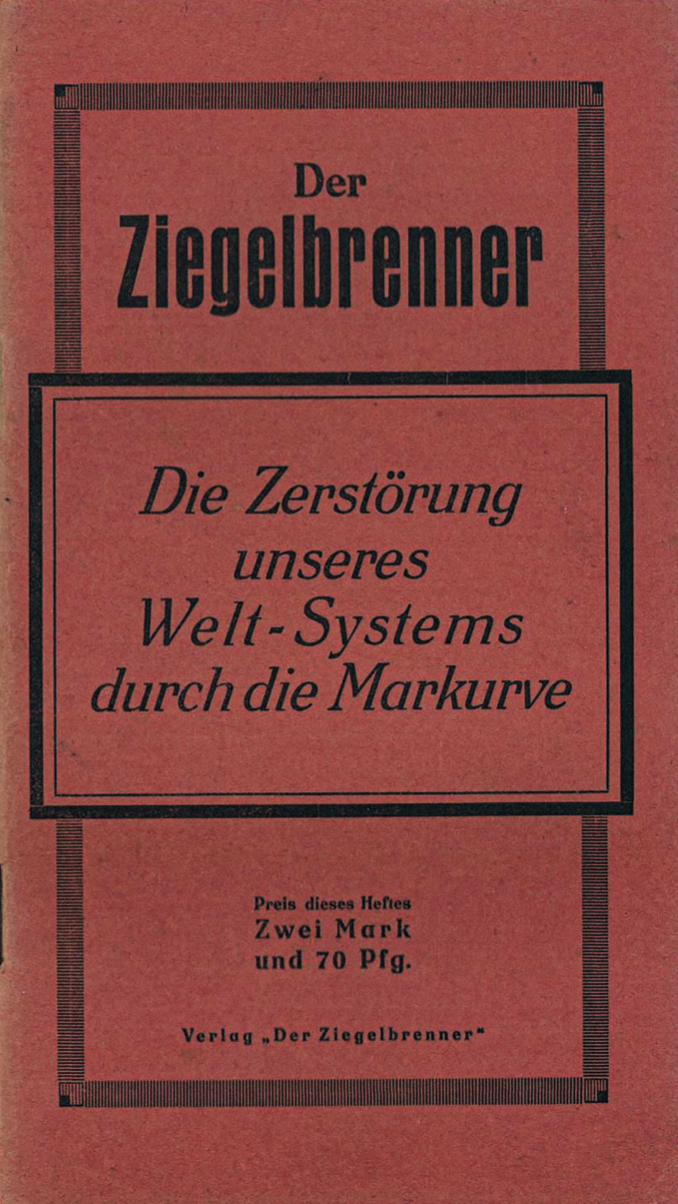
Die Zerstörung unseres Welt-Systems durch die Markurve The Destruction of Our World-System through the MARkurve [1] Translated by Fiona Vivienne
The sum of two adjacent angles[2] amounts either to more than two right angles or to less than two right angles. Two adjacent angles never amount together to two right angles. There have never been two adjacent angles whose sum was two right angles. Throughout all eternity there will never be two adjacent angles whose sum is two right angles.
The contrary assertion rests upon a fundamental error. Adjacent angles are two angles which have the vertex and one side in common, while the other two sides form a straight line. There is no straight line.
Consequently, two angles cannot lie upon a straight line. If one nevertheless attempts to construct a straight line and place two adjacent angles upon this forcibly constructed straight line, then these two adjacent angles can never together amount to two right angles. Facts do not need to be proved.
Facts cannot be proved.
If a fact must be proved, or if it can be proved, then it is no longer a fact, but a construction. A construction made evident to the senses.
Truth is truth.
Into the equation of truth no other concept can be substituted for truth. And truth no more needs to be proved, nor can it be proved, than a fact. The only thing I can do is simply recognize a fact as a fact, and make that fact recognizable, or at least comprehensible, to other people as a fact.
All mathematical proofs are superfluous; they are nothing but sophistry. Mathematical demonstrations[3] may provide satisfaction; nevertheless they remain nothing more than foolish play.
No mathematical demonstration leads to truth. Every mathematical demonstration reaches only an approximation of the truth[4], and even that only in the most favorable case. The final result achieved by means of a mathematical demonstration is not a final solution. Only with the completion of a mathematical demonstration is the assertion first made.
If that assertion is a fact, then it does not need to be proved; indeed, it cannot be proved. The demonstration was therefore a scientific plaything[5] and a superfluous expenditure of effort.
Mathematics is, in the most favorable case, nothing more than philosophy. It presupposes what has been purely thought-conceived things[6] as something given and as something present, or at least as something capable of being present.
Philosophy always remains within the realm of pure thought[7]; when it steps beyond that realm and becomes morality, it causes harm. When mathematics steps beyond the realm of pure thought and finds practical application, it likewise causes immeasurable harm. The harm that philosophy brings about, and has brought about, has been recognized. The harm that mathematics brings about[8] has not yet been recognized, because to this day mathematical results are apprehended with mathematical senses[9], and mathematical results or mathematical conclusions are viewed from the same standpoint from which the mathematical demonstration itself proceeded.
Whoever lives constantly in water cannot perceive water as water. Whoever proceeds from a fundamental error in mathematics cannot recognize the result as an error; for the accuracy of a meterstick cannot be tested by that same meterstick[10].
The straight line is the shortest distance between two points. Mathematical figures cannot be represented[11]. A drawn straight line is a body. A drawn straight line can be comprehended only by means of physical (or chemical) concepts and through physical (or chemical) laws. The mathematical straight line can only be thought, it can only be thought.[12] The mathematical straight line cannot be represented by our human mind.
No human being can form a representation of a mathematical straight line.
The contrary assertion rests upon a fundamental error. One may imagine a straight line as a ray or as a thread. One may imagine a straight line as a thread (or ray) that is exceedingly thin and exceedingly fine. One may imagine that this thread is one millionth of a millimeter thick. One may imagine that this thread is a thousand million times thinner still. Yet no human being can imagine that the thread is infinitely thin, because the human being cannot imagine infinity, but can only think infinity.
As long as the thread possesses even the slightest degree more thickness than the infinitely thin thread, it can only be imagined as a body. Since this thread can only be imagined as a body, it is also subject to all the laws to which conceived and conceivable bodies are subject. Whether I regard these laws as correct, incorrect, or erroneously formulated shall remain undiscussed here.
Every human being, even the simplest, can think God. No human being, not even the one who appears most highly developed, can imagine God. Whether the human being will ever be able to imagine God is improbable. The capacity to imagine God is bound up with the capacity to imagine infinity[13]. The human being imagines God as resembling a human being, another living creature, or some object that he knows, whose existence he has heard of, or whose form he can construct without violence[14], whose appearance he can depict in an image or in a gesture.
No human being can imagine anything that does not exist somewhere in the universe in some similar form or in some constructible form. But the human being can think everything.
The mathematical straight line, the absolute straight line, the straight line abstracted from every thing, every representation, and every thought that is not purely mathematical, no human being can imagine. He cannot imagine it because nowhere in the entire universe does a mathematical straight line exist.
There exists neither on the earth nor anywhere in the entire universe a single object that represents a mathematical straight line or in which a mathematical straight line could be demonstrated. There exists no technical instrument, neither today nor ever shall there exist one, not even in the remotest future, by means of which anyone could construct a mathematical straight line.
The famous standard meter[15], produced at enormous expense and with enormous difficulty, regarded as a triumph of technology, preserved as though it were the most precious sanctuary[16] of humanity, is not a mathematical straight line, nor does it contain a single line that is a mathematical straight line.
I have said that no mathematical straight line can be constructed or represented by means of any technical instrument. I add that no instrument, not even the most refined means (for example: a ray of light[17], a radium ray, a light vibration, a sound vibration, an ether wave, or any other physical or chemical means), can demonstrate that a mathematical straight line has been constructed or represented.
A ray of light does not form a straight line, but a curve. Every ray of light, always. Waves and vibrations likewise never form a mathematical straight line, but only curves. The standard meter is a curve and not a straight line. The standard meter measures either more than one meter or less than one meter; according to mathematical concepts, it never measures exactly one meter.
The mathematical straight line is only thought. One cannot operate with[18] something that exists only in thought; one cannot prove anything with it, one cannot measure anything with it. If one nevertheless attempts to do so, one must arrive at errors, false conclusions, and false calculations[19].
For ordinary life this may be of little importance. For science, for research, for everything that is intended to possess enduring value, this fact signifies the complete collapse of everything we know, beginning with the first theorem of geometry and ending with the world-system[20].
The sun is not where we see it. Every schoolboy knows that. But neither is the sun where the astronomer asserts that it actually is. For the astronomer measures and calculates by means of mathematical means and assertions that are untrue and must be untrue, because they are simply impossible.
The astronomer calculates in advance the exact moment at which the transit of Mercury[21] will begin. He rightly believes that he may take pride in the fact that the solar eclipse, the transit of Mercury, or any event within our solar system or another solar system occurs precisely at the time he calculated beforehand. But the event does not occur at the time the astronomer calculated. Expressed in sensory terms, slight errors and deviations are always found, which are attributed to the inaccuracy of the instruments or to various other influences, whereas they ought to be attributed to the incorrectness of mathematical principles and assertions.
Daily and nightly disturbances[22] in the universe are observed and recorded, some of them quite strange and inexplicable. Yet there are no disturbances and no accidents in the universe. Everything proceeds according to strict law[23]. If even a single disturbance were to occur anywhere in the universe, it would bring about a catastrophe for which every concept, every power of imagination, indeed perhaps even every power of thought, would fail us. Such a catastrophe can never occur, because the universe would thereby cease to be what it is, which is impossible if there is an infinity, especially an infinity of space, an infinity of time, and an infinity of things.
All disturbances that the astronomer observes, or believes he observes, do not take place. They do not even rest upon an illusion; they arise solely from the astronomer's calculation. And they must occur, because the calculation is false.
Even when, in the case of nearby events, for example the transit of Mercury, a solar eclipse, a lunar eclipse, and others, it is believed that the calculated time agrees exactly to the second, this is an illusion that is not immediately recognized as such only because the dimensions involved are too small.
If mathematical assertions were correct, then no error could ever occur, no matter how great the dimensions[24]; nor could any disturbances ever be perceived.
Disturbances resulting from optical illusion, from the imperfection of the human eye, or from technical instruments, I intentionally disregard here. Disturbances caused by unknown celestial bodies[25] I likewise do not regard as disturbances, although I hold the astronomer responsible even for these disturbances.
It is not true that there exists an absolutely empty space between the earth and the sun, or between our solar system and another solar system. It is not correct that the atmosphere comes entirely to an end at a certain height above the earth. The atmosphere, or the ether-envelope[26] (or whatever else it may be, or choose to call itself[27]) of the solar system becomes ever thinner beyond the solar system, never infinitely thin, until at last it encounters the atmosphere of the next solar system and unites with it.
Even from the most distant solar system, atoms of that most distant atmosphere reach us here upon the earth. For this reason, a ray of light never traverses an absolutely empty space. If it were possible to create an absolutely empty space, then we should be able to determine that even in such a space a ray of light does not constitute a straight line, but a curve. Even if the ray of light were nevertheless to attempt to form a mathematical straight line, the ray would still be deflected so far from its straight line by waves, vibrations, and other influences, some of which are still entirely unknown to us and others of which we only suspect, perhaps even perceive, that it could not form a straight line.
From this point onward, I shall leave all such deviations from the mathematical straight line entirely out of consideration, because they are deviations that perhaps may one day be avoided.
A ray of light never forms a straight line, nor an arc of a circle, nor an ellipse, nor a hyperbola, nor a parabola, but rather a curve possessing at least more than three dimensions. This curve cannot be demonstrated by mathematical means. The conic sections[28] come closest to it.
A mathematical straight line cannot be imagined[29]; consequently, it is likewise unfit to serve as the point of departure[30] for mathematical calculations. There is no mathematical straight line. Consequently, there is no angle. Consequently, there is no triangle (nor any polygon). Consequently, the angles of a triangle cannot together amount to two right angles. Consequently, there is no plane trigonometry.[31] Nor any spherical trigonometry.
Spherical trigonometry comes nearer to the truth than plane trigonometry. But it does not lead to the truth, because it still permits a straight line in one direction, whereas there exists no mathematical straight line in any direction whatsoever. The angles of a triangle amount either to less than two right angles or to more than two right angles, but never to two right angles.
There is no mathematical triangle because it cannot be imagined[32]. There is no mathematical triangle because there is no mathematical angle. The mathematical angle cannot be imagined, because there is no mathematical point.
Yet there must be a point, for otherwise the mathematical straight lines could not meet at that point, and consequently no angle could come into being. A point can only be conceived, it can only be thought.[33] No human being can imagine a point. There exists neither on the earth nor anywhere else in the universe a point.
The point that is drawn is a body, and the point that is imagined is a body. The straight line begins at a point and ends at a point. But it can neither begin at a point nor end at a point, because there is no point. A point is the smallest head of the smallest pin that can be produced on earth.
I reduce this little head by a factor of a thousand billion[34] and now call it k. I reduce this k again by a factor of a thousand billion and now call it kk.[35] I reduce this kk once more by a factor of a thousand billion, and then immediately once again by a factor of one hundred thousand billion.
Yet no matter how much I reduce the head of the pin, in my imagination, and in the imagination of every human being, it will always remain a body possessing three measurable dimensions. But even the smallest imaginable pinhead is still not a mathematical point. It can become a mathematical point only if it is reduced by an infinite factor. Once infinitely reduced, however, it is no longer imaginable, but only thinkable. One cannot operate with a purely conceived point. It can be regarded neither as the end point nor as the starting point of a straight line. If, then, a mathematical proposition states: A straight line is a point moving continuously in the same direction, then this proposition is true only under a very limited condition. It is true only if I say: A conceived point moving continuously in the same direction gives rise to a conceived straight line.
Since, however, there exists no point either in our world of representation[36] or anywhere in the universe, this proposition must lead to errors and false calculations, because with this purely conceived point and this purely conceived straight line I intend to measure not conceived, but existing and imaginable magnitudes or values[37].
The point is not merely an infinitely small conceived head; it is at the same time the beginning and the end of a straight line (or of an open curve). The point is therefore a place of rest. A straight line begins there and ends there. It comes to rest at that place, even if that moment of rest is the shortest duration of time that can be imagined. Time can only be thought, not imagined. Let us nevertheless attempt, for once, to imagine time here. We shall choose the smallest fraction of a second that can still be imagined, therefore one degree above the infinitely smallest interval of time. In order to imagine time, we make use of the period of the earth's revolution around the sun.
This, of course, cannot actually be done. It could be done only if the earth's orbit around the sun, or the sun's orbit around a fixed (apparently fixed, or more correctly: forcibly nailed-fast[38]) star, formed a closed curve.
But nowhere in the universe is there an orbit that is closed, so completely closed that we could imagine its closure. The mathematical point is a place where a straight line (or a curve) comes to rest for a time. The mathematical point can be nothing else, because otherwise it would not be a point. The duration of this rest may be as long or as short as one wishes. Yet however short the interval of time may be, there is always a place of resting[39], whereby I expressly assume that time can be imagined[40], whereas in reality it cannot.
The first mathematical proposition in geometry states: A straight line is the shortest distance between two points; or again: A straight line is a point moving continuously in the same direction. But mathematics does not tell us where the point comes from. It therefore employs a value, or a magnitude, or a thing that is not present at all. For the point is not present. Mathematics simply says: The point is there[41].
Anyone can say that, but I do not believe anyone. And upon this point, whose origin mathematics neither knows nor states, indeed neither can know nor state, mathematics erects its entire edifice[42]. It leaves our first and simplest question unanswered.
Every religion does the same. Nevertheless, people say that mathematics is the most exact of all the sciences because it can prove everything. But it owes us the very first proof. Without that proof, it ceases to be an exact science. Without that proof, it ceases to be a science at all. It is a speculative science, pure speculation. It presupposes as existing things that do not exist, indeed things that are not even imaginable. Mathematics works with precisely the same means as theology. Its assertions and propositions must therefore be regarded and treated in exactly the same way as theological assertions and demonstrations[43].
A point suspended somewhere cannot be imagined. Consequently, a straight line can neither begin nor end anywhere. For this reason as well, apart from more important reasons, there is no straight line. The mathematical point comes into being because one straight line meets or intersects another straight line, any other straight line, at any point whatsoever.
A mathematical point can come into being in no other way. There are no straight lines; there are only curves. One curve can meet or intersect another curve, any other curve, at any point whatsoever. But in this way a point never comes into being, not now, not throughout all eternity. A point can come into being only because the straight line comes to rest at the place of meeting or at the place of intersection.
There is no straight line. There are only curves. And a curve never comes to rest, neither at its place of meeting nor at its place of intersection. It does not come to rest even for the smallest fraction of time that can still be imagined. At best, it comes to rest only for an infinitely brief interval of time; but an infinitely brief interval of time cannot be imagined.
The curve meets the other curve, yet within that same infinitely brief interval of time it immediately hastens onward[44] again, for otherwise it could not be a curve. The meeting (or intersection) and the hastening onward take place within the same unit of time. Since the ceaselessly hastening curve does not come to rest, a point can never come into being; at the very moment when it is about to form, the possibility of its formation has already passed.
An angle never comes into being[45]; for at the very place where the angle is about to form, the hastening curve has already carried away[46] the place of meeting or the place of intersection[47]. The angle does not even come approximately into being, because the rays that would have to form the angle lie outside the dimensions that permit a plane angle or a spherical angle. Curves curve only in higher dimensions.[48]
There is no circle. Nowhere in the universe is there a circle. No human being can imagine a mathematical circle; one can only think it. No human being is capable of constructing a circle, not even with the most perfect technical means. Not even as a body (for example, a wire ring) can a circle be represented.[49]
The circle has a center, from which every part of the circumference is equally distant. This center does not exist, because there is no point. No human being is capable of indicating the center of a circle.
Mathematics, the most exact of the sciences, nevertheless indicates it; it indicates many things that are, for that very reason, not present. All diameters of a circle pass through the center; they are all of equal length. Diameters cannot pass through something that is not present.[50] Nor can they all be of equal length, because they would then have to be straight lines.
But there is no straight line. Neither are the radii of equal length. There are no radii in a circle. The circumference of a circle must lie, in all its parts, together with its center, in the same plane. There is no mathematical plane because there is no straight line. And the straight line is the prerequisite[51] for a plane. A plane comes into being when a straight line is moved in the same direction, a direction that is not parallel to the straight line's own direction
Since there is no straight line, the straight line cannot be moved. Nor can the straight line be moved in the same direction, because the same direction would be a straight direction[52], and no such direction exists.
Consequently, there is no plane. There exists no plane anywhere in the universe. Even the smallest part of a surface that can still be imagined will never be a plane, but always a curved surface. Upon a surface that is incorrectly designated as a plane, although a plane can never exist, any number of lines, that is, imaginable lines, may be drawn.
Yet no matter how these lines are drawn, not one of them, not even in its shortest extent, will ever be a straight line. It will always be a curve, from whatever side one may view the line that has been drawn.
Since there is no plane, the circumference of the circle cannot lie, in all its parts, in the same plane. In reality, the circumference of the circle, if viewed from the side, that is, in such a way that according to mathematical assertion it ought to appear as a straight line, forms a curve. And since the circumference of the circle is a curve in all its parts, even in the smallest imaginable segment, a circle can only be constructed by force[53].
The circumference does not close; rather, the rays that are supposed to form the circle pass one another by[54]. There is no possibility of bringing these rays, which pass one another, together at a point in order to close (or meet). The rays hasten into infinity.
If, nevertheless, an attempt is made to construct the circle, the result must be an untruth[55]. There is no circle. But mathematics thinks a circle, represents it as an elegant drawing, and calculates it.
The circle is a curve. The circle is not a closed curve. The circle is not the shortest line enclosing the greatest area. The circumference of the circle does not return into itself. It cannot return into itself because it is a curve. A curve hastens onward.
The circumference of the circle does not meet itself. The circumference of the circle does not intersect itself. The circumference of the circle cannot close. There is no mathematical circumference.
The ellipse likewise cannot be represented.
The parabola likewise cannot be represented.
The hyperbola likewise cannot be represented.
No mathematical figure can be represented.[56]
Every mathematical figure can only be thought. The mathematical figure is not present[57]. What is not present cannot be measured. What cannot be measured cannot be calculated. Consequently, mathematics cannot calculate. The mathematical operation[58] is a purely philosophical operation. Its result is therefore likewise philosophical. Philosophy can never produce certainty. Consequently, mathematics can never produce certainty. The mathematical result is therefore never certainty. It is always merely an approximation[59]. The approximation may come very close to the truth. It never reaches the truth. The truth is not calculated. The truth is recognized[60].
The line cannot be divided. It has neither beginning nor end. Neither does it have a point, because there is no point. The line may be met, but never cut.[61]
The duration of the meeting lies between infinity and the first degree of that shortest interval of time that can still just be imagined. At the very moment when the meeting is supposed to take place, the line has already hastened onward again. The place of meeting[62] can, in the most favorable case, be only an approximate point, never a point.
The line is not a straight line; it forms neither a circle nor an ellipse. Nor does it ever assume the form of a hyperbola or the form of a parabola. There is no hyperbola, nor is there any parabola. The conic sections are constructions made by force.[63] The line is a curve possessing an unchanging continuity of its course. This continuity[64] lies between infinity and that shortest interval of time that can still just be imagined.
This curve never comes to rest. This curve can never form a point. This curve can never be computed, calculated, measured, or represented by means of mathematical propositions and mathematical means. This curve can be observed and recognized only by means of chemistry and physics.
But it can be neither calculated nor measured by chemical or physical means.[65] This curve cannot be measured or calculated at all, because it is restless, because it is continuous. Let chemists and physicists conduct experiments. This curve is called the Markurve. I could neither find nor discover this curve, because it is there[66]. I can only report on it.
Mathematics does not recognize the true nature of the circle, yet it nevertheless attempts to calculate its values. It resorts to describing the circle as a polygon with infinitely many sides.
A circle can never be a polygon, even if the number of its sides were infinite. A circle always remains a circle; a polygon always remains a polygon.[67] Since there is no straight line, there can likewise be no polygon. The calculated value is an approximate value. But there is only one value, and that is truth. There is no approximate truth[68]. For an approximate truth is not truth, but an untruth.
Mathematics demands belief, just as theology does, or like an inferior religion. It demands that a person believe there is a point.
I do not believe that there is a personal God who rewards and punishes like a constable[69]; but neither do I believe that there is a point. There are no parallels. No two lines run parallel alongside one another even for the smallest interval of time that can still be imagined. All propositions concerning parallels are invalid.
There is no sphere. Nowhere in the whole universe is there a sphere[70]. Not a single celestial body is a sphere for even the smallest imaginable interval of time. The dimensions of the sphere cannot be calculated. All mathematical propositions concerning the sphere are erroneous. Nowhere in the whole universe is there a sphere.
Nowhere in the whole universe is there an oblate sphere. No human being is capable of producing, imagining, or drawing a sphere or an oblate sphere. But every human being can (perhaps) think a sphere or an oblate sphere.
Everything visible and everything imaginable that is found upon the earth has the form of an egg. Everything that is found in the universe has the form of an egg. The sun has the form of an egg. The moon has the form of an egg. Venus has the form of an egg. Sirius has the form of an egg. Every celestial body[71] has the form of an egg.
The title of this report must, in its entirety, read:
The Destruction of All Ideas and Concepts Which We Have Held Until Today Concerning Our World-System, Both as a Whole and in Its Individual Parts, through the Recognition of the Markurve.[72][73]
Whoever recognizes the Markurve no longer sees all the things of the world with the imperfect eye of the human being. He sees the things and the processes in the world as they truly are.
The day on which humanity recognizes the Markurve and its significance is the midday[74] of the developmental history of humanity. The inhabitants of other celestial bodies had to arrive, and must arrive, at the truth by the same false paths by which we had to arrive. For their brains[75] and senses are the same as ours.
The sun stands at the center of the universe. The earth stands at the center of the universe. The moon stands at the center of the universe. Sirius stands at the center of the universe. Every body stands at the center of the universe. I stand at the center of the universe.
I alone.[76]
Only I stand at the center of the universe, because only I can think: I. No other human being can think that for me. Therefore no other human being can stand at the center of the universe.
I think: I. I think: I; and I am infinite so long as I think: I.
I am indestructible in my essence.
I am original.[77]
Only my condition can change, can alter.
I am imperishable.
I am immortal.
I think: I.
I am.
I am from eternity to eternity.
I think: God.
I am God.
How else could I think: God?
I think: I.
I am unique.
I am infinite.
I am.
I created this world for myself when I recognized it. The world belongs to me because I recognize it.[78]
Written down in two days in the autumn of 1919. Written while in flight as a persecuted high traitor, in flight from mosquitoes.
-Marut.
[1] "Markurve." The German Markurve has been left untranslated throughout this edition. It is Ret Marut's own coined term et functions as a central concept rather than an ordinary compound noun. Translating it as "MAR-Curve," "Mar-Curve," or "Market Curve" would either over-explain or distort the author's intended ambiguity.
[2] "Adjacent angles." The German Nebenwinkel is the standard geometrical term for adjacent angles. The conventional English mathematical equivalent has been retained rather than translated literally as "neighboring angles."
[3] Marut repeatedly uses the verb beweisen ("to prove") throughout this opening passage. In the final sentence, Beweisführungen has been rendered as "mathematical demonstrations" rather than repeating "proofs" once more. This preserves the distinction between the act of proving and a formal demonstration while maintaining the cadence of the English prose.
[4] The German annähernd die Wahrheit has been translated as "an approximation of the truth." The definite article has been retained because Marut writes die Wahrheit , not simply Wahrheit.
[5] The German wissenschaftliche Spielerei has been translated as "scientific plaything." Alternatives such as "scientific game" or "academic exercise" I rejected because Spielerei suggests intellectual play carried on for its own sake, with an undertone of frivolity.
[6] "Purely thought-conceived things." The compound Rein-Gedachtes has been translated as "purely thought-conceived things" rather than "abstractions." Marut's wording emphasizes what exists only in thought, so the translation preserves that distinction.
[7] The German reine Denkwelt has been translated as "the realm of pure thought." Although literally "pure thought-world," the English I chose preserves Marut's distinction between the world of thought and the world of experience while remaining idiomatic.
[8] The verb anrichten has been translated consistently as "brings about" when paired with Unheil ("harm," "calamity"). This preserves Marut's repeated phrasing across both philosophy and mathematics.
[9] The phrase mathematischen Sinnen has been translated literally. Its unusual formulation appears deliberate and has therefore been preserved.
[10] The German Meterstab has been translated as "meterstick" rather than "measuring rod." Marut's example is specific rather than generic, so the translation reflects his specificity.
[11] The German vorstellen and Vorstellung distinguish between thinking something ( denken ) and forming a mental representation of it. Accordingly, vorstellen has been translated as "imagine" or "form a mental representation," while denken remains "think." Preserving this distinction is one of the central principles of this translation.
[12] Repeated "it can only be thought." Marut writes: " sie kann nur er-dacht werden, sie kann nur ge-dacht werden. " His repetition has been preserved exactly. The unusual hyphenation in the original is a typographical emphasis so it has not been reproduced in English.
[13] "Infinity." The distinction between imagining infinity and thinking infinity follows the German exactly. No attempt has been made to smooth or reinterpret the repetition, since it forms part of Marut's philosophical vocabulary.
[14] The German nicht-gewaltsam konstruieren has been translated literally. Marut's adjective recalls his recurring criticism of concepts that are "forcibly constructed," a phrase already established earlier in the text.
[15] "Standard meter." The German Normalmeter has been translated literally as standard meter. It refers to the physical prototype meter standard, not to a measuring device in general.
[16] Marut's Heiligtum has been retained as sanctuary rather than "relic" or "sacred object." His religious language is deliberate and anticipates his repeated comparisons between mathematics and theology.
[17] Lichtstrahl is translated consistently as 'ray of light' throughout the work. Marut's subsequent discussion depends upon treating light as a physical phenomenon rather than as a mathematical abstraction.
[18] The German operieren has been translated literally. Here, Marut is referring broadly to the use of mathematical procedures rather than merely to calculation, so the English preserves that breadth.
[19] I translated the German Fehlrechnungen as “false calculations” rather than "miscalculations." The latter suggests accidental error, whereas Marut was arguiung that the error is inherent in the mathematical premises themselves.
[20] "World-system." Welt-System continues to be translated with the original hyphenation preserved in English, reflecting the form used by Marut in the title.
[21] The German Merkurdurchgang has been translated as transit of Mercury, the established English astronomical term.
[22] Störungen has been translated consistently as 'disturbances'. I rejected alternatives such as "irregularities" or "anomalies" to preserve Marut's repeated terminology.
[23] I have translated streng gesetzmäßig as 'according to strict law' as Marut is asserting absolute regularity in the universe rather than merely conformity to natural laws in the scientific sense.
[24] Dimensionen has been translated literally. Marut is referring to the scale of the phenomena under observation rather than to mathematical dimensions in the abstract.
[25] "Celestial bodies." The German Weltkörper has been translated as celestial bodies, the conventional English astronomical term, while preserving the scope of Marut's argument.
[26] Aetherhülle has been translated literally as 'ether-envelope.' No attempt has been made to modernize the scientific terminology, as Marut was writing within the conceptual vocabulary of 1919-1920.
[27] The parenthetical phrase oder was es sonst sein mag oder heißen will has been translated closely. Marut briefly personifies the term with his characteristic irony, and I felt this English preserves his tone without expanding it.
[28] "Conic sections." The German Kegelschnitt has been rendered by its conventional mathematical equivalent, conic sections.
[29] Throughout this section, vorstellbar continues to be translated as 'can be imagined,' to preserve Marut's distinction between what may be thought (gedacht) and what may be imagined or represented (vorgestellt).
[30] "Point of departure." The German Ausgangspunkt has been translated as point of departure, to preserve Marut's metaphor of mathematical reasoning proceeding from an initial foundation.
[31] The repeated Infolgedessen has been translated consistently as 'consequently.' Marut deliberately constructs these sentences as a chain of deductions, so his repetition is retained.
[32] The German vorstellen continues to be translated as 'imagine,' to maintain Marut's consistent distinction between what can be imagined and what can only be thought.
[33] "Conceived" and "thought." Marut again distinguishes between erdenken ("to conceive" or "to devise in thought") and denken ("to think"). The distinction has been preserved wherever English permits it.
[34] The German Tausendmilliardenfache has been translated literally as a factor of a thousand billion. The original numerical scale is preserved rather than converted into modern scientific notation.
[35] "k and kk." Marut introduces these symbols himself. They have been retained exactly as they appear in the original.
[36] "World of representation." The German Vorstellungswelt has been translated literally. Rendering it simply as "imagination" here would lose Marut's distinction between the world of thought ( Denkwelt ) and the world of mental representation ( Vorstellungswelt ).
[37] "Magnitudes or values." Größen oder Werte has been translated literally. Marut repeatedly pairs these terms, so the pairing is preserved consistently throughout the translation.
[38] "Forcibly nailed-fast." The phrase gewaltsam festgenagelten has been rendered closely, as the unusual wording is deliberate et echoes Marut's recurring criticism of concepts that are imposed by force rather than recognized as facts.
[39] "Place of resting.” Ruheplatz has been translated literally. Marut's metaphor is central to his criticism of the mathematical point and has therefore been preserved.
[40] "Can be imagined." The distinction between denken ("to think") and vorstellen ("to imagine") continues unchanged. Probably did not need a third footnote on it but Marut's argument repeatedly depends upon this distinction, so I did want to point to that again.
[41] "The point is there." The German Der Punkt ist da has been translated literally to preserve Marut's deliberately abrupt formulation.
[42] The German Gebäude has been translated as edifice rather than "building" because Marut is speaking metaphorically of the entire structure of mathematics.
[43] As elsewhere in this edition, Beweisführungen is translated as demonstrations, preserving Marut's distinction between a proposition ( Satz ), an assertion ( Behauptung ), and the process of proof ( Beweisführung ).
[44] "Hastens onward." The verb eilen means "to hasten" or "to hurry." I preferred it over the weaker English phrase "moves on," to preserve the sense of uninterrupted motion in Marut's argument.
[45] The German entsteht has been translated consistently as "comes into being," rather than alternating between "arises," "is formed," or "originates." Marut repeatedly employs this verb as part of his logical sequence.
[46] "The curve has already carried away..." The German reißt ... schon wieder fort has been translated closely. Marut personifies the curve as carrying away the very location at which an angle might otherwise arise.
[47] "Place of meeting" / "place of intersection." The compounds Treff-Ort and Schnitt-Ort have been translated literally. His repetition is deliberate, so I have preserved it.
[48] "Curves curve..." The original reads Die Kurven kurvieren ... The tautological wording has been preserved. Although it is unusual for English, it reflects Marut's intentionally emphatic style.
[49] The German darstellen is translated as "represented," maintaining consistency with the earlier discussion of the mathematical straight line and avoiding unnecessary variation in terminology.
[50] "Present." The German vorhanden has been translated consistently as "present" rather than "existent" as Marut repeatedly contrasts what is present with what is merely conceived .
[51] Voraussetzung has been translated literally as "prerequisite", preserving Marut's logical sequence of dependency.
[52] The phrase geradlinige Richtung has been rendered literally. Although it is slightly unusual in English, it reflects Marut's insistence that even direction depends upon the existence of the straight line.
[53] The German gewaltsam konstruiert has been translated consistently with earlier occurrences as "constructed by force." The recurrence of gewaltsam is a deliberate feature of Marut's vocabulary, so it has been preserved.
[54] The verb aneinander vorüber eilen has been translated as "pass one another by" rather than simply "miss one another" as the image of uninterrupted movement is central to Marut's argument.
[55] "An untruth." The German Unwahrheit has been translated literally. Marut does not write "error" ( Irrtum ) here, but its deliberate opposite, truth / untruth, so the distinction has been maintained.
[56] The German darstellen continues to be translated consistently as "represented," to preserve Marut's distinction between what may be thought and what may be represented .
[57] Vorhanden continues to be rendered as 'present,' maintaining the terminology established earlier in my translation.
[58] The German mathematische Operation has been translated literally as this term is broader than "calculation" and encompasses mathematical procedure generally.
[59] Annäherung has been translated consistently as 'approximation,' to preserve his recurring distinction between approximation and truth.
[60] The opposition between berechnen ("to calculate") and erkennen ("to recognize") I retained exactly as Marut's philosophical argument depends upon maintaining this distinction without paraphrase.
[61] "The line may be met, but never cut." The German Die Linie kann getroffen, nie aber geschnitten werden has been translated as literally as possible. Marut deliberately contrasts treffen ("to meet," "to strike") with schneiden ("to cut," "to intersect"), so that distinction is preserved.
[62] Treff-Ort continues to be translated consistently as place of meeting, maintaining the terminology established in the earlier sections.
[63] "Constructions made by force." The German gewaltsame Konstruktionen has been translated consistently with earlier occurrences of gewaltsam . This edition will use the same terminology throughout whenever Marut characterizes mathematical objects as imposed rather than recognized.
[64] Stetigkeit has been translated as "continuity," to preserve Marut's technical vocabulary. The term recurs throughout the essay and will remain unchanged.
[65] "Computed, calculated." Marut uses both errechnet and berechnet . Rather than collapse them into a single English verb, I have translated it as 'computed' and 'calculated,' to preserve his deliberate doubling of the terms.
[66] The closing sentence, weil sie da ist is translated literally as "because it is there." Marut's argument rests on the distinction between discovering something and recognizing something already present.
[67] Vieleck continues to be translated as polygon, the standard English mathematical term.
[68] Marut distinguishes sharply between an approximate value ( angenäherter Wert) and truth. The phrase angenäherte Wahrheit has therefore been translated literally as "approximate truth," to preserve the force of his argument that truth admits no degrees.
[69] Büttel has been translated as "constable" rather than "policeman" or "beadle" because Marut is invoking the older image of an officer who enforces authority and punishment.
[70] * Kugel* is rendered consistently as "sphere." Although the word can denote both a mathematical sphere and a physical globe, Marut is attacking the mathematical ideal while simultaneously applying it to celestial bodies.
[71] “ Weltkörper ” is translated consistently as "celestial body" throughout the edition.
[72] Erkennen / Erkenntnis are translated consistently as recognize / recognition.
[73] "Ideas and concepts." V orstellungen und Begriffe has been translated literally.
[74] Mittel-Tag is rendered literally as "midday."
[75] Hirne is translated literally as "brains."
[76] "Center of the universe" Mittel-Ort des Weltalls is translated literally.
[77] The German ursprünglich has been translated as "original." Although the word may also suggest "primordial" or "originating," Marut's terse predicate needed to be preserved without amplification.
[78] "The world belongs to me because I recognize it." Erkennen remains "recognize" throughout.