M Rizky Sasono
Anarchism and Democracy in Indonesia: An Underground Perspective
October, 2022
This chapter scrutinizes musical narratives that emphasize the underground as a political space that strives for ‘democracy’, particularly the processes of democracy during the period of political reform known as Reformasi in Indonesia 1998, and the notion of democracy in the domain of do-it-yourself (DIY) music production in twenty-first-century Indonesia. These narratives illuminate the ways in which anarchism is manifested in the sphere of the underground and what it means to be democratic. I employ the term ‘underground’ as an overarching setting of musical cases where anarchism is identifiable. Rather than a top-down explication of anarchism and democracy, I opt for a descriptive narrative from below – accounts of those who are exponents of the underground, aesthetically and politically. Hence, the title of this chapter: ‘an underground perspective’.
The first section traces underground activism against President Suharto’s New Order regime in the period leading up to ‘Reformasi’ – music was central to resistance against the authoritarian regime. Political protests during the late-New Order (1994-1998) were characterized by the existence of underground organizations, many of which were led by student activists (Lane, 2008; Lee, 2016). However, this narrative of students as agents of change obscures the history of non-students who participated in and contributed to the escalation of pressures that forced President Suharto to resign and gave hope for democracy in Indonesia. It eliminates the participation of marginalized groups whose struggles were not limited to student-organized protests, but for whom struggle became part of their everyday lives. Here, the narratives of anarchism and democracy in the late- New Order period are focused on the underground struggles of street buskers (pengamen), as some of the most oppressed members of society.
The term ‘democracy’ generally revolves around power, its entitlement and how power is appointed among, or delegated to, the people. In the ideal (representative) democracy, institutions such as the state serve the rights of its citizens, and these rights are not dependent on the policies of the current government. Despite their emphasis on rights and the state, discourses of democracy also cross over with libertarian socialist anarchism in their demand for freedom and social equality (Rooum, 2014, p. 14), though anarchists usually strive towards participatory democracy, rather than representative forms. In the case of Indonesia, however, Suharto’s ‘Demokrasi Pancasila’ failed to serve the ‘sovereignty of the people’, and the 32 years of the New Order regime (1966-1998) decayed into growing feudalism and fascism (Vltchek, 2012, pp. 38-39). This highlights the anarchist critique of ‘democratic’ state systems whose sovereignty is, in the words of Bakunin, ‘wholly fictitious’ and which ‘continue to serve as the instrument of thoughts, wills, and consequently interests not [their] own’ (Bakunin, 1970 [1882], p. 40). To counter the mischiefs of statist or representative democracy, anarchists prioritize concepts such as horizontalism and collectivism, stressing principles of autonomy, voluntary association, self-organization, and mutual aid (Graeber, 2009, p. 105). The development brought by post-anarchists sees anarchism move beyond classical philosophy towards more practicable, grounded forms of anarchist theory (Lazaar, 2018, p. 160), and this anarchism also widens the main objective of opposing power beyond merely the state or economic power, incorporating all forms of power exercised by one group over another (May, 1994, p. 168). In moments of social upheaval, such as the protests leading to Reformasi in Indonesia, themes central to democracy and anarchism come to the fore, and, crucially, they take on particular meaning for the people in their daily lives. The example of pengamen street buskers in and around the 1998 protest movement is an interesting example of this.
The second section of this chapter revolves around post-anarchism in the field of cultural production, examining a manifestation of ‘audio anarchy’ against the backdrop of early-twenty-first-century neoliberal Indonesia. DIY music production can be understood as a response to the dominance of the capitalist music industry and its power over musicians and popular tastes. As such, DIY production endeavors for control over the means of production, and control over means of representation, through ‘a vision of a desired society which is participatory and democratic’ (Shantz, 2010, p. 164). Here, I will be focusing on Yogyakarta-based label Yes No Wave (YNW), who practice alternative forms of music production, and Senyawa, an experimental-punk group closely associated with the label, who strive for decentralization in their DIY music production. The socio-history of YNW and Senyawa exemplifies underground values of anti-capitalism and the democratized political economy of DIY. While DIY processes of production, distribution, and consumption have been understood as counter to capitalism, not all DIY music making can be considered as anarchist (Jeppesen, 2018). In this regard, the investigation into the political economy of the musicians discussed includes, and contributes to, the idea of DIY-as-anarchism, which in Jeppesen’s view must include oppositional content, aesthetic experiments, community practice, anti-hierarchical organizational structures, prefigurative processes, anti-capitalist economics, and direct action (Jeppesen, 2018, p. 207).
SPI Buskers’ Union and the Sound of Democracy, 1998
This section focuses on the involvement of pengamen during the escalating Reformasi protests in Yogyakarta 1998. ‘Pengamen’ is an overarching term to describe street buskers in urban centers in Indonesia – anthropologist Max Richter describes pengamen as being ‘like beggars … humble street musicians slinging battered colorfully decorated guitars as they roam through the city in search of spare change’ (2013, p. 54). However, this is open to challenge as the word ‘ngamen’ is also used to describe all practices of music performances in exchange for money, not limited to a group who are economically marginalized. But, while such definitions are often incompatible with the individual trajectory of street buskers, the emphasis on economic and political marginalization is important – as anthropologist Jeremy Wallach puts it: ‘pengamen represent the failure of the Indonesian government to provide economic security for all its citizens’ (2008, p. 179). Pengamen, as an umbrella term of street musicians, is also qualified to indicate a certain hierarchy according to musical tropes and aesthetics. For example, street artists of seniman jalanan are considered to possess better musical skills and as having more aesthetic privilege than pengamen, who often play established songs from known artists. Another group that falls into the street buskers category are street punk kids or ‘anak punk’ – one component of the diverse and ambiguous Indonesian punk scenes, alongside artists, student activists and assorted ‘middle class’ dropouts (Martin-Iverson, forthcoming). However, these categories are often blurred and meshed as interactions between these sub-groups of street dwellers are inevitable. This is the situation described by Ahmad ‘Thole’, a former pengamen who came from East Java to Yogyakarta in 1998 in search of better musical opportunities. In his early period in the new city, he dressed in the punk outfit of boots, jean jacket, and red dyed hair. However, he is reluctant to consider himself as punk, despite his active interaction with anak punk in his hometown of Surabaya, and his on-off interaction with anak punk in other East Javan cities. Suggesting the musical hierarchy, noted above, Ahmad considers himself as a street busker or pengamen to emphasize his more advanced level of musicality compared to his punk counterparts. ‘I am not anak punk, but my lifestyle was’, he said, pointing to his abnormal way of life spent mostly on the streets.
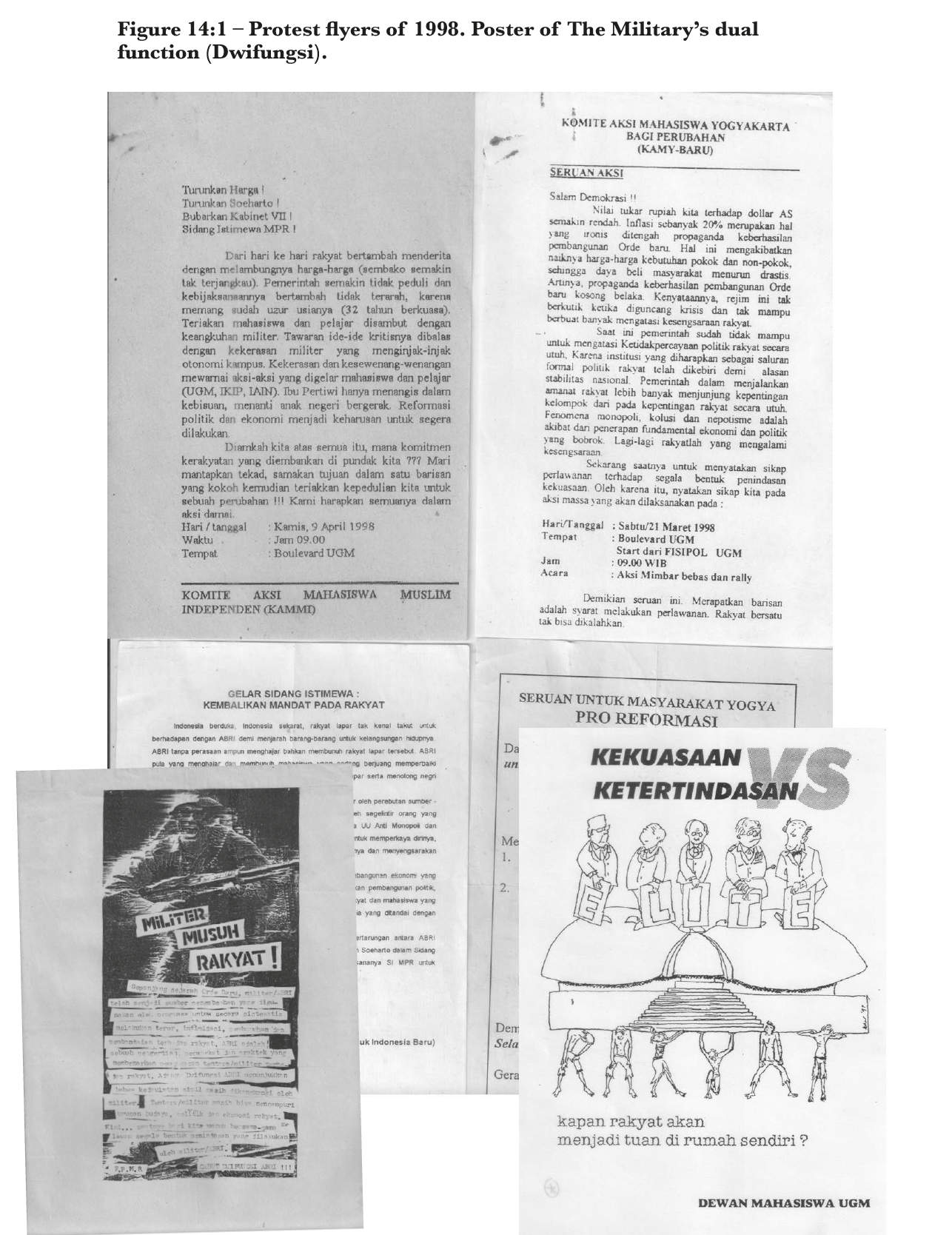
Aside from being labeled as a social nuisance, pengamen, beggars and, to a large extent, street vendors are susceptible to violence from the forces of authority. They are considered as disrupting security (keamanan) and order (ketertiban) and are therefore subject to oppression from the military state apparatus, specifically the troops and officers. The military under President Suharto’s New Order regime held an institutionalized role and developed an ideological and legal framework to support a formal role in political affairs called the ‘dual function’ or dwifungsi (Kingsbury, 2003, p. 10; Elson, 2001, pp. 270-273). Dwifungsi held that the military had a ‘sociopolitical’ function as well as a defense function – the sociopolitical function was to serve as a watchdog over social activities, with the military monitoring every effort and activity of the people in the field of ideology, politics, and economics. Through the establishment of the Command for the Restoration of Security and Order (Koordinasi Keamanan dan Ketertiban, or Kopkamtib) in 1988, the military intruded into the social lives of the people and exercised broad and loosely defined security, intelligence, and interrogation functions to identify suspected sources of threat to the state (Hill, 1994, p. 24). Military troops and officers would often be found in the same public spaces favored by pengamen, such as at bus stations, inside commuter buses and trains, in the market, or in red light districts. Under dwifungsi, the military exercised coercive control over these spaces. On an East Java inter-city bus route, for example, the military administered a curfew on buskers. If found playing beyond certain hours, their instruments would be confiscated. As Ahmad reports, there have been accounts of pengamen’s musical instruments being destroyed by military personnel, and one pengamen musician was lucky to escape being shot (interview with the author, 2019).
The conflation of the state and its security and order in New Order Indonesia is an example of state violence, and the state’s disregard for the protection of the economically oppressed. For pengamen, the vulnerability of the urban poor and the oppression from the state, channeled through the military, became a subject of concern in their music scene. The anonymously written song ‘Mengadu Pada Indonesia’ [‘Complaining to Indonesia’] depicts the state as being far removed from the ideal form of democratic society that ought to protect its citizens, and the pengamen plead to an imagined beneficent ‘Indonesia’ over their military’s violence whose power is ‘bigger than God’:
Tentang ulah aparatmu yang lupa waktu.
Oh, tentu kamu tahu.
Bayangkan ulah mereka,
Mereka sok berkuasa.
Mereka suka menyiksa.
Bahkan membunuh sudah biasa.
Aku melihat tindakan apparat.
Tembak sana tembak sini sampai ke akhirat.
Sialan (sialan) aparat tuh setan.
Kuasanya melebihi kuasanya Tuhan.
trans.
[Today I purposely complain to you my Indonesia,]
[About your troops who have forgotten about time.]
[Oh, you know that one.]
[Imagine, their behavior,]
[They are playing the authoritarian.]
[They like to torture.]
[Even killing people is normal.]
[I see troops in action.]
[They shoot here and there until (we) go heaven.]
[Damn (damn) troops are the devil.]
[Their authority is bigger than God.]
(As sung by Ahmad ‘Thole’)
The song develops an anarchistic undertone through sound. This musical narrative of power and oppression by the state became a vernacular expression that was passed on among pengamen – a consensus of embodied knowledge that was familiar to the urban poor. The expression of dissatisfaction with the militarist state became a tuneful 1-3-5 musical piece whose sound was intended to be as catchy as possible, while still getting the message across. The chords and melody were simple enough to be learnt by the least skilled street musicians, even for anak punk who were deemed to be at the bottom of the musical hierarchy. As Ahmad notes, the song became a popular sarcastic depiction of state violence, sung widely by street musicians, including those under the umbrella organization of Malioboro Streetside Singing Group art communities (Kelompok pengamen Jalanan Malioboro) in Yogyakarta’s city center, and the loosely organized large concentration of anak punk in Mojokerto, near Surabaya in East Java (interview with the author, 2019).
Criticism of the military was a common theme in the years leading to Reformasi. The slogan Aparat Keparat! (Fuck the Troops!), something equivalent to All Cops Are Bastards (ACAB), was often used, albeit with a lack of detailed knowledge of the systematic violence underpinning it. Some pengamen, however, were more politically aware and engaged in organizations such as the groups of street artists and buskers who call themselves Sarikat Pengamen Indonesia (Indonesia Union of Buskers), founded in September 1994 in Yogyakarta. Abbreviated as SPI, the group was born out of anger about lack of access to mainstream politics. SPI was proactive in politically educating their urban poor counterparts, including pedicab drivers, street vendors, and other people who earn their living from the informal economy on the streets. SPI believed that social issues such as poverty and unemployment are systematic problems and the result of government policy. They were against the system and positioned themselves alongside their fellow people, or ‘rakyat’ – ‘the common people, non-elites, the illiterate’ (Anderson, 1990, p. 61), ‘those who occupy the lower stratum of the political and economic structure, the poverty-stricken, marginalized, and those who have been pushed aside’ (Weintraub, 2006, p. 412).
SPI’s political movement was known to be affiliated with the Committee of the Peoples’ Struggle for Change (Komite Perjuangan Rakyat untuk Perubahan – KPRP), an organization of leftist students (Human Rights Watch, 1998). Whereas other student pro-democracy groups were relatively elitist, KPRP was known as the radical pro-democracy group that opened-up for members other than students, such as artists, labor representatives, and groups from the urban poor, including activists from underground music communities. In the years leading to Reformasi, members of the punk communities were conspicuously engaged in activism. Groups such as the anarchist hardcore crust-punk band Blackboots, political hip-metal band Teknoshit, and the underground artists who formed the radical art collective Taring Padi in 1998, are a few punk and underground examples of those were engaged in activism at this time, notably in association with KPRP. Daru Supriyono, a punk enthusiast who traversed the punk and activist scenes, was a student at Atma Jaya University and an active participant in two renowned underground music communities in Yogyakarta, Realino Punk Community and Last Palm, and was also an active member of KPRP. As part of a larger collective circle of activists, he has helped organize labor organizations with groups such as The National Forum of Labor Struggle (Forum Nasional Perjuangan Buruh Indonesia – FNBI). The solidarity among labor activists was based on Daru’s understanding that ‘we are all workers’ (interview with the author, 2020). For Daru and his anarchist punk community, and for their labor counterparts, the common struggle was to end the political and economic oppression carried out by Suharto’s regime. As articulated Widji Thukul, a poet and activist who was declared missing in 1998, with many believing that he had likely been killed by the state: ‘If an opinion is rejected without consideration, criticism is prohibited. Voices are silenced without reason … there is only one word: Resist!’ (Thukul, 2014 [1986]).
From the SPI’s perspective, to resist the policies that created inequities, activists needed to mobilize the people to think critically and systematically. Despite the dislike of the elite status of students, who were regarded as contributing to the problematic representations of poverty and marginalized populations, SPI reached out to students for assistance. As Ahmad recalled:
Students did not share experiences with the ‘people’, and yet they had the knowledge, skills, and resources to fight systems of oppression. If the students could teach the people the knowledge and skills needed and provide resources and support, the people would have a better chance for success in their struggle. (Interview with the author, 2019)
As part of this wider network struggling for reform, the SPI buskers’ union became an active political entity. They organized discussions of ideology and politics, inviting student activists to present the material in a language that urban poor participants could understand. In solidarity, they often supported protests organized by other subjugated people, such as farmers and labor organizations. Their contributions to student-led mass protests reflected their active approach to the struggle of Reformasi and their position as agents of democracy. However, their distinctive, and anarchistic, contribution was as musicians. Their musical aesthetics signified the urban poor’s struggle for democracy from below – these embodied experiences were channeled through sound aesthetics, transforming everyday experience under military oppression to the musical sphere. Their music discloses deeper critiques of state violence carried out by the New Order regime, while presenting an aesthetic that is deeply rooted in their oppressed status as pengamen.
An example of SPI’s performativity was their involvement in a three-day protest organized by different activist groups in Yogyakarta in April 1998. During the protest SPI performed four songs (audio documentation of protest, 1998), one of which was entitled ‘OTB Jare Suharto’ [‘OTB Says Suharto’] (OTB, Organisasi Tanpa Bentuk, literally translates as ‘formless organization’ but is better understood as ‘illegal organization’). Following the pengamen trope of ‘covering’ other people’s music, but expertly changing the lyrics to fit the context of their everyday experience, the melody borrows from a hit song that was performed by child singer Enno Lerian, entitled ‘Si Nyamuk Nakal’ (‘The Naughty Mosquito’). Penned by prominent children’s song writer, Papa T Bob, the song was a big hit in 1992, six years prior to the protest. SPI’s presence at the protest was significant because, in this domain of students, they performed what it meant to be the oppressed urban poor. Some of the protest participants responded in familiarity to the tunes, but most applause was given to each line and its recontextualization to the struggle. Their performance was greeted with an exceptional response from other protest participants for several reasons: first, the contextuality of the lyrics; second, the aesthetics, blending the familiarity of a popular tune with unexpected content; third, the subject of performance, and its representation of the people by the people in this least-mediated (if not completely un-mediated) performance.
Banyak sawah yang digusur,
Karena pejabat pada kolusi
Banyak buruh yang menuntut
Karena gaji tak mencukupi
Banyak buruh yang menuntut
Banyak petani demonstra
Apa rakyat cuma dianggap
sampah?
Dimanakah kebenaran?
Dimanakah keadilan?
Apa rakyat perlu turun ke jalan?
Banyak paguyuban baru
Menjelang pemilu Sembilan tujuh
Kita butuh berorganisasi
tapi kenapa diintimidasi
Dimanakah hak-asasi
Dimanakah demokrasi
Apa kami perlu ber-revolusi?
Tong Kosong Tut-Tut-Tut- Tut-Tut
Masalah Moko Harmoko
Klir-Nuklir BJ Habibie
OTB Jare Soeharto
trans:
[‘“Illegal Organization” says Suharto’]
[(There are) so many rice fields confiscated,]
[because the bureaucrats are in collusion.]
[So many laborers are protesting,]
[because their salary is inadequate.]
[(There are) so many labors who demand,]
[(there are) so many farmers who protest.]
[Do they consider people as trash?]
[Where is virtue?]
[Where is justice?]
[Or do we need to descend to the streets?]
[(There are) so many organizations,]
[Leading to the ‘97 elections.]
[We need to be in an organization,]
[but why do we get intimidation?]
[Where is human rights?]
[Where is democracy?]
[Or do we need to have a revolution?]
[Empty can Tut-Tut-Tut-Tut-Tut.]
[Troubled Moko Harmoko.]
[Clear-nuclear BJ Habibie.]
[OTB (illegal organization) says Soeharto.]
(As performed by Sarikat Pengamen Indonesia)
The verses of the song describe the circumstances that generated discontent among laborers and farmers, as represented in the speeches, chants, and songs of ‘98 activists. Land was frequently confiscated under the state’s macro-economic development program (Hill, 1994, p. 85), and labor issues were amplified after the political conspiracy that led to the death of activist Marsinah, in Sidoarjo, East Java in 1993 (Kurniasari and Krisnadi, 2014). A year later, the Centre for Indonesia Working Class Struggle (Persatuan Pekerja Buruh Indonesia – PPBI) was formed, actively demanding a living wage for workers and calling for Suharto to step down. PPBI was later declared an ‘illegal organization’ (OTB), and the General Secretary, Dita Indah Sari, along with a few other colleagues, was captured by the police in July 1996 (Pakpahan, 1999). The lyrics at the coda mention prominent political figures of the New Order government: Harmoko was the longtime information minister, and Suharto’s loyal servant; BJ Habibie was the Research and Technology Minister, who succeeded Suharto as president in 1998; Tutut was the nickname of Suharto’s daughter, Siti Hardianti Rukmana, who was appointed as a government minister in 1997. Responding to the call, the audience shouted ‘Suharto’ emphasizing the main perpetrator among his main political helpers.
These aesthetics, playing popular songs but changing the lyrics to fit a certain context, signified pengamen as one of the active social agents for change through their musical performances. It is a distinctive sound of democracy that differs from voices of student activists, anarchist punk bands, and other performances in the underground sphere. In the context of the student protest held at Universitas Gadjah Mada in April 1998, SPI’s folky performance signifies the struggle for democracy from the bottom up. The aesthetics of pengamen were an anarchistic representation of the oppressed, in a least-mediated form.
Audio Anarchy — Yes No Wave and Senyawa
Besides the escalating dissent, the 1990s was also a time when Indonesian youths embraced new musical forms. With the increasing access of global media to Indonesia, sounds of punk, Oi!, ska, indie-rock, alternative rock, hardcore, and death metal became popular among youths ‘in the know’, coming from a diverse range of backgrounds from anak punk to children of the elite (Martin-Iverson, 2012). These sounds were distinguished from popular tunes, such as ‘pop Indonesia’, slow rock, and jazz, and were considered as, and formed into, an ideological space called ‘the underground’. These new sounds were associated with independent DIY production, as opposed to mainstream cultural production by the multinational record labels that were newly stationed in Jakarta (see Luvaas, 2009), and were attributed with aesthetics and politics of resistance. The ideological space of these new scenes created a sense of democracy against the backdrop of escalating demands for political reform.
DIY music production has been a much-contested sphere, especially in terms of what aspects are ‘anarchist’ and which are not. As asserted by Kevin Dunn, DIY record labels embody what Walter Benjamin calls progressive production, serving as an anti-capitalist business model (Dunn, 2012). Similarly, for Sandra Jeppesen, the ‘anarchism’ of DIY is identifiable in the scene’s generation of products, culture, and services by themselves, keeping the production, distribution, and consumption as separate from capitalism as possible (Jeppesen, 2018, p. 205). Although early examples of DIY production were responses to the dominance of the corporate music industry (involvement with which may mean loss of financial reward, and especially artistic freedom and integrity (Donaghey, 2013, p. 159)), by the end of the 1990s DIY producers were becoming entangled with the corporate industry. Compilations of various underground genres, who recorded their songs by way of DIY, were released by big recording companies – Indienesia, for example, was released by Musica in 1999 consisting of underground genres such as ska, britpop, indie, punk, hardcore, alternative, and grunge (Various Artists, 1999). A number of underground exponents ‘sold out’ and released their albums [on] mainstream record labels. Bali based punk outfit, Superman is Dead, for example, signed with Sony Indonesia in 2003. For some hard-core underground scenesters they were considered as traitors (Lilley, 2015). At the turn of the twenty-first century, more and more DIY practitioners distanced themselves from the anarchist explications of do-it-yourself. DIY came to be understood as a capitalist mode of economy, either by selling out or by following the economic logics of capitalist industries (Hesmondhalgh, 1999). In the 2000s, amidst capitalized indie festivals sponsored by tobacco companies and the broadcasting of indie and underground bands on national television, the remnants of anarchism of the early DIY underground music scene were like nostalgic tales of the golden past told by an ageing underground musician.
However, despite the numerous co-optations of underground forms into profit-oriented objectives, there are still some communities that maintain the post-anarchist DIY approach, finding new ways to navigate against the profit-oriented trend in twenty-first-century Indonesia. In this regard I follow the trajectory of a 1990s punk exponent, Wok the Rock, whose legacy of the underground materialized into a different form of cultural activism. He founded Yes No Wave (YNW) in 2007, an internet-based free download record label, whose objective resonates with Sean Martin-Iverson’s observation of post-Reformasi Indonesian punk as ‘turning away from overt protest politics and focus[ing] instead on their own cultural and economy, constituting significant forms of working class politics’ (Martin-Iverson, forthcoming). Wok the Rock, real name Woto Wibowo, was involved in the establishment of the underground scene in Yogyakarta against the backdrop of political activism in the 1990s. He was renowned for his engagement with underground scenes, mainly punk communities between his hometown in Madiun, East Java, and Yogyakarta, where he studied communication and fine art. From 1999 to 2004 he was the prominent figure with a punk record label called Realino Records, he booked underground gigs, and produced several zines (Juliastuti, 2018, p. 90). As an artist aligned with the Mes 56 art collective, his works often take a cynical approach to capitalist means of production in popular culture. His journey into the multiple dimensions of anarchism can be traced since his time as a student in Yogyakarta in the 1990s. In 1997, alongside fellow students from Indonesia Institute of the Arts (Institut Seni Indonesia – ISI), he organized a showcase entitled ‘Twenty Something Twenty Nothing’ held in a sports hall at the center of Yogyakarta. The bands that performed were affiliates of students from the arts institutions.
As the Wok the Rock suggests, the production of the gig exemplifies the camaraderie and voluntary work that revolved around the circle of students/ artists: work was shared collectively; travelling bands financed their own expenses; the committee gathered funds for sports hall rental and logistics through donations and contributions from circles of associates; the advertisements were hand drawn and stuck on walls around the city (interview with the author, 2018). Bands such as Bandoso, Race Riot, Turtles.Jr, Fabel, Naif, Rumah Sakit, I Hate Mondayz, and Wok’s own band Polka Dot Panties, were some of those who took turns on the stage performing their cultural expression of the underground. The work that was put into producing the gig was a true reflection of DIY praxis – that is to say, a close intertwinement between theoretical ideas and practice – with producers, performers, and perhaps some of the audience engaged in a process of self-participatory democracy, autonomy, and self-valorization. In the late-New Order period, at the time when democracy was in decline, and musical taste was defined by capitalist owners and the state, Twenty Something Twenty Nothing and other regular gigs at campuses exemplified activism in the sphere of cultural production, enhanced by anarchistic praxes and the surrounding political atmosphere. No one was able to formulate it then, but the sense of change was captured by anthropologist Brent Luvaas, who attended the show: ‘The nation’s youth were perched on the edge of a precipice they could barely see over. They had a sense that something new and better was waiting for them on the other side but couldn’t say exactly what it was’ (2009, p. 3).
The political stance of this DIY production, however, went beyond an opposition to sponsorships or mainstream genres. The underlying camaraderie reflects the zeitgeist of the decade, shaping the meaning of being underground, being democratic, being pro-democracy, and being anarchist. Being a student carries political connotations in this context too, because campuses were centers of political, as well as cultural, activism. Many underground bands were given the opportunity to perform at student-organized gigs because some of the band members were students themselves, and, as such, the network of the underground music scene intersects with the student culture of staging free gigs on college campus premises. Reciprocal objectives were met; students needed bands to play at their events, underground bands could not hope for a more diverse audience than at campuses. The campus is therefore a site of political and aesthetic social relations (Sasono, 2021).
In the mid 2000s as underground scenesters became more accustomed to the internet, and major recording companies’ profits were disrupted by easy access to free downloads, more and more musicians from the underground scene saw internet platforms as a democratizing domain. The internet, and later innovations such as MySpace and Facebook, increased the possibilities for virtual connection between participants (Bennet and Peterson, 2004, p. 187). Moreover, activities of sharing previously practiced in the physical sense, such as home taping and CD ripping, traversed into the virtual. This digital culture also provided an accessible space for anarchy in terms of democratic forms of knowledge sharing. For many musicians and music enthusiasts, torrent files in ‘illegal blogs’, where people share and download music, enriched their musical horizons (Juliastuti, 2018, p. 92). For Wok the Rock, the overarching idea of digital culture and sharing was a source of inspiration for his artistic work. He initiated the ‘Burn Your Idol’ project to endorse the sharing culture, compiling 1,000 CD-Rs from friends, colleagues and anonymous others, who burned their favorite music onto a blank CD and provided a photo of themselves for the cover. These burned albums were accompanied with a piece of information about each of submitters: childhood, adolescence, the first addictive substance consumed, courtship, growing old, birth, death, loss, and so on (Wicaksono, 2011). The thousand pieces of information (and the CDs) became a disordered timeline of music history, a random discography of an artist or band’s journey, and their juxtapositional intersections with the journeys of each participant involved in the Burn Your Idol project.
In 2007, Wok the Rock established a music label, Yes No Wave (YNW), which is described on their website as ‘a non-profit music label that distributes sound or musical works to a broaden public as a “gift-economy” act; an experiment on applying free legal music both online and offline to support open-sharing culture movement’ [sic] (Yes No Wave website). YNW’s free download policy and adherence to Creative Commons sharing is a uniting concept envisioned to achieve collective sustainability (Juliastuti, 2018, p. 91). As opposed to copyright, which reserves all the rights to a piece of work to the producer(s) or distributor(s), Creative Commons derives from the concept of ‘copyleft’, which puts the work into the public realm, where, depending on the degree of freedom in the particular license used, the work can be freely changed, reproduced, used, or distributed (Downing, 2010, p. 143). In this sense, YNW exemplifies the values of the gift economy, an idea coined by Marcel Mauss to describe complex interpersonal bonds, as opposed to straightforward market economy (Mauss, 1990). David Graeber places Mauss’s gift economy at the core of the forming of a society that relies on personal and reciprocal qualities:
In gift economies, exchanges do not have the impersonal qualities of the capitalist marketplace: In fact, even when objects of great value change hands, what really matters is the relations between the people; exchange is about creating friendships, or working out rivalries, or obligations, and only incidentally about moving around valuable goods. As a result, everything becomes personally charged. (Graeber, 2008, n.p.)
This resembles punk’s culture of sharing, where money-oriented matters are viewed as supplementary to integrity rather than merely means of exchange. This is contradictory to market economy where transactions are based upon the use value (or, more usually, the distorted market value) of things, regardless of the personal qualities of buyer and seller. In the sphere of DIY production, Shannon Garland claims that indie communities snub the market economy by working within the idea of ‘friendism’. Participants within the indie music scene (musicians, producers, organizers, even the audience) are intertwined; indie participants – like their punk counterparts – are socially connected to one another, making their relations intimate. While stranger-oriented music practice is compatible with capitalist economy, friendism defines itself in terms of a sociality that sustains the community. In Garland’s words:
such values and relationships are the very glue that sustains meaningful musical practice. Musical production and circulation, in other words, are inherently ‘interested’, there is no musical meaning without social meaning, there is no social meaning without social relationships, and there are no social relationships without contestation over their historical, contemporary, and future nature. (Garland, 2019, pp. 40-41)
The sharing culture that became the soul of YNW’s hundreds of releases is itself an underground practice and an anarchistic praxis challenging the normalized power of for-profit music productions. The profit-oriented industry endorses capitalism, retaining the power hierarchies of the market economy. Their cultural production, or music production in this case, is defined by a top-down approach which attempts to influence wider society, and is deeply engrained in the logics and behaviors of capitalism (Donaghey, 2019, p. 434). This top-down, for-profit model fits neatly with the state’s view of cultural expressions as ‘creative economy’, and in neoliberal Indonesia, this is supported with governmental initiatives around entrepreneurship and labor incentives (Pangestu, 2008; Purnomo, 2016, pp. 48-52), but also enforced through copyright. In 2021 the government of President Joko Widodo established the National Collective Management Institute (Lembaga Manajemen Kolektif Nasional – LMKN) to collect and distribute the rights relating to creators, copyright holders and owners (Lembaga Kolektif Manajemen Nasional website). Moreover, there have been controversies surrounding the establishment of LKMN, questioning its power, financial accountability, equity (Barus, 2021), and the links between LKMN, other State-Owned Public Enterprises, and ‘powerful people’ in the music industries.
While the capitalist mode of economy is the norm for the Indonesian music industry in general, YNW’s underground trajectory continues to find alternative ways towards a more democratizing economic system. YNW continue to experiment with a free music model, outside of the industry (Agato and Rasudi, 2017). The notion of democracy that surrounds YNW can be exemplified by the release of Senyawa’s album entitled Alkisah in February 2021. Senyawa, a group put together by Wok the Rock, consisting of Rully Shabara and Wukir Suryadi, were born out of the underground, noise and experimental scene in Yogyakarta. Scrutinizing alternative means of distribution while abiding by their sharing culture, Senyawa decided to open their album to labels all over the world as co-producers. The group put out an open call through social media for labels who would produce and sell small, localized editions of the same record. As a result, 44 labels around the world produced distinct editions of Alkisah, with different artwork and, in many cases, bonus tracks (Currin, 2021). Rather than being trapped into a hierarchical power relationship by submitting music to big streaming companies who don’t care about their music, Senyawa distributes their power by giving authority to a network of people who do care and who are supportive. The trust network also allows the public to explore and exploit Senyawa’s works, so it is not only appointed labels that are allowed to negotiate how the system works in terms of distribution area or format (vinyl, cassettes, digital), and people are invited to transform it into new works beyond Senyawa’s authority. As Rully from Senyawa puts it:
Not only [do] we provide stem files, artwork, we provide everything that we produced to be owned by anybody – it also means [it is] not owned by anybody. It belongs to anybody who wants to explore, utilize or exploit it in any way, even for money. If someone can eat by being involved with this project in some way, why not? (Interview with the author, 2021)
The multiplicity of new creations based on Alkisah echoes Deleuze and Guattari’s rhizome metaphor of influences and intersections with no clear origin (Deleuze and Guattari, 1987 [1980]) – the rhizome epitomizes the idea of decentralization, which creates autonomy in multiple centers rather than merely going against one center of power. Although regarded as an experiment, Senyawa’s initiative to decentralize power exemplifies anarchistic approaches in audio production, which Rully describes as ‘letting go of the power and a step towards fairness’ (interview with the author, 2021). The experiment to decentralize the means of production through Creative Commons approaches is also a manifestation of local traditions of sharing, and therefore a work of decolonization against Western economic ideology. Traditional Indonesian cultures, for example, recognize concepts of swasembada (self-sufficiency) and gotong-royong (mutual aid) as a form of collectivism, which includes traditional systems of communal service where people contribute their labor (Suwignyo, 2019, p. 387). Despite the usage of these terms for government-initiated programs, the ideals of the gift economy are evident in traditional Javanese (and Asian) societies. These ‘Eastern’ ways of thinking were also highlighted by Rully in terms of the gift philosophy popularly known as ‘rejeki’ (or fortune), in which personal misfortunes are caused by lack of giving (sedekah) (interview with the author, 2021).
While we recognize in the underground culture, especially in the discussion of punk, a legacy of anarchism filtered through avant-garde culture, hippie counterculture, and the class-conscious of European societies (Donaghey 2013, pp. 149-150), we should also bear in mind that international anarchism in the underground scenes entails engrained local social, political, and economic circumstances that have a contextual bearing on anarchist and democratic behaviors. These go beyond the musical and visual attributes of counter cultures, and reside under the surface of the global appropriation of punk culture. Indonesia’s underground societies have their own indigenous expressions (Donaghey, 2016, p. 259), and we must be aware of the subtle traditions that underground individuals carry within their expressions of anarchism. YNW and Senyawa may well be representations of that. Senyawa’s politics of sound traces back to the sphere of the underground and punk’s political attitude. Although they are often described in the media as experimental punk, Rully claims that there have been no punk elements in their music. For him, punk is about attitude rather than aesthetics. During the height of the Covid-19 pandemic, Rully recognized the government’s failure to provide for the people, and stepped up to help, in the mutual aid spirit of gotong-royong, which highlights the local social order of things, such as the joint bearing of burdens and reciprocal assistance, or ‘tolong menolong’ (Geertz, 1983, p. 146). Addressing the anxiety about people’s inability to work during the pandemic lockdown, especially for those who make a daily, hand-to-mouth living, Rully initiated a ‘Feed Your Neighbor’ project. He provided over 200 artworks for participants who were willing to feed one neighbor – there would be no need to feed many people because everyone should care for just one neighbor. By doing that no one would be left starving.
Coda
The underground perspectives of anarchism and democracy help to explain the sonic politics of the SPI busker union’s music during the struggle for political reform in the late-New Order authoritarian regime, and these perspectives are also informative in understanding the politics of sound of YNW and Senyawa against the background of contemporary neoliberal Indonesia.
In 2009, the SPI was restructured and became two separate entities, Kepal SPI (Keluarga Seni Pinggiran Anti-Kapitalisasi Sarekat Pengamen Indonesia [Family of Anti-Capitalist Marginalized Art]) and SeBUMI (Serikat Kebudayaan Masyarakat Indonesia [Union of Indonesian People’s Cultures]). Although employing slightly different strategies, both maintain their anarchistic traditions through sound and by being involved in social movements against the state oppressions that have characterized Indonesia’s prolonged neoliberal authoritarianism since Reformasi.
A few months after Senyawa’s Alkisah release, a version of their album was found on sale at Walmart, an American multinational retail corporation, assumingly initiated by Senyawa’s label partner in the US. When I informed Rully about the Alkisah vinyl being distributed in one of the biggest commercial chains in the US, he noted that the deeply rooted cultural and economic dominance of capitalism simply shakes off the whole idea of the sharing philosophy. Referring to the traditional values of the ‘East’, Rully said, ‘the doors for decolonization are seemingly open, but we need to teach philosophies that they don’t understand. The West needs to be educated’ (interview with the author, 2021).
References
Agato, Y. and Rasudi, A.M. (2017, August 11). The Noisey Guide to Indonesia’s Most Diverse Indie Label, Yes No Wave. Vice. Retrieved from https://www.vice.com/en/article/evvdwa/the-noisey-guide-to-indonesias-most-diverse-indie-label-yes-no-wave
Anderson, B. (1990). Language and Power: Exploring Political Cultures in Indonesia. Ithaca and London: Cornell University Press.
Audio Documentation of Protests. (1988). Yogyakarta: personal collection.
Bakunin, M. (1970 [1882]). God and The State. New York: Dover Publications.
Barus, H. (2021, August 9). ICLD Gelar Seminar Membedah PP 56 2021, yang Sempat Heboh di Awal Tahun 2021. Industri.co.id. Retrieved from https://www.industry.co.id/read/90807/icld-gelar-seminar-membedah-pp-56-2021-yang-sempat-heboh-di-awal-tahun-2021
Bennet, A. and Peterson, R.A. (2004). Music Scenes: Local, Translocal, Virtual. Nashville, TN: Vanderbilt.
Currin, G.H. (2021, February 18). One Album Released by 44 Labels. Is This the New Global Jukebox? New York Times. Retrieved from https://www.nytimes.com/2021/02/18/arts/music/senyawa-alkisah.html
Deleuze, G. and Guattari, F. (1987 [1980]). A Thousand Plateaus: Capitalism and Schizophrenia. Trans. B. Massumi. Minneapolis and London: University of Minnesota Press.
Donaghey, J. (2013). Bakunin Brand Vodka: An Exploration into Anarchist-punk and Punk-anarchism. Anarchist Developments in Cultural Studies, 1, 138-170.
Donaghey, J. (2016). Punk and Anarchism: UK, Poland, Indonesia. [PhD thesis]. Loughborough: Loughborough University. Retrieved from https://repository.lboro.ac.uk/articles/thesis/Punk_and_anarchism_UK_Poland_Indonesia/9467177
Donaghey, J. (2019). Dances with Agitators: What Is ‘Anarchist Music’? In R. Kinna and U. Gordon (eds). Routledge Handbook of Radical Politics (pp. 433-452). London: Routledge.
Downing, J.D.H. (ed.). (2010). Encyclopedia of Social Movement Media. Thousand Oaks, CA: SAGE Publications.
Dunn, K. (2012). ‘If It Ain’t Cheap, It Ain’t Punk’: Walter Benjamin’s Progressive Cultural Production and DIY Punk Record Labels. Journal of Popular Music Studies, 24(2), 217-237.
Elson, R.E. (2001). Suharto, A Political Biography. Cambridge: Cambridge University Press.
Garland, S. (2019). Amiguismo: capitalism, sociality, and the sustainability of indie music in Santiago, Chile. Ethnomusicology Forum, 28(1), 26-44.
Geertz, C. (1983). Local Knowledge. New York: Basic Books.
Graeber, D. (2008). Give it away. The Anarchist Library version. Retrieved from: https://theanarchistlibrary.org/library/david-graeber-give-it-away
Graeber, D. (2009). Anarchism, Academia, and the Avant-garde. In R. Amster, A. DeLeon, L.A. Fernandez, A.J. Nocella II, and D. Shannon (eds). Contemporary Anarchist Studies: An Introductory Anthology of Anarchy in the Academy (pp. 103-112). Abingdon: Routledge.
Hill, H. (1994). Indonesia’s New Order: The Dynamics of Socio-Economic Transformation. Honolulu: University of Hawaii Press.
Hesmondhalgh, D. (1999). Indie: the institutional politics and aesthetics of a popular music genre. Cultural Studies, 13(1), 34-61.
Human Rights Watch. (1998). Academic Freedom in Indonesia: Dismantling Soeharto-Era Barriers. New York, Washington, London, and Brussels: Human Rights Watch.
Jeppesen, S. (2018). DIY. In B. Franks, N. Jun and L. Williams (eds). Anarchism: A Conceptual Approach (pp. 203-218). London: Routledge.
Juliastuti, N. (2018). Limits of sharing and materialization of support: Indonesian Net Label Union. Inter-Asia Cultural Studies, 19(1), 87-102.
Kurniasari, I. and Krisnadi, I.G. (2014). Konspirasi Politik Dalam Kematian Marsinah Di Porong Sidorajo PORONG 1993-1995. Publika Budaya, 3(2), 18-25.
Kingsbury, D. (2003). Power Politics and the Indonesian Military. London and New York: RoutledgeCurzon.
Lane, M. (2008). Unfinished Nation: Before and After Suharto. London: Verso.
Lazaar, H. (2018). Intersectionality. In B. Franks, N. Jun and L. Williams (eds). Anarchism: A Conceptual Approach (pp. 203-218). London: Routledge.
Lerian, E. (1992). Si Nyamuk Nakal [The Naughty Mosquito]. MM Records.
Lee, D. (2016). Activist Archives, Youth Culture and the Political Past in Indonesia. Durham, NC: Duke University Press.
Lembaga Kolektif Manajemen Nasional website. Available at: https://www.lmkn.id/
Lilley, L. (2015, April 9). Superman Is Dead: from underground punk rockers to green leaders. The Jakarta Post. Retrieved from: https://www.thejakartapost.com/news/2015/09/04/superman-is-dead-underground-punk-rockers-green-leaders.html
Luvaas, B. (2009). Generation DIY: Youth, Class, and the Culture of Indie Production in Digital-Age Indonesia. [PhD thesis]. Los Angeles: University of California Los Angeles.
May, T. (1994). The Political Philosophy of Poststructuralist Anarchism. University Park, PA: The Pennsylvania State University Press.
Martin-Iverson, S. (2012). Autonomous Youth? Independence and Precariousness in the Indonesian Underground Music Scene. The Asia Pacific Journal of Anthropology, 13(4), 382-397.
Martin-Iverson, S. (forthcoming). Anak Punk and Kaum Pekerja: Punk and Class Recomposition in Urban Indonesia. Counter Signals, 4.
Mauss, M. (1990). The Gift: The Form and Reason for Exchange in Archaic Societies. London: Routledge.
Pakpahan, M. (1999, February 23). Dear Dita. Kompas. n.p.
Pangestu, M.E. (2008). Hasil Konvensi Pengembangan Ekonomi Kreatif 2009-2015. Jakarta: Departemen Perdagangan Republik Indonesia. Retrieved from http://dgi.or.id/wp-content/uploads/2015/05/hasil-konvensipengembangan-ekonomi-kreatif1.pdf
Purnomo, R.A. (2016). Ekonomi Kreatif Pilar Pembangunan Indonesia. Surakarta: Ziya Visi Media dan Nulisbuku.com
Richter, M. (2013). Musical Worlds in Yogyakarta. Leiden: KITLV/Royal Netherlands Institute of Southeast Asian and Caribbean Studies.
Rooum, D. (2016). What Is Anarchism?: An Introduction. Oakland, CA: PM Press.
Sasono, M.R. (2021). Sounds of Political Reform: Indie Rock in Late New Order Indonesia. In L. Ó Briain and M.Y. Ong (eds). Sound Communities in the Asia-Pacific (pp. 211-226). New York and London: Bloomsbury.
Senyawa (2021). Alkisah. Stock Records – Perth, Australia; Annihaya and Ruptured – Beirut, Lebanon; WV Sorcerer – Nanjing, China; Raindogs Record – Jakarta, Indonesia; Katuktu Collective – California, USA.
Shantz, J. (2010). Constructive Anarchy: Building Infrastructures of Resistance. Farnham: Ashgate.
Suwignyo, A. (2019). Gotong royong as social citizenship in Indonesia. Journal of Southeast Asian Studies, 50(3), 387-408.
Thukul, W. (2014 [1986]). Nyanyian Akar Rumput. Jakarta: Gramedia.
Various Artists. (1999). Indienesia. Jakarta: Musica.
Vltchek, A. (2012). Indonesia Archipelago of Fear. London: Pluto Press.
Wallach, J. (2008). Modern Noise, Fluid Genres: Popular Music in Indonesia, 1997-2001. Madison, WI: University of Wisconsin Press.
Wicaksono, D. (2015, April 2). Thus Burn, Wok the Rock! Kompasiana. Retrieved from https://www.kompasiana.com/dion_wicaksono/5500a5b98133112819fa7c0b/thus-burn-wok-the-rock
Weintraub, A.N. (2006). Dangdut Soul: Who are ‘the People’ in Indonesian Popular Music? Asian Journal of Communication, 16(4), 411-431.
Yes No Wave website. Available at: http://yesnowave.com/